


As fans fill stadiums across the United States, Canada and Mexico for the 2026 FIFA World Cup, Phoenix is watching from the sidelines.
The Valley was once in contention to host matches but withdrew from the bidding process after civic leaders concluded FIFA's financial requirements outweighed the projected economic benefits.
“Representatives of local municipalities, the tourism community and the Arizona Sports and Tourism Authority spent much time deliberating on a potential 2026 FIFA World Cup bid, including attending a conference for potential host communities and going through many steps of the official bid process,” AZSTA president and CEO Tom Sadler said in a news release.
“Simply put, the hosting model and potential funding commitment did not work for this community. The estimated cost of hosting this event could have been far greater than a Super Bowl – but with less of a return for the state’s tourism industry. As a community, we had no doubt that we could execute the logistics, but we must be fiscally responsible when pursuing mega sporting events. Given what we know now, we feel confident that Valley leaders made the right call in 2017."
Sports business consultant Rob Yowell, who has spent more than three decades working in the sports industry and advised Phoenix on major sporting events, said the decision came after a thorough review of FIFA's hosting requirements.
"When those bids were out, FIFA supplied everyone with a wish list and an understanding of the things you were going to have to pay for while FIFA was going to keep a lot of the revenue," Yowell said.
Host cities would have been responsible for infrastructure improvements, security, accommodations for FIFA officials and creating a "clean stadium," a requirement that removes or covers sponsorships that conflict with FIFA's commercial partners, Yowell said
Phoenix officials evaluated the bid the same way they consider other major sporting events the city has hosted, including the Super Bowl, the NCAA Men's Final Four and the College Football Playoff national championship, comparing the projected costs with the anticipated economic impact.
"The financial commitment ultimately didn't outweigh the revenue," Yowell said. "At the end of the day, it was going to cost more to host than what we were going to make."
Other cities had similar reactions. Chicago withdrew its bid in 2018, with then‑mayor Rahm Emanuel framing FIFA’s requirements as financially untenable. Detroit also declined to put in a bid after learning of FIFA expectations.
Yowell said many people mistakenly believe Phoenix lost its bid. Instead, he said the city voluntarily ended its pursuit after reviewing FIFA's financial expectations.
"We were selected," Yowell said. "We just didn't continue with the process."
Although hosting the World Cup could have generated international exposure and tourism in the heat of Arizona's summer, Phoenix has continued to focus on attracting events that align with the region's long-term strategy.
"Our job isn't to chase every event," said Jay Parry, president and CEO of President & CEO of the Arizona Sports & Events Alliance. "It's to pursue events that create lasting value for Arizona."
Parry said the Valley has built a reputation as a premier destination for major sporting events, hosting multiple Super Bowls, the NCAA Men's Final Four, the College Football Playoff national championship and, most recently, the 2026 NCAA Women's Final Four.
Rather than measuring success by landing a single event, Parry said Arizona has focused on building a year-round sports economy that benefits tourism, local businesses and residents.
Yowell said that strategy reflects the reality of FIFA's bidding process. While larger markets such as Los Angeles, Dallas and New York can more easily absorb the governing body's financial requirements, Phoenix determined the return on investment did not justify the cost.
Even without hosting World Cup matches, both Yowell and Parry said Phoenix remains positioned to pursue future marquee sporting events that fit the region's long-term economic goals.
This article first appeared on Cronkite News and is republished here under a Creative Commons Attribution-NoDerivatives 4.0 International License.
-
 The Major League Baseball season is over, and the sport faces an uncertain 2027. It can often be a game of heartbreak. But for Mark Athitakis, fall baseball in the Valley inspires optimism.
-
 City officials are unveiling a new mural in a North Phoenix park Saturday – it’s not just a piece of art, but a heat-mitigation experiment.
-
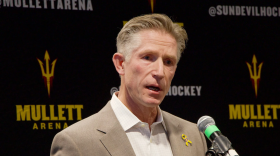 Now, along with returning to the conference he helped launch, Dave Hakstol is tasked with restoring a program that has been rife with controversy following an outdoor workout that left defenseman Matthew Mayich hospitalized after he collapsed from heat stroke at Sun Angel Stadium on Aug. 20.
-
 The popular West Fork Trail No. 108 between Flagstaff and Sedona will be closed for the foreseeable future due to hazardous conditions from recent flooding.
-
 The Arizona Game and Fish Department is warning that part of the route for this weekend’s three-day gravel bike race in the Prescott area runs through active hunting zones.


