


On the island of Taiwan, TSMC produces the world’s most advanced computer chips, making it a major player amid the AI boom driving the U.S. economy.
Arizona will soon have similar manufacturing capabilities as the company invests a record-breaking $265 billion to expand its operations in the state.
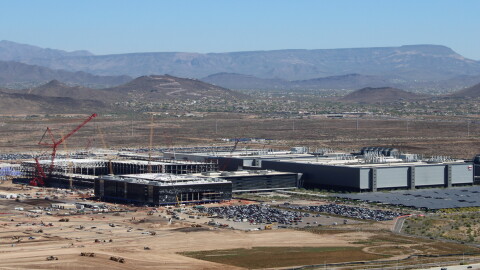
That’s taking place just off Loop 303 and Interstate 17 in north Phoenix, where excavation crews and about 70 cranes span TSMC’s current 1,100-acre campus. One factory is up and running with 11 more facilities planned for manufacturing, packaging and more.

Security checkpoints line each entrance of the central building where I’m meeting TSMC Arizona President Rose Castanares.
“We want to make sure that our customers' IP and TSMC’s IP is secure,” Castaneres said.
She leads me to a sitting area with a view of one of the towering semiconductor plants still under construction.
She shows me an iPhone with the back taken off and points to the central processing chip.
“Something like this would be the brains of a product like a phone or a watch or a laptop,” Castaneres said.
These advanced chips made by TSMC are at the center of what President Donald Trump has framed as an AI race between the U.S. and China.
Arizona will have the most advanced chipmaking capabilities behind Taiwan
Castanares points to a map on the wall that shows where TSMC has built facilities around the globe. While the top of the line chips are made in Taiwan, this campus here in Arizona is the only other spot that will have similar capabilities.
“We really felt that Arizona was the right place,” Castanares said.
One reason, Castanares says, was the state’s existing semiconductor ecosystem with companies like Intel and opportunities to partner with institutions like Arizona State University.
“Near the top of the list was a large university nearby that we could recruit engineers and also a well-established community college system to be able to have a pipeline for technicians,” Castanares said.
She says the deciding factor to expand operations in Phoenix was the cooperation from government officials.
“The state of Arizona and the city of Phoenix really understood what we were looking for. And they promised to be able to help us,” Castanares said.

At the same time TSMC has rapidly scaled its investments in Arizona, China has continued to ramp up its military presence near the island. China claims the democratic self-governing Taiwan is theirs under its One China principle.
Castanares wouldn’t comment directly when asked about how tensions with China factored into TSMC’s decision to build here.
“We focus on what we can control, which is how fast we can build here, how fast we can have our supply chain around us,” Castanares said.
'We are worth protecting'
TSMC’s founding in the 1980s came at a time when Taiwan was still trying to assert itself on the global stage. That’s according to Kings College London professor Robyn Klingler-Vidra who studies political economies in East Asia.
“You have a need for Taiwan to become indispensable and for its indispensability or importance on the world stage to come from its economic capabilities,” Klingler-Vidra said.
Klingler-Vidra says as TSMC became the world leader in advanced chip making, Taiwanese elected officials capitalized on that success.
“You'd be hard pressed to find technologies that we use every day that don't rely on a supply of chips,” Klingler-Vidra said.

Experts like Klingler-Vidra point to the geopolitical theory called “Silicon Shield,” which suggests that Taiwan’s dominance in the semiconductor industry would entice the U.S. to help protect the island to maintain its access to advanced chips.
“The Taiwanese government has explicitly named that, called that out and said, this is so important to the world that we are worth protecting,” Klingler-Vidra said.
The U.S. position as to whether it would actually use its military to protect Taiwan has been strategically ambiguous.
Conflict between China and Taiwan is the semiconductor industry’s 'biggest threat'
Semiconductor supply chain expert and Arizona State University professor John Fowler says TSMCs chips are crucial to the U.S. economy and national security.
“We have to be able to make advanced chips to develop our offensive and defensive weapon systems that we need,” Fowler said.
And Fowler says if China invades Taiwan, the U.S. wants to better secure its supply of chips by having TSMC’s operations here.
“The geopolitical tension in that, in Taiwan and China, is the biggest threat to the industry, in my opinion,” Fowler said.
And as TSMC’s operations continue to transform Arizona into a major semiconductor hub, economic and cultural ties between Arizona and Taiwan have grown — and that has caught China’s attention.

-
 Alex Hager/KJZZArizona business and political leaders have leaned on Taiwan to help transform the state into a hub for semiconductor manufacturing. But the island faces other pressures. KJZZ has obtained multiple letters addressed to Gov. Katie Hobbs from China’s LA consulate protesting the office and asking the state to stop building political ties with Taiwan.
-
 Greg Hahne/KJZZHow are Arizona and the city of Phoenix responding as TSMC has committed $265 billion in investments in the state?


