


Casa Grande held its first public hearing on a data center, but it did not go as residents had hoped. Now, a data center, battery and natural gas facility — roughly the same size as New York City’s Central Park — will be allowed to take shape 8 miles from the city’s downtown.
Last year, the Casa Grande City Council voted to make data centers a conditional industrial use. This means they can no longer develop by right within industrially zoned areas, as they could before.
Now, developers must demonstrate to the public and the city’s planning and zoning commission how the project meets the city’s requirements for water, energy, noise, hazardous materials handling, decommissioning and more. The developer only needs approval from a volunteer planning and zoning commission — it does not need to go to the City Council.
The city was promptly sued for its new rules over claims of lost property values, because the barrier for approval was raised just as a data center developer was about to apply. Two landowners argued successfully to waive the requirements for that data center, and the city avoided a $146 million settlement cost.
Thursday’s planning and zoning commission meeting began with a reminder of criteria developers must meet in the city’s new conditional use permit for data centers, and another on the role of public comments when considering if those conditions have been met.
“Public comments help identify relevant impacts, but decisions should be supported by facts tied to the standards, not simply support or opposition to the use,” said Dan Coxworth, the city’s planning director.
The city says it received 17 emails in opposition to the now approved Grande Valley Data Center and three in support. There were 10 speakers during the call to the public Thursday — all but one were against the project.
As the commission voted 6-1 to approve, groans and loud protests were heard among the audience of around 40, with one resident shouting, “Why are we here?” and another, saying, “Don’t sell yourselves out.”
What we know about the Grande Valley Data Center
The city has limited the Grande Valley Data Center complex to 300 acre-feet of water — or 97 million gallons of water use per year. That includes water for cooling servers in the facilities and for generating natural gas power on-site. We don’t know how much energy the site will use, if it will connect to the state’s grid, or when.
Speakers were particularly disturbed by the project’s intended water use amid major Colorado River cuts that have impacted farmers in the community and across Central Arizona.
One man said he worked for a local water district.
“We convey water for agricultural lands, and we are in a drought,” he said. “Several years ago, we were in a Tier 2 drought, and I’ve always said, ‘What do you do when you have this valuable commodity?’ People say, ‘Oh, we’re never going to run out.’ … Well, guess what, folks? We’re here.”
Anita Allen, who at one point worked for the United States Coast Guard’s chief of environmental compliance, spoke. She said this one data center’s water use could be seen as minimal, until viewed in aggregate with other development taking place across the state.
“Currently, there are 86 data centers in some level of planning and construction in this state. With the recent change in the water allocation from the Colorado River, the state just lost 8% of its total water for the whole state. So that means water’s got to be pushed around to fill in the gap,” said Allen.
Commissioner Celeste Garza asked the applicant to describe the project’s water use in relation to other industrial uses in the city. She specifically asked that they not compare their use to agriculture.
Lindsay Schube, a Gammage and Burnham attorney representing the project said they didn't have that information, but would confer and get back to her by the end of the meeting.
She eventually did, and claimed Chang Chun Arizona, a local chemical manufacturing company for the semiconductor industry, uses 157 acre-feet — that’s 50 million gallons — of water per year on 145 acres.
Kohler, a kitchen and bath fixture maker, has a 126-acre factory in Casa Grande. Schube says they use 118 acre-feet, or 38 million gallons of water per year.
“Our project: 300 acre-feet for 954 acres,” Schube said. “So, it’s a third of the water that is used for those other two projects.”
There is no specified cap on energy use for the facility. But the developer says it won’t connect to the grid, to avoid raising energy costs on others.
“I cannot stress enough: we will have no impact on the residential power or increase in residential power costs. Again, this will all be independent,” said Schube.
A representative from the San Carlos Irrigation Project’s Electrical District 3 (ED3), a federally owned electric and water utility that covers the project’s area, came and spoke in support of the project.
“Everything that they have stated about their relationship with ED3 and how they are working with us is completely true. They have engaged with us over a number of months. They have already — or in the future — have agreed to pay any costs of ED3, related to reviewing the project,” said Brian Yerges, general manager of ED3.
According to a representative from Bloom Energy, the Grande Valley Data Center will include the company’s first installation of solid oxide fuel cells in Arizona.
Bloom Energy is a California-based company advertising clean, reliable, scalable onsite power for multiple industries. They say their solid oxide fuel cells — which generate natural gas power through an electrochemical reaction, rather than steam combustion — potentially reducing water use and methane emissions, can be installed in as little as three months.
The developer says the Casa Grande location was favored because it sits atop two existing natural gas lines.
The city has included requirements to eventually disclose the project’s complete energy demands and generation mix to the city manager in the project’s conditional use permit.
Developer touts jobs, residents remain skeptical
The project’s presentation featured a brief discussion on potential job creation and economic benefits, with a caveat that these figures are all estimated.
The developer says the construction phase should generate over $3 billion in wages and $15 billion for regional output. They estimate 445 long-term jobs with wages at $108,000 per year, but it was unclear what these roles could be and if there were any outside of construction.
“There’ll be way more jobs in terms of construction, and I believe it's 1,200 jobs at final buildout, but 450 on the site at one time,” said Schube. “But there will be 1000s of jobs through the construction phase of this.”
Lastly, they estimate there will be around $680 million in construction tax revenues and $280 million in annual tax revenues from the project.
“I know quite a few people that are construction workers, so that would help them out,” said resident Lorenzo Mendoza during the public comment. “But, like every day, regular people like me, my mom, my dad, my sisters, and then other people, the older folk here — how’s that going to help them?”
Another resident told KJZZ they were unimpressed by the promise of jobs and opportunity, using the recent layoff of hundreds of workers from Lucid Motors Casa Grande factory, as an example.
-
 Pima County has paused all data center development as leaders consider new rules and regulations for their development. The Goldwater Institute believes that pause goes against state property rights, but county officials say its necessary to buy time to revise their code to stop unregulated data center construction.
-
 In a debate Wednesday, Arizona 1st Congressional District candidates shared different views on data centers.
-
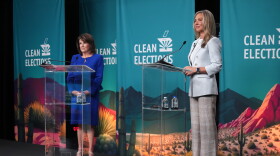 In a debate of lieutenant governor candidates on Monday, Republican Sine Kerr said incoming Medicaid cuts aren’t really cuts.
-
 As the majority of voters believe the economy and their own financial situation is getting worse, their candidate preferences reflect that.
-
 Open AI, the company behind ChatGPT, said it canceled the planned release of its new AI model over safety concerns. Artificial intelligence and its uses have grown exponentially recently, and that includes in scams.


