


Even though Arizona’s water supplies are down, water bills in most cities have stayed relatively low. A new study found that water rates in Arizona have increased over the past decade, but many utilities in the Phoenix area have kept costs below the national median.
Other Valley cities — Tempe, Scottsdale and Chandler — landed in the bottom fifth of those rankings. Mesa and the private utilities EPCOR and Arizona Water Company were near the middle of the pack.
Gilbert and Tucson had the highest water bills of the dozen Arizona utilities included, with Gilbert’s $658.50 typical annual water bill topping that group and landing as the 121st most-expensive nationwide.
Kathryn Sorensen, director of research at Arizona State University’s Kyl Center for Water Policy, said city size is a big part of the reason for the wide spread of water bills in the Phoenix area. Larger utilities — such as Phoenix, which serves 1.7 million people — can take the cost of big, expensive infrastructure and spread it across more customers.

Arizona’s water supplies are getting squeezed by drought, climate change, demand from growing cities and new mandatory cutbacks on the Colorado River. However, the availability of water itself is a relatively small part of the price you see on your water bill.
The overwhelming majority of the cost has to do with the price of infrastructure such as pipes and treatment plants.
“Phoenix is young compared to other cities back East,” Sorensen said. “That means that its infrastructure tends to be younger, and so we really haven't gotten to a point where we've had to put a huge amount of money into replacing that infrastructure. That day is coming, but so we're basically starting from a lower price level than other cities.”
Sorensen, who used to run the Phoenix water department, also said the city’s rate structure helps keep typical water bills low. For example, the city charges relatively little for low levels of consumption — the amount used for cleaning, washing and cooking — but charges much more for the amount of water it takes to water a lawn in the summer.
Despite relatively low water bills, every Arizona city included in the study saw a jump in costs since 2015. Water bills increased by an average of 60%, but some were much higher. Phoenix water bills went up by 80% over the past decade, Tucson’s went up by 96%, and Gilbert’s went up by 174%.
City water leaders say rates will continue to rise. Limited supplies from the Colorado River are forcing them to adapt with big, expensive infrastructure projects — like pipelines to move water from one side of the city to another and “advanced water purification” plants that can turn sewage back into safe, clean drinking water.
“Eventually we're going to have to do harder, more difficult, and — read into that — more expensive things to make sure that water resources are brought in,” Doug Dunham, associate director of water resources for EPCOR USA, told KJZZ in August. “The next buckets, so to speak, the next sources of water, those projects are going to be very expensive.”
-
On Sept. 8, KJZZ water reporter Alex Hager presented your questions and concerns to a panel of experts.
-
 Drought and climate change have cut deep into the Colorado River's reservoirs, and Arizona rains did little to boost Lake Powell and Lake Mead.
-
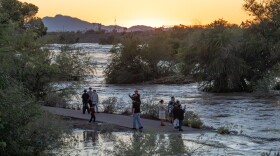 Heavy rains caused the Salt River Project to release extra water into the Salt River. That will impact plants and animals that live in the river.
-
 The National Weather Service issued flood warnings that could last through Tuesday in northern Arizona. But down in Maricopa County, they could extend into Saturday.
-
 The Valley was pounded with rain and flash floods over the weekend. But just how much does the wet weather help our water future?


