


Lawyers for the state are telling a federal judge it's none of the business of the Trump administration who gets reduced tuition at Arizona's public universities.
In new court filings, Assistant Attorney General Hayleigh Crawford acknowledges that Arizonans voted in 2022 to change the law for who qualifies for in-state tuition and is eligible for certain kinds of financial aid. And it allows the lower tuition for those who meet certain requirements, "regardless of residence and lawful immigration status."
That led to the Trump administration filing suit earlier this year claiming that the policy runs afoul of both a 1998 federal law and an executive order issued last year by President Donald Trump.

But Crawford told U.S. District Court Judge Murray Snow he should send the attorney from the Department of Justice packing.
"The government lacks standing," she wrote.
Crawford said the only people who can sue in federal court to overturn Arizona's law are those who can show an injury that "concrete and particularized, and actual or imminent." Yet the administration's lawsuit nowhere claims such an injury to the federal government.
"Instead, the government points to alleged economic harm suffered by Arizona universities," she said, a figure the Department of Justice put at $10.5 million for the last school year.
Aside from the fact that Crawford told Snow the amount of reduced tuition is wrong -- she does not say what it actually is — she said it's irrelevant.
"Any alleged economic harm from reduced tuition payments to state universities accrues to Arizona and its institutions, not the United States," Crawford said.
She also sniffed at the claim that the federal law was designed to ensure that those who are not citizens would not become "public charges." She said what voters approved are "state education policies intended to promote self-sufficiency through educational attainment and training."
And if those arguments don't work, Crawford has several others.
The issue of tuition for those who are not citizens traces its roots back to the Obama administration which created the Deferred Action for Childhood Arrivals program in 2012. It allows people who arrived in this country illegally as children before 2007 — colloquially called "Dreamers'' — to remain and even to work if they meet certain conditions.
Based on that, the Maricopa community college system and, later, the Arizona Board of Regents agreed to let DACA recipients pay in-state tuition. But the Arizona Supreme Court ruled in 2018 that is precluded by Proposition 300, a 2006 ballot measure that denies various public benefits to those not in the country legally — including any form of subsidized tuition.
Proposition 308, approved in 2022 by a margin of 51.2% to 48.8%, was crafted to say that no longer applies to tuition and scholarships.
A 1998 federal law says someone who is not lawfully present in the United States can't get any postsecondary benefits based on residency in a state unless the same benefits are available to citizens of any other state.
But it was not until 2025 when Trump when Trump issued an executive order directing the Department of Justice to take action against any state that has practices that give benefits to aliens that are not available to all American citizens. That, the order says, includes "state laws that provide in-state higher education tuition to aliens but not to out-of-state American citizens."
There is no question but that Prop. 308, the 2022 ballot measure, allows certain individuals who have graduated from a high school in Arizona and meet other conditions to pay the same tuition available to state residents, regardless of immigration status. At the same time, U.S. citizens from another state can be required to pay the higher non-resident tuition.
More to the point, none of what is in Prop. 308 is linked to the student's legal status. In fact, one provision in that voter-approved law specifically says that "persons without lawful immigration status are eligible for in-state tuition."
The financial difference is significant.
At the University of Arizona, for example, in-state undergraduate tuition is $13,906 a year. That compares with the out-of-state cost of $43,068.
Crawford, in her new court filing, acknowledged that Congress has "broad, undoubted power" over immigration and the status of those who are not here legally.
"But the regulation of education remains a core state prerogative,'' she said. "Indeed, education is perhaps the most important function of state and local governments."
What the Trump administration is doing, Crawford said, is attempting to use immigration law "to curtail a state law that has no connection with immigration law."
"There is no conflict between Arizona's classification of who pays in-state tuition and any federal immigration classification," she told the judge.
Even if Snow doesn't accept all that, Crawford said there's another reason why the lawsuit against the state fails.
She says that Prop. 308, strictly speaking, isn't based on whether a person resides in Arizona. Instead, the law says in-state tuition requires meeting two conditions.
First is that the person attended any public or private high school or is home schooled "while physically present in this state for at least two years."
Second is having graduated while physically present.
"Those requirements do not mention a student's 'principal, actual dwelling place,'" Crawford said, the language used in the federal law that Arizona is accused of violating.
For example, Crawford said, a student who crossed into Arizona daily from another state would be a resident of that state but could qualify for in-state tuition by attending and graduating from an Arizona high school.
She also said someone from elsewhere who graduated from an Arizona boarding school could qualify to pay the lower-in state rate even though that person, strictly speaking, is a resident of the state where her parents lived.
And anyone who met the conditions but later moved to another state also could qualify, even after being gone for years.
Conversely, Crawford said someone whose family moves to Arizona in a final year of high school does not qualify. Ditto an Arizonan who attends and graduates from a boarding school or private school out of state.
She said rulings in favor of the Trump administration in Illinois, Texas and Nebraska are irrelevant because the wording of the laws in those states are different.
Snow has not said when he will consider the arguments.
-
 Colette Kress is a high-ranking financial executive who regularly communicated with Wall Street analysts and investors as the company burgeoned into a $4 trillion linchpin in the artificial intelligence industry.
-
 The Florence Unified School District’s governing board has voted to close three schools due to enrollment declines and budget issues. The district needs to cut its budget by $5 million to $7 million.
-
 Teresa Leyba Ruiz taught math for much of her career and served as president of Glendale Community College. She defeated Arizona state treasurer Kimberly Yee in last week’s election.
-
 Large animals like elephants can play a role in mitigating the impacts of climate change. NAU researcher Andrew Abraham joined The Show to talk more about it.
-
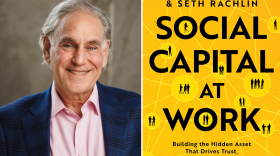 Seth Rachlin is an assistant teaching professor in ASU’s School of Social and Behavioral Sciences and co-author of the new book "Social Capital at Work: Building the Hidden Asset that Drives Trust, Engagement and Performance."


