


In Hermosillo, the faces of the disappeared look out from missing posters plastered on electrical poles and memorials in the Sonoran capital’s main plaza.
And on the cracked earth of the desert on the city’s outskirts on a recent blistering Saturday morning, they looked out from the long-sleeved white T-shirts of their searching mothers.
“We’re here, fighting, until we find them,” said Alicia Salomón, shovel in hand. Her son, 27-year-old Marco Antonio Garcia Salomón, has been missing for more than two years.

The individuals being looked for by the Madres Buscadoras de Sonora — or Searching Mothers of Sonora — are just a few of Mexico’s more than 130,000 registered missing. That number has ballooned as years of cartel violence have ravaged parts of the country. During that time, civilian search groups have formed throughout Mexico to do what they say the government won’t.
In Sonora, the state south of Arizona, the country’s registry shows more than 5,700 missing people. Two years into a new Mexican presidential administration that has claimed success easing the homicide rate, those searching for their missing loved ones are calling on authorities to do more.
Dirt or death
On the way to comb the desert for their children’s remains, a group of Madres Buscadoras de Sonora bumped down the sandy dirt road in a packed white pickup truck.
Before 9 a.m., the conversation was already heavy — how to believe in God when your child is missing. For Ana Luz Juárez, the search has shaken her faith.
“Where is God? Or where was God when this happened to my son?” she asks. Her 27-year-old son, Brayan Ulises Miranda Juárez, has been missing for four years.
Driving down winding dirt paths on the edge of Hermosillo, the Madres Buscadoras were followed by a truck of armed Mexican National Guard troops for protection.
The search began before the shovels were even unloaded from the truck bed. The pickup parked next to a rolled-up black garbage bag tied with decaying rope.
One of the mothers drove a sharp metal pole into the bag. She pulled it out and raised the tip to her nose.
“It smells bad,” she confirmed.

This is the Madres Buscadoras’ main tool for locating the missing — thrusting a sharpened rod into a suspected grave and determining whether the end smells like dirt, or like death.
Another member of the search party, a father looking for his son, cut open the bag with a switchblade to reveal a decaying body. It belonged to a dog, they concluded after brief discussion, not a human.
The Madres Buscadoras de Sonora search most weekends, often working off of anonymous tips. The searchers, many of them older women looking for their adult children, trek through difficult terrain in dangerously high temperatures — sharing water bottles and Gatorades, occasionally pausing for smoke breaks. Their talk shifts from dealing with grief to gallows humor to politics, and the politicians they wish were doing more to help them.
Safety concerns
When Mexican President Claudia Sheinbaum was sworn into office two years ago on Oct. 1, 2024, she inherited a massive murder problem.
In her inaugural address that day, she promised to reduce high-impact crimes like homicide.
By her own government’s metrics, she has. The administration claims a more than 50% decrease in murders since that day, according to state and local crime data that trickles up to the federal government. That’s meant, they say, 46 fewer homicides per day.
But crime and security analysts urge caution.
“I don’t think Mexico is safer now,” said security analyst David Saucedo.
While most experts agree there likely has been some reduction in homicides since the start of the Sheinbaum administration, reports of extortion and other crimes have increased. And the government’s independent statistics agency shows Mexicans still feel their country is extremely unsafe, Saucedo pointed out.
Sheinbaum’s government has gone after high-profile drug lords and regularly publicizes drug busts and arrests — an end to her predecessor’s so-called “hugs not bullets” strategy for dealing with organized crime.
That hasn’t translated into safer streets and fewer disappearances, said Cristina Reyes Ortiz, the general director of the nonprofit México Unido Contra la Delincuencia, or Mexico United Against Crime.
“We don’t see a solid or close-to-the-people strategy that’s capable of addressing extortion and, above all, disappearances,” she said. “It’s a phenomenon that’s been growing, that they haven’t been able to address that has afflicted the country.”
As Sheinbaum faces pressure from her constituents to make Mexico safer, she also faces pressure from her counterpart to the north, said Asael Nuche González with the group Causa en Común, which researches public safety issues in Mexico.
“A major factor has been the shift in the context of the bilateral relationship between the United States and Mexico since Donald Trump returned to power in 2025,” Nuche González said.
President Trump and members of his administration have accused Mexico of widespread institutional corruption. Sheinbaum’s security forces, meanwhile, have captured and killed high-profile drug lords, extraditing some alleged criminals to the United States.

All throughout, the search groups have kept digging across Mexico. In Sinaloa, the Mexican state south of Sonora, multiple searching mothers have been murdered, disappeared or attacked within the last year.
A group of United Nations experts warned this week that groups like the Madres Buscadoras de Sonora need to be better protected by the Mexican government and continue to face “brutal violence.”
“This is a tragic example of the State’s failure to fulfil its obligations to protect human rights defenders,” the U.N. experts said.
In a statement addressing the U.N. experts’ warning, Mexico said it reiterated its commitment to searching for the disappeared.
“Every case of disappearance is important and is handled with due diligence,” Mexico’s interior and foreign ministries said in a joint statement. “For this reason, high-level authorities have traveled throughout the country to speak with the families of the missing and the organizations that support them, and to address their concerns.”
Searchers persist
Back in the desert, Salomón raised the sharp end of a metal pole to her nose and breathed in deeply. An anonymous tipster told the Madres Buscadoras her son could be buried here.
The only smell on the end of the pole this time is wet earth, she told the group.
“There’s disappointment, sadness, because what we want is to find them,” Salomón said. The group has been searching under the scorching sun for hours, as the temperature hovered around 100 degrees Fahrenheit. Many of the mothers will be out searching the desert again tomorrow.

In the more than two years since Salomón started looking for her son, she’s been part of searches that have found the remains of others. But he remains missing. She thinks of him constantly.
“In my opinion, the government is completely useless,” Salomón said.
She, like many Madres Buscadoras, feel officials haven’t done enough to search for the missing, even as they boast declines in the murder rate.
“Look at us out here searching,” she said. “Because they don’t do their job.”
Today, the search yielded nothing. But not all do — other searching mothers found the skeletal remains of two people in Hermosillo the same weekend.
Shovel in hand, Salomón and the other mothers trekked deeper into the pathless desert. They’ll keep going, they say, until they find them all.
-
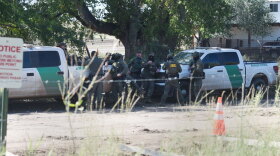 On Monday, dozens of agents swarmed a stretch of private land where the activists had been camped in and around a centuries-old cottonwood tree. Contractors tore down the tree and agents made multiple arrests.
-
 Dr. Jesús Maximiano Verduzco Soto turned himself in to authorities in Hermosillo after evading arrest for months.
-
 Nearly 30 people have died from heat stroke in the Mexican state south of Arizona this year.
-
 Some communities remained difficult to access after flooding from Tropical Storm Polo.
-
 The Arizona Game and Fish Department warns that Arizona is at risk of the flesh-eating parasite after recent cases in New Mexico and northern Mexico.


