


Earlier in October, a federal judge agreed to pause border wall construction in and near Big Bend National Park in Texas.
But lawsuits to stop border wall construction in Arizona have not had that same success.
Now, tribal leaders in the Tohono O’odham Nation say contractors plan to level thousands of saguaros and other plants along the roughly 60-mile stretch of border on tribal land.
And despite months-long protests, centuries-old cottonwoods have been bulldozed east of there, in Lochiel, Arizona.
A video filmed by protesters shows the moment a towering cottonwood tree crashes into the dirt. Its limbs crackle as they hit the ground, and protesters scream in the background.


The tree was the last of a border-hugging grove that was estimated to be as much as 250 years old.
Customs and Border Protection greenlit the grove’s demolition earlier this year to make way for two steel walls — one piece of a multi-billion dollar project along the Arizona-Mexico border.
Activists started occupying the cottonwood at the end of July, hoping to save it after the others were felled. They hoisted a wooden platform high into its branches, and camped on private land right next to it.
‘Working all night’
On a hot morning in Lochiel, Alex Chabbott, one of the protesters, paused in the tall grass next to a section of barbed wire fence separating the private ranch land from the federally-owed easement where wall construction is taking place. A black and white sign hanging from the fence commemorated where the old cottonwood once stood.
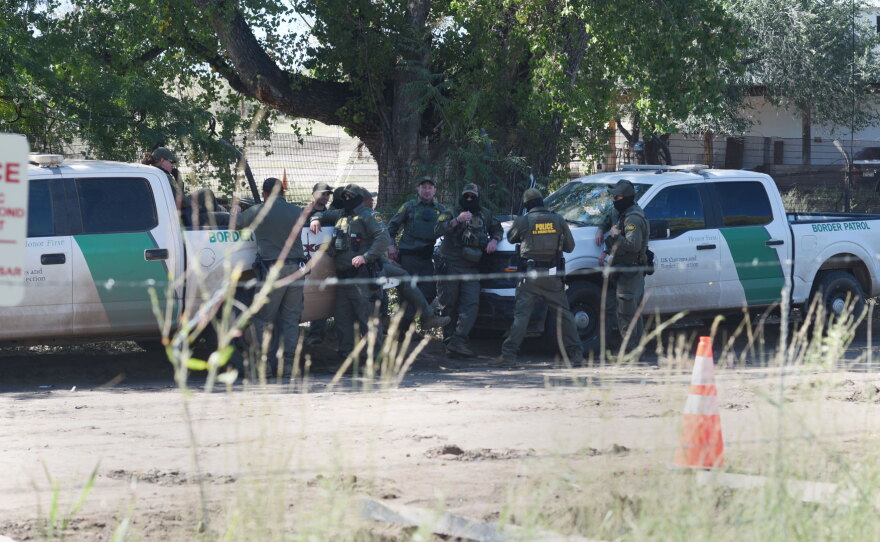
Days beforehand, dozens of Border Patrol agents swarmed the camp and used a crane to forcibly remove the person inside the tree. Contractors tore it down and hauled the pieces away.
At least 10 people were arrested. Others were cited and released.
“Just in the last 48 hours, it’s changed so much,” Chabbott said.

In front of us, piles of the 30-foot steel wall panels sit stacked on the road. Construction workers operate a vehicle to lift one of the huge panels and place it into the ground.
“It takes them six minutes between touching it and putting it up for it to be locked in place. They’re moving so fast and they worked all night,” he said.
Activists say roughly two dozen people were arrested or detained during nearly a week of standoffs with Border Patrol after the cottonwood’s demolition.
One person locked themselves to a hauling truck to keep it from moving. Video shows Border Patrol agents surrounding the vehicle and trying to wrestle the person off of it, as other protesters scream.
Another spent days in a cottonwood just on the other side of the border in Mexico to stave off construction temporarily, scrambling higher into the tree after their wooden platform was cut down.
Both walls now snake their way through the town. Chabbott says a lot of people might look at Lochiel and say they didn’t win.
“For me it’s not so much about the immediate win, as much as it’s being on the right side of history, standing up for what we believe in,” he said.
Projects move forward
Customs and Border Protection has not responded to questions about the protesters’ arrests or whether agents had a warrant to enter the private ranch land where they were staying. But the agency says it’s moving forward with that and other wall projects in Arizona.
Like some 200 miles west of Lochiel, in the Tohono O’odham Nation. The tribe is trying to stop wall construction in federal court, but their requests have so far been denied.
Tribal Chairman Verlon Jose says CBP told the tribe they plan to tear out thousands of saguaro cactus and other plants in the wall’s path.

The huge green limbs of the iconic saguaro grow slowly over the course of decades and can stretch more than 60-feet tall. They’re sacred to the Tohono O’odham.
“Our concern is that any removal of any plants, especially saguaros, the likelihood of them surviving any kind of transplant are not very high,” Jose said.
Without a court order in place to stop the project, Jose says tribal members have set up a prayer camp to monitor construction instead. Contractors were expected to come to the tribal nation on Oct. 12, but didn’t show up, Jose says.
Already, in August, dozens of masked Border Patrol agents entered the nation alongside wall contractors to do pre-construction work. When they return, Jose says, his office is bracing for the possibility of a federal response like the one in Lochiel.
“We’re next. So it’s not a matter that the contractors are not going to come. It’s a matter of when the contractors are going to come,” he said. “We understand that’s the same fight we’re fighting here.”


Back in Tucson, a group of Lochiel protesters hugged each other and cheered outside the federal courthouse this week as the last tree-sitter was released from federal custody after more than three days.
Organizer Kate Scott says a movement began around the centuries-old cottonwoods — or the grandmothers, as she calls them. Now that they’ve been cut down?
“It just emboldens us all, the energy of the four grandmothers now are in all of us. And when you have that type of connection to the land, you don’t … it never leaves you,” Scott said.
Scott says now, as wall construction moves forward, they’ll find another place to defend.
-
 The more than 300 packages of fentanyl were discovered hidden in folding chairs in a truck bed earlier this month.
-
 Long after President Donald Trump barred asylum seekers at the U.S.-Mexico border, migrants stuck in Mexico remain in limbo in border towns like Nogales, Sonora.
-
 Carlos Alonso Nugent is a scholar of the U.S.-Mexico borderlands and author of the new book “Imagined Environments: The Making of Borderlands.”
-
 JoAnna Mendoza won roughly 53% of the votes and beat Republican incumbent Juan Ciscomani, who held the seat for two terms.
-
 State agriculture officials say the case was detected less than a week and around 45 miles from the first Arizona case in a dog in the same county.


