


KJZZ’s segment Voices of Arizona spotlights everyday Arizonans who help make our state an extraordinary place to live.
Tucked off Seventh Street and Townley Avenue in Sunnyslope is what from the outside might look like is a simple, tan block building. But step inside the Acacia Public Library, and you’ll find high ceilings with wooden beams above the many stacks of books.
“I remember my aunt would take us here for story time,” Julia Taggart, president of the Sunnyslope Historical Society, said. “My dad would take us here for story time because we just lived up off Turquoise Avenue, so like this is maybe a 5-minute drive.”

Taggart has fond memories of her public library.
"It was always just fun to come to the library and you felt like an adult because you got your little basket and you have to go around the shelves and pick out your books.”
That was in the mid to late 2000s. But this library has been around since 1969. And it’ll likely be here for a while thanks to the efforts of 27-year-old Taggart to get the building on the Phoenix Historic Property Register.
For the past few years, she has been on a mission to preserve the city’s historic buildings like Acacia.
“Yes, well I love libraries. I've always loved libraries,” she said. And she loves history.
So she went digging into Acacia’s past and found it’s the only Phoenix library branch that hasn’t been altered or destroyed.
“And it has meant so much to the Sunnyslope community,” Taggart said. “And we're seeing a lot of development come into Sunnyslope — good development. But I wanted to make sure that this piece of history would be preserved.”
Still, her efforts led to pushback from some members of the community.
“I know a lot of people from the outside, they don't see the architectural value of the building,” she said.
A novel architectural style
Designed by the world-renowned architect Bennie Gonzales, the Acacia Library was created to look like burnt adobe.
His son, Barney Gonzales says the style is called regionalism, a blend of Native American, Mexican and modern architecture.


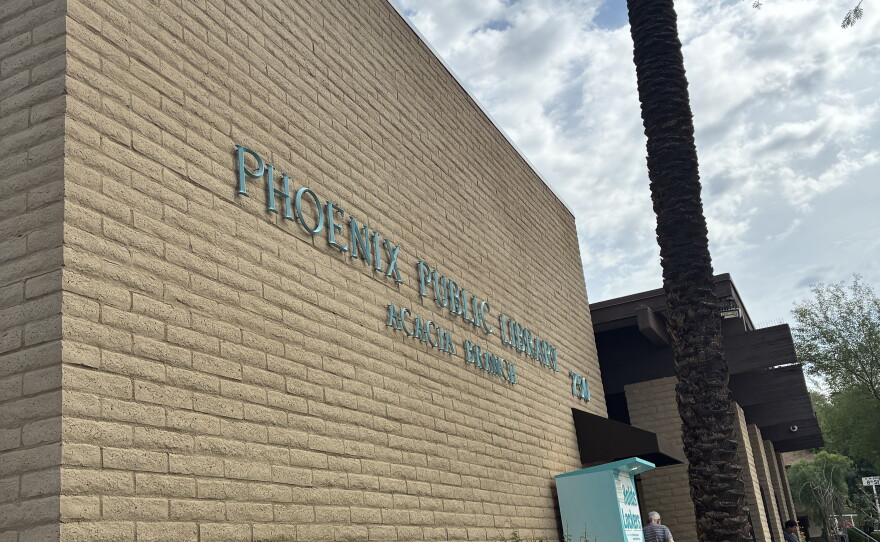
“My dad loved adobe, his uncle — my dad's uncle — was an adobe maker, so my dad made adobe blocks, so he understood and he always liked that look,” he said.
Gonzales says his father was able to create that look with concrete slump blocks, which he used in several of his buildings throughout the 1960s.
“What it does is it has bulging side pieces that would articulate and be most readily assumed as being adobe if you saw it from afar.”
The Acacia Library is quintessential Bennie Gonzales. Among the high ceilings and wooden beams, there's also a large skylight in the middle of the space, as well as smaller, rectangular windows.
“That would draw light in without contributing a lot of heat factor to the room because the skylights are recessed and the windows are very small, and they only get a very small portion of sunlight at, at any given time from the rising sun, and it still lights up the room without creating a lot of heat,” Barney Gonzales said.

He says everything in this library was designed to keep the space cool. And that made this library a gathering place for the Sunnyslope community in those early days when air conditioning was not yet a common feature in homes.
Then there’s the custom wall paint which Bennie Gonzales named Navajo White.
“My dad did a lot of work in the Navajo Nation, and always liked the refractory type of paint that would actually push the heat away from it and actually be more radiant, especially in the summer.”
But don’t let the name fool you, his son says his dad worked with other tribal nations, including the Hopi.

Past is prologue
A lot has changed in the neighborhood surrounding the Acacia Library, but the building itself has stayed pretty much the same.
And the city of Phoenix has agreed to keep it that way. More than a year after Julia Taggart began doing all the things to get the ball rolling, the city approved the library’s historic status earlier this month.
And it was a lot of work.
“Scanning all the files, which are like close to four or 500 pages of history of acacia and sending it to the preservation office to the library. And, you know, scheduling the meetings, having people come to the meetings, getting letters of support from the community.”
Along the way, Taggart says some of those naysayers who didn’t really get Bennie Gonzales and his role in our history at the start of this became converts.
“We've had people that have come in that were not in support of it that said, ‘I learned so much about the architecture and what this library means to the community. I see now why you're going for historic status,’" Taggart said.

Barney Gonzales isn’t sure how many commercial buildings and homes were designed by his father in Phoenix — possibly hundreds.
Like a lot of the city’s old buildings, many have been demolished or altered over the decades.
For Taggart, though, fighting for these buildings is worth it.
“It's very sad to me because I understand both arguments with development — it's great. But also, you know, Phoenix, we like to think of ourselves as a new city. We're not a new city.”
Rather, she says we’re a city with a rich and diverse history that deserves to have its story told and remembered by the people who call this place home.
The Sunnyslope Historical Society, in collaboration with the Friends of Phoenix Public Library, are hosting an open house at the Acacia Public Library to celebrate the designation at 11 a.m. on Oct. 24.

-
 Every summer, more than 10,000 aircraft fly to Wisconsin for AirVenture, the world's largest fly-in. Cadets from the Civil Air Patrol attend every year to help guide aircraft on the ground safely.
-
 Phoenix-based artist Daniel Ragsdale Combs has earned four decades of awards for his work. Now, he’s a new member of the Colored Pencil Society of America.
-
 A Phoenix teen recently broke several national para-swimming records. And her sight is set on the 2028 Paralympics.
-
 In a Flagstaff retirement community, one veteran sits with his wife and stepdaughter as the smell of BBQ wafts, and the sounds of music blare from the DJ booth. It’s his birthday, and as the oldest resident at The Bluffs of Flagstaff, they threw him a party.
-
 Michael Clare, owner of Clare Framing and Art, has dedicated more than 40 years of his life making frames to display works of art.


