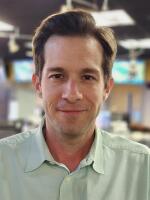
It takes an extraordinary amount of effort to relocate and refurbish a two-thousand pound antique letterpress, let alone publish on one. For Dan Mayer, it’s all part of the story.
The Analogs is a production of The Show, on KJZZ 91.5, in Phoenix, Arizona. This episode was produced, written, and edited by Sam Dingman, with additional production by Amber Victoria Singer. Original music by Ben Levin. The montage music is "Brush it off" by Diego Martinez and the outro music is "The Adjuster" by American Legion. Digital production by Sky Schaudt. The cover art is by Claire Lawton. The Show’s executive producer is Amy Silverman. Special thanks to John Risseeuw and Dan Mayer.
Transcript
Sam Dingman You’re listening to Season two of The Analogs — stories about people who make things by hand, and what those things tell us about those people. I’m Sam Dingman, and this is episode four: A Record of Our Time.
[ANALOGS THEME MUSIC PLAYS]
Sam Dingman In 1975, John Risseeuw had just been hired to teach printmaking at the University of South Dakota, in Vermillion, South Dakota. There was just one problem: The University didn’t have a letterpress machine — not to mention any physical letters, or what printmakers call type. So, John had work to do.
John Risseeuw I started writing to printing companies in the area, and asking if they had equipment.
Sam Dingman Even then, over fifty years ago, John knew that handset type was on its way out. Lots of presses were being sent to the junkyard, and he figured maybe he could save some of them. It took a lot of query letters, but he finally got a reply, from a printing company in Aberdeen, South Dakota — four hours north of Vermillion.
John Risseeuw And they replied that they had the letterpress that they had used, and they had put it in mothballs … And they said you can come and take as much as you want.
Sam Dingman So John and five other people from the University drove up to Aberdeen with a giant truck. They took everything.
John Risseeuw We moved something like thirteen tons of lead and presses and a giant papercutter, that we had to take apart, all into the back of this truck.
Sam Dingman It took all of that just to start making prints at the University of South Dakota.
And then, five years later, John had to do that whole thing again. In 1980, he got hired at ASU, and part of his job was to launch a printmaking and book art studio. Once again, he found himself scouring the country for old presses. This time, he came across a doctor in California named Adam Petko.
John Risseeuw Who was not a printer himself, but he was very enthusiastic about printing, and the history of printing and everything else. And he was literally buying up print shops that were going out of business, and storing the presses and cabinets of type in warehouses, until he could find schools that would take them. And he had a huge quantity of this stuff.
Sam Dingman Once again, John took everything, to the tune of another several tons of equipment. Over the years, he acquired over 1,600 cases of type from Dr. Petko, as well as a 19th century letterpress machine, which is still in use today at ASU’s publishing imprint, Pyracantha Press.
Sam Dingman Oh my god, is that the press?!
Dan Mayer: Yes. It was designed by John Clymer, who was a Philadelphia machinist, and he wanted to design the biggest, heaviest, and most ornate press in the world. And he did.
Sam Dingman That’s Dan Mayer, Pyracantha’s director, who showed me around Pyracantha when I visited last fall. It’s hard to overstate how remarkable this press is as a physical presence. Dan says it weighs about two thousand pounds. I didn’t measure, but I’d guess it’s about nine feet tall, and made entirely out of cast iron. In addition to the press bed, levers, and wheels, it’s adorned with elaborate design elements painted in vibrant colors: a cornucopia of fruit, a pair of silver dragons and a golden eagle. They’re beautiful — but they aren’t just for decoration. They’re part of the design. The press bed alone weighs about five hundred pounds, yet it’s almost effortless to move back and forth with the handle of the press.
Dan Mayer The eagle on top’s a counterweight, and this mechanism just sort of goes up and down, and the eagle rises up, into the sky.
Sam Dingman It may not take much effort to operate the press, but it takes hours to actually make a print. On the day I visited Pyracantha, Dan had set up a demo. He printed an image from a 16th century playing card, surrounded by some text. That may sound simple, but to make something like that on a letterpress machine, you have to set the etching of the image in the center of the press bed, and then select each individual letter of type for the words you want to print. Of course, in order to do that, you first have to select which typeface you want those words to appear in. Each letter is then placed by hand around the etching. I watched as Dan spread thick black ink over the type and etching, covered them with a blank sheet of paper, and placed a weight on top of the whole thing to hold it in place. Only then did he start pulling the handle of the press. When the print came out, it was a little smudged.
Dan Mayer And it looks like the paper shifted a little bit, and we’re kind of getting an idea of what it looks like, and typically, I say the first proofs are not the best proofs. It’s like making pancakes in the morning. The first one’s not so great, the second one’s better. There’s a lot of lore to printing, it’s like they say, they basically say: When you print the last one, it’s the best.
Sam Dingman I asked Dan how long it had taken just to get to this point — choosing the type, preparing the press, and making this initial test print of a relatively small design.
Dan Mayer Like a half-day?
Sam Dingman Wow.
Sam Dingman A half-day. There’s a reason Dan likes to talk about the full-length books he prints at Pyracantha as five-year projects.
Dan Mayer To do work by hand, you have to be very thoughtful about what you might be working on. The projects are very labor intensive.
Sam Dingman The books that Pyracantha prints aren’t the kind you find in bookstores. These books are works of art, often released in limited editions. You do way more than read them — you sort of experience them. Dan showed me one called “Eco Songs,” published in 2000 with the artist Dimitrije Buzarovski. It’s a song cycle about earth and ecology printed on handmade paper, which is made out of plant fibers. It opens like an accordion, and includes printed renditions of the lyrics, as well as a CD with recordings of the songs.
Dan Mayer So it’s very thoughtful as far as how to present the content of the work.
Sam Dingman As I flipped through “Eco Songs,” I found myself marveling at the number of ways one might interact with this book. It was beautiful to look at, tactile to hold, and moving in terms of the content of the lyrics. Dan told me that when an artist like Buzarovski approaches Pyracantha with an idea, they don’t necessarily know they want to make an accordion book on handmade paper, with a CD in it. It usually takes several years of working with Dan to get there.
Dan Mayer I view myself as an artist collaborator, facilitator of ideas. So if I’m collaborating on something, I pull all my sorta bag of tricks into it. To look at how this project might lay, as far as what it may look like in the end. But you have to trust the process in a way, and follow that journey all along the way. And then there’s a certain point where you kind of have to mix ink, and get on the press, and print, to finally sort of realize what you’re making. … It’s a very hybrid form that is an intersection of past and present, and future.
Sam Dingman You need a lot of time to get to something like that — which is why, for Dan, it’s worth every hour that it takes.
Dan Mayer You know, I think print-making, book arts, you know trying to think of a nutshell way of it, it’s really an extension of the self. You know how you process information, what content you want to express or explore, and then when you’re on a hand press you’re transmitting all that information back to a press bed where you’re taking image and text back off. And it’s actually making it permanent.
Sam Dingman That’s also why it was worth it to John Risseeuw to spend countless hours hauling thousands of pounds of supposedly obsolete equipment around the country to set the press up in the first place. It’s part of why he named the press after the pyracantha plant.
John Risseeuw When I looked it up, I found that the pyracantha plant is a hardy desert dweller. And there was something else about how it survived in the desert. And I thought that that was a good omen.
Sam Dingman Now, I have to admit something. I didn’t find out about Pyracantha Press by accident. Dan and John actually published a book of photographs and poetry by my mom and my brother called “Moon Journey.”
Sam Dingman Now, I have to say Dan, you have a copy of “Moon Journey” here.
Dan Mayer Yes, I do. I thought it might come up.
Sam Dingman If you’ve listened to the Analogs story I did about my mom, you know that a big part of my interest in hand-made work is that I feel like I’m on this life-long quest to make things the way she does. And standing at Pyracantha that day with Dan, I felt like I had a kind of a breakthrough about why I always feel like I can’t quite get there.
Sam Dingman I’m just having this thought as you’re talking about this, probably because we were just looking at “Moon Journey” that everything I have ever made that I would ever consider to be my work, that I would want people to interact with, is in sound. And there is this beautiful and frustrating thing about working in sound, where you go to a place, you talk to a person, you have an idea about why it would be interesting to talk to that person. You show up there, the conversation goes the way you think it’s going to go, or there are surprises — and then you go back to your desk and you listen through to the thing you’ve recorded, and often times you find that the story has turned into something different than what you thought it was going to be. And then you finally reach the point that you can make it. You can make the piece. And it doesn’t exist! I’m sorry, this is a long-winded revelation I’m having.
Dan Mayer I think I know where you’re going.
Sam Dingman With your work it seems, you can go through that whole similar conceptual process, but then, as you put it, you get on the press, but then you make the thing and you can hold it in your hand and look at it, and really kind of reckon with it.
Dan Mayer Yeah, I mean, I think it’s — in kind of looking at it in that way, this is a record of our time.
Sam Dingman That is — that is — I’m gonna keep that with me, Dan.
Dan Mayer OK.
Sam Dingman Thank you.
Sam Dingman Next week, on the finale of the Analogs, I’ll try my hand at making a record of this time.
The Analogs is a production of The Show, on KJZZ 91.5 FM, in Phoenix, Arizona. This episode was produced, written, and edited by me, Sam Dingman, with additional production by Amber Victoria Singer, who also produced the podcast version of the series. The Show’s executive producer is Amy Silverman. This episode featured original music by Ben Levin. Special thanks to John Risseeuw and Dan Mayer — and to you, for listening.
Next time, on the finale of The Analogs, a painful memory.
Sam Dingman Oop! Are you supposed to stab yourself with the awl?
Person at table I think the goal is not to do that.
Sam Dingman I definitely did that.
Person at table Not the desired outcome.
Person at table Unless you like that kind of thing.
Person at table Well to each their own, I guess.
Sam Dingman No judgement, no judgement…
Sam Dingman That’s next time, on The Analogs.