


The Goldwater Institute is telling Arizonans that if they vote for Proposition 320 that teacher pay will increase.
But a representative of groups that oppose the measure contends that's not only not guaranteed but would hurt overall education.
In a debate Thursday, Chris Thomas who is in charge of education policy for the organization, said that the measure on the November ballot would force most schools to spend at least 60 cents of every dollar in what are described as "direct educational expenses." And that, he said, includes teachers, aides, general instructional supplies and field trips, and athletics.
What makes that number significant is that, on average, Arizona schools spend just 52.1 cents on instructional expenses. And that's the lowest figure in the two decades that the Auditor General's Office has been conducting that study.
And what approval of Prop. 320 would mean, Thomas said, is that districts would be forced to get to that 60-cent figure or face loss of some state aid. More to the point, he said they will have to spend less on everything else.
But Jimmy Arwood, representing Arizonans for Quality Education, said all that ignores what is in that "everything else" category.
Arwood, whose organization lobbies on education issues, said this isn't just about administrative costs. And Thomas acknowledged that the auditor general has concluded that Arizona schools, on average, spend less on administration than the national average.
What it does include, Arwood said during the half-hour debate sponsored by the Citizens Clean Elections Commission, is the cost of others who help students, ranging from speech pathologists to counselors and nurses. Then there are the costs for everything from food services and utilities to the diesel fuel to run the buses.
"If that bus isn't picking them up, those kids aren't going to school," Arwood said. And the state provides aid to schools based on the number of kids in class.
And there's something else.
As crafted, any affected district that is below that 60-cent figure would face financial penalties in the form of reduced state aid.
That's true, Thomas said. But he said that penalty wouldn't apply to districts making adequate progress toward reaching the goal, meaning boosting funding by a half cent a year.
So the Glendale Union High School District, which recorded spending at 57.1 cents, would have six years to comply. And Tucson Unified School District, currently at 48.5 cents, would be given 26 years before a penalty would kick in.
But not all schools would be required to meet that 60-cent figure.
As crafted and approved for the ballot by Republican lawmakers, Prop. 320 would apply to all schools in Pima, Pinal and Maricopa counties, regardless of size. But in the other 12 counties, only districts with more than 7,500 students need meet the new standard.
Thomas speculated that was done because legislators believed that districts in urban areas would have more opportunities to save money, such as compressing bus routes.
He had no answer, though, for why some tiny districts in the three largest counties, like Red Rock Elementary School District in Pinal County and the Continental Elementary School District in Pima County, also would be required to comply.
At the heart of the debate over Prop. 320 is the question of why schools aren't spending more on what the state considers instruction.
"Schools are maybe trying to do more than what they need to do," Thomas said. "They're not centered on the teaching and learning happening in the classroom."
And that, he said, is a mistake.
"The most important thing is to have a quality teacher in a classroom," Thomas said. "And you get quality teachers by paying them."
Arwood doesn't disagree with that premise. But he said that ignores another factor.
"When we fund our schools 25% less than the national average per pupil, that's going to lead to less resources for kids to be successful," Arwood said.
Data from the National Education Association puts per student funding in Arizona at $11,987. That compares with the national average of $17,873. More state aid, Arwood said, would bring up those teacher salaries.
Thomas, however, said the current funding formula does not preclude the state — and in this case, voters — from deciding that schools should devote 60 cents of every dollar they actually do get for instruction.
There is nothing in Prop. 320 that spells out there will be higher pay for teachers. But he said that requiring schools to spend that 60 cents on instruction — and not other things — pretty much makes that inevitable.
"Just do the math," Thomas said. "Teachers will get more money."
Arwood, however, said that focusing on teacher salaries and direct instructional expenses ignores that public schools are doing more for students — albeit in areas that don't fit into that 60-cent category. Consider, he said, special education.
As crafted, Prop. 320 would include the salaries of these teachers. But other expenses would not qualify toward hitting that 60-cent goal.
"It's speech language pathologists, it's audiologists," Arwood said.
"When you talk to a parent, they're not going to tell you that those things are simply administration," he said. "Those are resources that help kids get through the day, help them learn, and help them grow."
In fact, the most recent auditor general's report said that while the overall number of students in public schools is declining, the number of students receiving special education services has increased, particularly for autism. And that, the report says, can cause an increase the category of instructional support — something that doesn't count toward that 60-cent goal for instruction — because it includes those counselors, audiologists, speech pathologists, nurses and social workers.
Thomas said he doesn't disagree that those other professionals are needed. But he said that there's plenty of ways to fund those priorities from the other 40 cents in the budget.
"What this does is it encourages districts to scrutinize non-instructional spending and to look for those efficiencies in the other areas to devote more to the classroom," Thomas said.
"Right now, there is not that prioritization going on," he said. "And this law will require that prioritization."
One area is "plant maintenance," something that includes everything from utilities, building maintenance, custodial services, grounds keeping and security. Overall, schools in Arizona spend about $1,535 a year per student on such services, about 12% of all costs.
"We have some school districts that are not operating efficiently in terms of the number of buildings they have," Thomas said. "They're underutilized. Sometimes they're unused completely."
Consider, he said, that the Chandler Unified School District has more students than the Tucson Unified School District.
"And, yet, Chandler has 40 schools and TUSD has 80 schools," Thomas said. And that, he said, means the district is operating schools at less than capacity while fixed costs, like cooling, remain the same.
The answer, said Thomas, is closing the schools and even selling off the buildings.
Arwood said it's not that simple.
"When you're looking at issues of school closures, those are very difficult decisions for communities," he said, resulting in some of the most packed school board meetings as residents object. Still, Arwood said, districts are moving in that direction and closing schools with declining enrollment.
"But they have to do it in a way that's responsible, responsible for the parents and, especially, the kids," he said.
Arwood said there's another factor that has to be considered in why, year-after-year, schools are spending less of their budget in classrooms.
"School safety is something 20 years ago we didn't spend nearly as much as we do today," he said. "And so you're looking at a lot of these other costs that parents are asking for, that students want in their classroom."
-
 Find everything you need to know about elections in Arizona and Maricopa County from KJZZ's politics team.
-
 Jonathan Nez, a former Navajo Nation president, pointed out the Massachusetts-registered No Going Back PAC released the ad just days before the controversial federal Columbus Day holiday. He thinks they were in a rush.
-
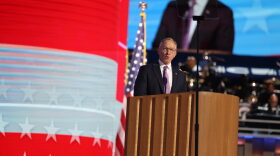 The nominee for lieutenant governor on the Democratic ticket is brushing aside the multiple speeding tickets he got while mayor of Mesa.
-
 A West Valley congressional candidate reported she was raped in August while repairing a damaged campaign sign in Sun City, the candidate, Bernadette Greene-Placentia, told KJZZ on Thursday. When that news publicly broke Wednesday, she said her world exploded.
-
 Learn more about the candidates for the 2026 Arizona Senate 9th Legislative District race.


