


President Trump rallied supporters in Bullhead City in an effort to build enthusiasm before the midterms. Which Arizona candidates were there — and which were not. Plus, a new exhibit that takes a closer look at the Sonoran Desert.
Ways To Subscribe


-
 Molly Riley/The White HousePresident Donald Trump's latest stop in the Mojave County city is part of his campaign to build enthusiasm for the midterm election.
-
 Getty Images/iStockphotoArizona has for a long time been one of the leading states for refugee resettlement, but now with the numbers cut so low, refugees in our state and the resettlement agencies that are built up to help them adjust are feeling the impact.
-
 Jorge Valencia/KJZZThe U.S. Fish and Wildlife Service has agreed to determine if it will list the monarch butterfly on the endangered species list by June 2030.
-
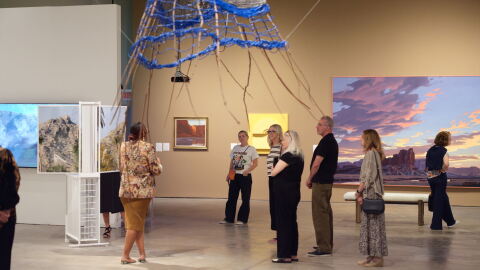 David Blakeman/CourtesyA new exhibit at the Scottsdale Museum of Contemporary Art showcases the Sonoran Desert in a unique way, utilizing materials from the desert itself.


Transcript
ANNOUNCER: KJZZ’s original production, The Show, is supported by Banner Health, Arizona’s largest nonprofit healthcare system. Last year, Banner reinvested more than $1.1 billion in community health and charity care. Banner Health: Nonprofit for Arizona. bannerhealth.com/nonprofitforaz.
MARK BRODIE: Hi, I’m Mark Brodie, co-host of The Show, an original production from KJZZ. Every weekday, we bring you the latest news and culture from across the state. You can find much more at theshow.kjzz.org. Here’s today’s episode.
LAUREN GILGER: Good morning. It is The Show here on KJZZ 91.5 in Phoenix. I am Lauren Gilger.
MARK BRODIE: And I’m Mark Brodie. Coming up, refugees lose healthcare coverage this month, how it’s impacting them here in Arizona.
LAUREN GILGER: And a new exhibit in Scottsdale delves deep into the Sonoran Desert.
MARK BRODIE: But first, President Trump rallied supporters in Bullhead City yesterday as part of his campaign to build enthusiasm with the midterms just a few weeks away. The president has also stumped this week in Alaska and Montana, and is scheduled to go to North Carolina and Kansas next week.
Some of the GOP candidates on the ballot in Arizona also took the stage yesterday — but not all of them. And with me now to talk more about who was there and who wasn’t is KJZZ’s Camryn Sanchez from the politics desk. Good morning, Camryn.
CAMRYN SANCHEZ: Good morning.
MARK BRODIE: So, what did the president have to say?
CAMRYN SANCHEZ: He said a lot. He kind of makes long speeches. But the main reason that he’s doing all this is this campaign tour, as you mentioned, ahead of the midterms. So he was there to stump for largely gubernatorial candidate Andy Biggs — that’s the Republican nominee — and some of Arizona’s other candidates, and a couple of Nevada candidates as well, but we won’t get into that.
MARK BRODIE: Close on the border there, yeah. So Andy Biggs was there, he spoke. What did he have to say?
CAMRYN SANCHEZ: Andy Biggs was there and he spoke very effusively. He said, you know, he’s going to be the governor to get things done, that he’s going to basically make Arizona more affordable, bring back the American Dream, etc., etc. His running mate, Sine Kerr, also had a little speech, and the secretary of state candidate, Alexander Kolodin, was on the stage as well.
MARK BRODIE: And what did Kolodin talk about?
CAMRYN SANCHEZ: Kolodin, also very energetically, spoke against his opponent, which is Adrian Fontes, the incumbent Democratic secretary of state. He said he’s going to get transparency and secure election results back, kind of indicating that that’s not what we have right now.
MARK BRODIE: So how much of what those candidates talked about had to do with the person for whom the rally was held? Like, did they talk about Donald Trump?
CAMRYN SANCHEZ: Not so much, but obviously it’s very much the Trump show. Like, people come to see Trump, and Trump is there telling people to vote as if he’s on the ballot — something that we’ve heard him say before.
I think what was notable to a lot of us reporters is that Juan Ciscomani and Jay Feely — who are the candidates in the most competitive congressional races in the state — did not come, and that Trump did not mention them. He also didn’t mention attorney general candidate Warren Petersen.
MARK BRODIE: Do we have a sense as to why Feely and Ciscomani didn’t go?
CAMRYN SANCHEZ: Yeah. Feely didn’t respond to my request for comment, but he did have some social media posts indicating that he was at an event. Ciscomani’s team did respond and they said, “Oh, you know, we couldn’t go because he was busy in the district all day that day going to events.”
But yeah, Trump didn’t mention them, and as Trump said himself, he’s there to stump for Biggs and stump for congressmen in competitive races, and those are our two most competitive races. So it struck me as kind of a glaring omission.
MARK BRODIE: Yeah, it is interesting if, you know, those are the two most competitive districts. Obviously, they’re far away from Bullhead City, but, you know —
CAMRYN SANCHEZ: Everything’s far.
MARK BRODIE: A lot of things are far from Bullhead City, with all due respect to the fine folks of Bullhead City. So, Camryn, I’m curious about sort of this juxtaposition. As you reported not that long ago, there have been a number of candidates in Arizona who have been, let’s say, changing their websites and changing sort of how they talk about the president, especially, you know, now those that were campaigning with him yesterday in Northwestern Arizona. How is that going?
CAMRYN SANCHEZ: Yeah, I took a look at those campaign websites and how they’ve changed as they were ahead of the primary election and as they are now ahead of the general election. And it’s what you said, which is that a lot of candidates have minimized mentions or images of Trump and/or Turning Point USA, or even changed some of their language to be less, I would say, conservative and come across as more moderate, because that’s part of the game of Arizona elections.
Here in a swing state, you have to come across as more like red meat ra-ra for your base in the primary, and then you have to turn into a different person sort of going into the general election to make sure you can still get those independent voters and hopefully hold on to the base voters that you have in your own party.
MARK BRODIE: How are those changes — like, how are voters potentially seeing those? Like, is it very obvious where websites used to have Donald Trump plastered all over them and now they don’t?
CAMRYN SANCHEZ: I mean, but how would voters know that unless they had the websites memorized, right? So I don’t know — I don’t think voters would necessarily be surprised to hear that candidates are acting more moderate. And I think for some of these folks, like Andy Biggs for example, he is very much associated with Trump, and there’s no way to separate that. And he’s obviously leaning into it by attending this rally and having so much stage time.
MARK BRODIE: I assume the president didn’t bring any of that up, right? That these candidates maybe took references to him off their website and here they are campaigning with him on stage.
CAMRYN SANCHEZ: No, he did not mention that.
MARK BRODIE: So did the president have anything specific to say about races here in Arizona? I mean, you mentioned some of the issues that he talked about that are sort of his greatest hits from wherever he goes. Anything specific to Arizona he talked about?
CAMRYN SANCHEZ: Yeah, I mean he definitely took some time to bash Katie Hobbs, who’s our incumbent governor, obviously. But he also said this thing that kind of strikes me as interesting when we’ve got him in office as the president of the United States and her in office simultaneously as the governor of Arizona, where he said both that Arizona’s economy is booming — I think thanks to him is what he’s saying — but also that Arizona is like a hellish place to live because of Katie Hobbs.
So I guess it’s for voters in the crowd to decide if their lives are really, really great because of Trump or really, really horrible because of Katie Hobbs — or perhaps pick and choose different aspects of your life to blame.
MARK BRODIE: Have any of the candidates whose websites you looked at, like, have they said anything about why they’ve maybe removed references to the president or photos of the president or mentions of his endorsement?
CAMRYN SANCHEZ: Yeah, Kolodin, who spoke at this rally, didn’t respond to my request for comment about why he removed so many Trump references from his website.
Biggs did, though. He said that his logo, for example — his little campaign logo, which is like an image of the state and it says “Biggs” on it — it used to have “Trump Endorsed” across the top. Now it doesn’t, but it does have Kerr, his running mate’s name, added to it. And his campaign was like, “Well, it just didn’t fit. It was too clunky.” Which may be the case.
Other candidates, they have more subtle changes, like Feely’s website, for example. It used to be that when you clicked on it, there was this big pop-up of Trump’s face and it said “Trump Endorsed.” And now when you click on that section of the website, the pop-up doesn’t come up anymore.
But websites also change. You can change pop-ups and things as your endorsements change, or as you go through the campaign and you find other stuff you want to add. I mean, you have plausible deniability, right?
MARK BRODIE: Interesting. All right, that is KJZZ’s Camryn Sanchez from the politics desk. Thanks, Camryn.
CAMRYN SANCHEZ: Thank you.
MARK BRODIE: Good morning. It’s The Show on KJZZ 91.5. I’m Mark Brodie.
LAUREN GILGER: And I’m Lauren Gilger. Thousands of refugees in the U.S. lost their healthcare a few weeks ago. The move came as part of broader changes to Medicaid that took effect on October 1st that could end up stripping millions of their coverage. Here in Arizona, as our colleague Katherine Davis-Young has reported, even refugee kids are losing access to healthcare. This latest hit to refugees comes as the Trump administration has slashed the number of refugees admitted into the country dramatically. This year, they’re on track to hit an historic low. Right now, there are 17,500 spots—the lowest final refugee ceiling set by the president since the resettlement program began. Arizona has for a long time been one of the leading states for refugee resettlement, but now with the numbers cut so low, refugees in our state and the resettlement agencies that are built up to help them adjust are feeling the impact. Bobby Ghisolfo is President and CEO of the nonprofit Lutheran Social Services of the Southwest, which has been resettling refugees across our state since 1970. He came into our studios recently to tell me more about it.
BOBBY GHISOLFO: We have a state that is so open to these individuals, and now things are—things have and are continuing to change for them, too.
LAUREN GILGER: Yeah. So let’s talk about that change. I mean, if we talk about Arizona as kind of a stronghold of refugee services, I think a lot of people will think of like, you know, the Lost Boys of the Sudan. There are some communities here that people know about. But I think in general, this kind of gets wrapped up in a broader immigration narrative. Is that a challenge for you and your organization in terms of differentiating for folks what is a refugee versus what is an immigrant?
BOBBY GHISOLFO: You know, that’s one of the things that we talk a lot about. There’s a wide brush that is shared of refugees, asylum seekers, and individuals that are undocumented or here illegally. And I think that’s one of the things is the refugees and asylum seekers, they have raised their hand in other countries to say, "Hey, look, I need to find safety in another country." They didn’t choose to come to the United States. The United States was chosen for them.
LAUREN GILGER: Right. There’s an international refugee process, right?
BOBBY GHISOLFO: That’s right. That’s right. And they literally come here with two bags, you know, and that’s it. That’s all they have. And they don’t know where they’re going until they get to the airport usually, and they’re told, "This is where you’re going to go, and you’re going to Phoenix, Arizona, and welcome to the 115-degree weather."
LAUREN GILGER: Right. And here you are, right? Which I’m sure can be a shock for some people.
BOBBY GHISOLFO: That’s right.
LAUREN GILGER: Right. So this, unlike many industries, right, in the work that you do in nonprofit work, is very dictated by the policies of the federal government, and has been very impacted by the policies of the Trump administration, which has cut the cap on refugees coming into this country down by a whole lot over the last several years. Talk a little bit about just the numbers.
BOBBY GHISOLFO: Yeah. I would say we’re probably seeing a decrease of anywhere between 80 to 90% of individuals coming in to the state of Arizona. Last year for fiscal year 25-26, the Trump administration had stated 17 to 18,000 people could come into the United States of America. Last year in Phoenix, we only saw 58 individuals come from South Africa. So those numbers compared to what we were seeing back in 2022, 2023, we were seeing thousands of individuals coming into this country looking for a better life. And now we have 58 individuals that have entered into America here in Phoenix from South Africa.
LAUREN GILGER: Yeah. And refugees are highly vetted before they come to this country, right?
BOBBY GHISOLFO: Absolutely.
LAUREN GILGER: But I mean, it’s still a brand new country and they’re coming from really, really difficult situations often. Give us a sense of kind of the breadth of trauma that a lot of these folks have probably experienced.
BOBBY GHISOLFO: You know, we were working with some individuals that were coming from Ukraine and things along those lines. And, you know, they’re coming from a war-torn area, you know? And so trauma every single day—waking up in the morning, not sure whether or not you’re going to be alive, if you’re going to have a place to live. So there’s a lot of PTSD that a lot of these individuals deal with when they’re coming here. Even though things are rough here, they’re not as bad as the countries that they’re coming from. And yes, they see that there’s challenges. Yes, they see that there’s a lot of things that we may not be doing right politically, but it’s better than where they were coming from and they’re grateful to be here. And I think that’s the one thing that even the individuals that have entered into the country the last two or three years are still coming here because they want a better life. But when policies are changed midstream, that’s where the real challenges come in. You know, they came here under one premise, saying, "I was going to get this, I’m going to get this, and I’m going to get this." In the middle of them being here for a year or two, everything changes. They don’t get the additional funding, they’re losing their medical coverage, and all these other pieces that when they were chosen to come here, that was all promised to them. And when they got here, no more.
LAUREN GILGER: Yeah. So, I mean, first of all, let’s talk about those challenges for the refugees themselves, right? You mentioned lack of medical coverage, funding being cut in terms of support that they receive when they come here because they’re coming, you know, to this place with nothing. I mean, what has that been like for these folks who were promised something?
BOBBY GHISOLFO: I can tell you some of the conversations that I’ve had with individuals is that if they could go back to their country, they would. Now, that—when going back to a country where there’s war-torn, you know, they’re going to be persecuted because of their religious beliefs, that they would rather go back there because at least they know what they’re dealing with. Here, things have been changing so much and so often. Now, I understand—you know, maybe I don’t understand. I don’t necessarily agree why it’s changing so quickly, because you’re dealing with human lives here and they’ve come here under the premise that, "I’m doing this, I’m following all of the steps that you’ve asked me to do, and now you’re changing it in the middle of it." You know, and when we start talking about medical coverage that majority of these individuals lost October 1st, that puts such a huge strain on the entire healthcare system. So these individuals now, instead of going in for, you know, not feeling well or having a fever and just seeing the doctor, now they’re going to go into the emergency rooms. Now they’re going to put a strain on the rest of the system. And those are things that I just don’t know have really been thought through. And many of the clients are coming to us saying, "Okay, well, what are we supposed to do? What are we supposed to do for my children that are sick and now they don’t have the coverage?" And those are things that we’re trying to work through with our clients, but it is extremely challenging.
LAUREN GILGER: Right. So, I mean, what do you say to folks who say, "Well, you know, they’ve been here for a while now, they should just get a job and get health insurance, right?"
BOBBY GHISOLFO: Yeah. Well, and I think that’s the whole thing, is once again going back to these individuals that are here trying to assimilate into our country, to get them a job, it isn’t just as easy as going out to McDonald’s or going out to Circle K and trying to find a role. They have to understand what they’re actually doing. And many of these individuals that are coming from other countries are very highly educated, had very great jobs in the countries that they were, but those certificates do not necessarily transfer into the United States. So they’re starting at ground zero.
LAUREN GILGER: Doctors, lawyers, things like that, yeah.
BOBBY GHISOLFO: Exactly. And part of the other challenge is because there is such a target put on refugees, asylums, and undocumented individuals, there are many employers that don’t want to hire these individuals because they don’t have their green cards and things along those lines. Well, there is a two-year backlog now to get your green card when it should be taking three to four months to get that process done. So there’s so many different things that are wrong with the system right now that we’re trying to work through. I can tell you we’re doing a lot of work with other nonprofits trying to help them that also offer medical coverage or funds, you know, that they received to help individuals out in the community that need medical assistance. But also, the longer plan is to help them become sustainable on their own, get their workforce development skills up, find them a job to where they can have employee coverage, you know, for them. But then you’re even looking at 90 days after that after they start a new job. So it just prolongs it even longer. And the thing is, is that we weren’t given, you know, years to figure this out for these individuals. We had to figure it out within months, and we’re doing the best that we can to help these individuals, but there’s still a lot of work to be done ahead of us.
LAUREN GILGER: Right. Okay, so that’s the refugee side of it. What about the organizational side of it? Like, what is this doing to your organization and the work that you’ve done here for a very long time?
BOBBY GHISOLFO: You know, I can tell you we have a lot of individuals that are scared. Many of the individuals that work at Lutheran Social Services of the Southwest were refugees and asylum seekers, and now they’re working for us. So they understand firsthand what these individuals have gone through. And I can tell you a lot of individuals within probably the last three weeks, because of the challenges that have been rolled out with the medical piece, we’ve lost anywhere between 7 to 10 individuals because they know that changes are coming and they’re trying to get out in front of it and find more secure employment.
LAUREN GILGER: Bobby, what if in a couple of years, administrations change hands in Washington, you have someone come in and turn this back around, bump those numbers way back up?
BOBBY GHISOLFO: Yeah. Well, and then we’re going to have to scale up, because, you know, at one point, you know, we had several, you know, I would say probably close to 90 to 100 individuals within our refugee and immigration services. We’re half of that right now. And if we continue down the road that we’re going right now with only 50 to 60 individuals entering the country each year, we’ll probably be down to 25 people within our team. Now, if they scale it up and say, "Okay, Arizona, you’re going to start receiving thousands. Lutheran Social Services, you’re going to receive anywhere between 1,500 to 2,000 people," it’s going to take us months to scale back up to actually deliver those services. So then what ends up happening is you have new arrivals that are coming in that are waiting for these services to be delivered to them, and then we won’t have the staff to absolutely serve them. So I think there’s a lot of challenges with planning and trying to anticipate, and things just keep on changing. And I think, you know, the administration is trying to figure out what they’re doing, but I think they forget at times that there’s an end user and a human being at the end of the line that is feeling the indecisions and the impact of some of the decisions that are being made.
LAUREN GILGER: All right. We’ll leave it there. That is Bobby Ghisolfo, President and CEO of Lutheran Social Services of the Southwest, joining us to talk about refugees here in Arizona. Bobby, thank you very much for coming in. Appreciate it.
BOBBY GHISOLFO: Thank you. I appreciate your time.
LAUREN GILGER: Good morning. It is The Show here on KJZZ 91.5 in Phoenix. I’m Lauren Gilger.
MARK BRODIE: And I’m Mark Brodie. The U.S. Fish and Wildlife Service has agreed to determine if it will list the monarch butterfly on the endangered species list by June 2030. That follows a lawsuit from the Tucson-based Center for Biological Diversity after the listing decision was delayed from this past December.
With me to talk more about this is Katy Prudic, an associate professor and associate director in the School of Natural Resources and the Environment at the University of Arizona. And Katy, what are your thoughts on whether or not these butterflies should be listed?
KATY PRUDIC: Oh, this is always tricky, right, Mark? So you are estimating what is happening now in the future, like because you can’t go out and observe every single monarch that is out there. You have to sort of estimate that with the best possible tools you can. And I think that has — a lot of people have spent, with, you know, and they have incredible expertise, spent time thinking about that and estimating as best as they can.
But the big — I think the big trouble is that like, this is a weird animal compared to most other animals that have been listed in the past. So it goes across three countries, a complete continent in terms of its life cycle. It doesn’t migrate as a single generation, right? So it takes multiple generations to complete the migration pathway. That’s also complicated. And you’re living in a world where its major threat, which is climate change, is sort of hard to prognosticate. What’s going to happen?
So I think it’s really hard, and I think we need to give ourselves all sort of grace with that and think about that. My opinion is is that it definitely is worthy of consideration, and I trust the process to make the right designation.
MARK BRODIE: I want to ask you about one of the things you just said in terms of like, you can’t go out and count every single monarch butterfly. I would think that it’s pretty tricky. Like, by their nature, they’re kind of all over the place. Like, how do you even go about estimating how many of them there are?
KATY PRUDIC: Yeah. So there’s a lot of ecological models that we use that are pretty good. And so there’s what we call structured surveys. So there’s a structure where we’re going to sample certain areas, a certain amount of time in a certain way, unified, and that can help us sort of understand what we’re seeing better.
But of course, these things are — they have free will, right? And, you know, one of the things with climate change is that they’re not always going to go back to the same place. In fact, their biology in general, they tend not to go back to the same place because they get hit by various diseases and parasitoids.
It’s a — I hate to use the word trashy, but it’s a little bit of a trashy bug. It’s [LAUGHTER] ... It is moving from place to place. It’s always going to these weedy patches, that’s why I called it trashy, where, you know, parasitoids, predators, diseases can’t find it. And then it moves on, right? So it’s always running from something, basically.
So it makes it really hard to sample and to survey. So yeah, that’s kind of where you’re at with this species. It’s not, you know, it was reliable for a while going back to, you know, or the most reliable places is its overwintering ground. So in Mexico, that is southern — or sort of central Mexico, and then in the western migration pathway, that is the coast range of California.
But, you know, who knows what they’re up to? Like, they could change that they don’t want to roost there anymore, right? They again, they have free will, and the climate conditions are changing.
MARK BRODIE: Right. Well, you talk about sort of the difficulty of predicting where climate change is going, but it seems like most, if not all, of the models are suggesting like it’s not going to get better. So are — when you talk about the difficulty of predicting the future with regard to the monarch butterflies, is it just a matter of like, how many of them might survive depending on how much warmer it gets?
KATY PRUDIC: Right. That’s the idea. And so when you’re always thinking about threatened and endangered status, you’re thinking about a certain population size, a certain number of individuals, right, that really need extra protection or extra management strategies that brings the full force of the federal government to bear on that. And they can distribute that money in a variety of ways.
But yeah, I would want to say, too, I didn’t mention this before, but this particular situation is complicated because you have two migration pathways, one of which is the one that’s probably better known, which is the eastern pathway, which runs from central Mexico all the way up to eastern southern Canada. And then the other one is the western migration, which is the one from the coast range of California into the Great Basin and then back.
That California migration pathway is certainly in trouble. There’s nothing to indicate that it’s doing well. But the eastern pathway is experiencing, I think the estimates is about an 80% decline. But you have to treat the species all as one thing. We can’t conserve by migration pathway. So that makes this complicated, right.
MARK BRODIE: Yeah, that’s another complicating factor, right?
KATY PRUDIC: Right, absolutely. And so you’re thinking — you’re looking at the West Coast ones and you’re like, "Oh, this migration pathway needs a lot of help," but there isn’t, you know, quite the mechanisms just to focus on conservation of migration pathways.
MARK BRODIE: So this process, as you know, has been going on for many, many years now. Do you see a need to sort of wrap this up and decide one way or the other what the feds are going to do in the not-too-distant future?
KATY PRUDIC: Oh, always. I think, you know, everybody likes closure, right? Especially after all this effort. I think it started in 2013, 2014, we started this effort, so it’s been a hot minute, right? And having it delayed until 2030 is of course just, it’s, it just feels tiring, especially in this larger moment in the world.
And of course, it will cost more if we delay. If they really — if they need help, it will cost more to delay the intervention. They’ll just — they’ll need more help. It’s sort of like preventive care, right? Same idea here where we want to be able to make sure that, you know, we’re doing what we can, you know, any low-cost intervention is being — that can be really helpful early on doesn’t have to be scaled up to be something more intense later. And I think that’s one reason why you get so many people at the table wanting to help is because they also don’t want to have those — those bigger impacts in their operations, right?
MARK BRODIE: At this point, though, I mean, would the interventions be low-cost given how long this has already been taking?
KATY PRUDIC: I think they could be. Yeah, still I think there’s sort of like, you know, changing, you know, what you plant on the side of a road when you’ve got like a transportation question, right, for erosion control, mowing schedules on the side of a road are also things that we’ve definitely worked with with the Department of Transportation — when to mow, when not to mow. You’re balancing that, of course, with sort of fire management, right?
Yeah, you’d be amazed at what sort of simple things can happen. And again, it’s sort of creating, you know, reducing the threats to the animal. So planting more milkweed, planting more nectar flowers, planting them in places that might be a little bit cooler, right? So attracting them to those cooler areas where they’re more likely to survive, having good overnight roosting places where nobody’s going to eat them, all sorts of things.
MARK BRODIE: All right. Katy, thanks so much for the conversation. I really appreciate it.
KATY PRUDIC: Absolutely, Mark.
MARK BRODIE: Katy Prudic is an associate professor and associate director at the School of Natural Resources and the Environment at the University of Arizona.
LAUREN GILGER: Good morning. It is The Show here on KJZZ 91.5 in Phoenix. I’m Lauren Gilger.
MARK BRODIE: And I’m Mark Brodie. A new exhibit at the Scottsdale Museum of Contemporary Art takes a closer look at the Sonoran Desert. “Desert Perspectives” includes pieces old and new, some of which include parts of the desert landscape itself.
Keshia Turley is assistant curator at the Scottsdale Museum of Contemporary Art and the curator of the show. When I visited SMoCA recently to talk to her about it, we started with what was the inspiration behind the exhibition.
KESHIA TURLEY: The premise behind it is really the representation of this region in the landscape and where artists have taken that, how artists have responded to it. I was very interested kind of to kick off the idea of the exhibition in what it means when we have the kind of this long history of idealizing the landscape through artwork. What does it mean in today’s world when we are continually developing that landscape and changing that landscape?
There’s kind of an iconic painting within the exhibition that was the kind of impetus for this exhibition, which is Lon Megargee’s “Camelback Mountain” scene, that shows a depiction of Camelback Mountain from the 1920s that is obviously vastly different from the Camelback Mountain that we see today.
And so we have that record of that landscape, but what does it mean when that landscape is so vastly different and it really no longer exists? That picture of what it is or that painting of what it is no longer exists. And so for me, I was really interested in kind of this tension point and this juxtaposition between the kind of idealism of this landscape and our want to preserve that, but the realities of actually occupying this landscape and continually changing it, and also how artists are responding to that.
MARK BRODIE: Well, it’s particularly interesting, I think, because you can see, as you reference, a painting like from Lon Megargee from the ’20s, and there’s some stuff from the early part of the 20th century and also stuff that’s brand new.
KESHIA TURLEY: Yeah, we have so many new responses. The exhibition is structured to continue throughout the year. And because it’s up for a year, there are going to be three different rotations of collection work within the space, so three different perspectives on this desert and this region.
And within that, there are anchor points to the exhibition which are contemporary responses to this landscape and to the desert. So we have artists like Jen Urso, which I know is somebody who’s been on The Show in the past, an artist who’s been on The Show in the past. And her kind of representation of working through this durational performance in her yard for three years, just on the premise, this idea of what happens when we leave land to itself?
And so juxtaposing kind of her really embodied response to the landscape with these older, kind of more historic works, it’s really interesting. It brings these works into a totally new conversation. And for me, it kind of places the collection more as like a living archive rather than just kind of a repository for objects. It’s a way for us to continue to have new conversations around the work in our collection in a more contemporary context.
MARK BRODIE: Do you think that by juxtaposing some of the pieces from your collection that I assume have been on display before with pieces that are new or maybe haven’t been on display before, do you expect that maybe you and others will see the pieces that you’ve seen a hundred times before differently?
KESHIA TURLEY: I hope so. That is really what I hope the most from this exhibition. I hope that people take something very new from it. I hope people take a new perspective from work maybe they have already seen before in other contexts and see it in a new light.
MARK BRODIE: I also wonder if there’s a hope that people who come to see this will see this place in a different light, will see the Valley, see the Sonoran Desert somewhat differently.
KESHIA TURLEY: Absolutely. I think that obviously we have a long history of kind of an outward perspective of what this region means. It’s very different to us, the people who live in this space and who know this space best.
And so I hope that it makes people want to maybe go outside, appreciate the landscape a little bit more, think a little bit more about how we’re altering the landscape, the sustainability of what we’re doing to the landscape, but also in preserving that landscape for future generations that come after us.
MARK BRODIE: And you have like pieces of the landscape as part of this exhibit, right? There are pieces that include parts of the Sonoran Desert landscape, right?
KESHIA TURLEY: That’s correct. We have actually several pieces that include parts of the desert landscape. And actually a really interesting piece within the collection is actually by artist James Perkins. He’s actually an artist that is from New York, but he came specifically to this landscape to kind of do a new experimental take on his own practice. He’s a land artist, and he buries a lot of his pieces.
And so he came to the iconic Cattle Track Compound. ... He has these large pieces of silk that he buries in the dirt, and he sees the landscape as an active collaborator. So on that piece, you’ll see obviously dirt from the landscape, but also some pieces that are left behind from a lot of our fauna that comes. So coyotes visited, javelinas visited and kind of disrupted his pieces.
And so it’s really interesting to see kind of artists who are utilizing the landscape to create their work in a very different way from say somebody like Ed Mell or Lon Megargee who use paint to depict the landscape.
MARK BRODIE: Is there a way, do you think, to sort of re-idealize this area? I mean obviously, in the early part of the 20th century, as you referenced when we were walking through the exhibition, the goal was to get people to come here, to explore and move to the West because most people hadn’t seen it and certainly hadn’t been here.
So I wonder: Is there a way to sort of re-idealize this place, maybe in a more realistic way through this art?
KESHIA TURLEY: You know, I think that’s up to us. I think that’s up to interpretation. I think it’s one of those things where we’re at the crux of just that question. What does it mean to fall in love with this landscape, to fall in love with this place? What does it mean, how long can we sustain living in this landscape? And the want to continue to live here.
I live here, I’ve grown up here, and it is home to me like it’s home to so many others. And so I think that is, we’re at the kind of beginning point of that question. We obviously do have a long kind of this cinematic Western mythos of what this landscape is, but how is it recontextualized today and what does it mean to us today? That’s a really good question. I don't know if I can answer that.
MARK BRODIE: So in the process of putting this exhibition together, putting it up in the space, has it made you think about or see this place differently?
KESHIA TURLEY: I think it’s made me re-fall in love with this place in some ways. I think there is so much love that the artists put into their work, and so much of themselves that they put into this work. And the fact that they are choosing the landscape as a subject, I think speaks so much. And I think it makes me re-appreciate the landscape myself.
MARK BRODIE: What do you hope that people who come to see this take away from it and maybe think about on their own?
KESHIA TURLEY: I hope that people take away a new appreciation for the landscape that surrounds them. I hope that it helps them think a little bit about not only the history of this space that we live, but the future of it as well.
MARK BRODIE: Keshia Turley is assistant curator at the Scottsdale Museum of Contemporary Art. The exhibit, called “Desert Perspectives,” will be on display through early September of next year.
LAUREN GILGER: Thanks for listening to The Show’s podcast. The Show is produced by Sativa Peterson, Nick Sanchez, Amber Victoria Singer and Ayana Hamilton. The Show was created by Jon Hoban. Our executive producer is Amy Silverman.
You can find more of The Show and sign up for our newsletter at theshow.kjzz.org. You can also find us on Instagram @kjzztheshow.