


For the second time, the Border Security Expo returned to the Phoenix Convention Center this week — with vendors offering surveillance systems, drones and a look at what border enforcement could become.
More than 175 exhibitors, government officials and industry experts gathered to address evolving security challenges and the future of border operations. The Show spoke with several vendors about the technology on display.
AYANA HAMILTON: A little after 10 a.m. on the second day of the expo, it was clear there were more vendors than attendees in the main convention hall. It was so empty that conversations echoed in the huge room.
Just inside the entrance, it was hard to miss the long-range surveillance systems. The cameras were attached to towers as tall as telephone poles, which were planted on pickup trucks. One camera on the ground was sweeping back and forth, obviously scanning the attendees walking by.
The company behind the cameras is PVP Advanced EO Systems, which specializes in imaging systems, positioners and components for use in military, aerospace and commercial applications.
Most of the products on display are used on the southern border of the U.S. Larry Ottaviano, PVP vice president of sales explained that the cameras use geo-awareness, which detects potential breaches.
LARRY OTTAVIANO: It’s alerting you that there’s motion at this location. Now let’s make an assumption that it’s on the border, right? So it is suspect.
But the technology is very interesting. It can tell if a human is carrying something or not carrying by the gait, the way you’re walking. …
But ultimately what we’re trying to do, there’s no weapons involved in this. This is just geo-awareness. We’re providing images and feeding it back to the agents so they can make better decisions.
AYANA HAMILTON: OnPoint Solutions, based in Wisconsin, was showcasing a brand new product called the Upper Hand Glove.
Two of the company’s executives demonstrated a black glove with a built-in metal detector on top. The glove is designed for security professionals to perform faster, more accurate searches without relying on bulky equipment.
OnPoint Solutions CFO Joseph Fincher shared stories from expo attendees who told him how helpful the product could be for them.

JOSEPH FINCHER: We had a couple of guys come through here. One was a police officer, and he was telling us a story about a guy who had — they didn’t even realize it — the guy had a 9 mm gun strapped to his calf, and he did not even realize it.
This guy was in the back of his car and was with him for like half an hour, and so they finally found it when they got to the station. Our glove would have prevented that.
Had another person come by just a few minutes ago … Border Patrol. His supervisor was frisking a person down, got stabbed with a needle, Hepatitis C and died. So that’s the kind of thing that we’re working to prevent.
AYANA HAMILTON: And what’s a border expo without drones? There were at least a dozen different drones, ranging in size from handheld to 500 pounds. Some are designed with the intent to eliminate targets, while others are used for surveillance.
One drone can carry up to 300 pounds. It was designed by an Israel-based company called Aero Sentinel. This is lead engineer and test pilot Patrick Hinchey.

PATRICK HINCHEY: One variant we’re exploring is something like medevac. Where if you’ve got an injured person in an area where it would be too dangerous to send someone to get them — which is very much a situation that we’re seeing now in Ukraine, where thanks to the prevalence of FPV drones and just the generally drone-saturated area, when a soldier gets injured, medical personnel can’t get to that soldier without getting blown up themselves.
So medevac using unmanned vehicles is something that’s really coming to the fore right now.
AYANA HAMILTON: It’s not just border security experts who are interested in this technology. Several vendors mentioned there’s talk of their products being used by local law enforcement. So you might just encounter some of this technology before you know it.
For KJZZ’s The Show, I’m Ayana Hamilton.
-
 Several window panels were broken at the Fisher Industries facility. The parent company, North Dakota-based Fisher Sand & Gravel, is contracted by the federal government for border wall construction. Tempe Police say investigators believe multiple people arrived around 4 in the morning to damage the building.
-
 The Forest Service is closing off a long stretch of the border to protesters and the public alike, raising issues of transparency as they claim its unrelated to confrontations.
-
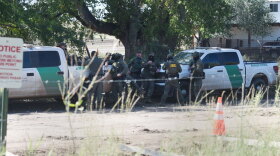 On Monday, dozens of agents swarmed a stretch of private land where the activists had been camped in and around a centuries-old cottonwood tree. Contractors tore down the tree and agents made multiple arrests.
-
 Protesters have been camped out in a plot of private ranch land in Lochiel for over two months now, trying to block wall construction as it neared a towering cottonwood tree that was the last of a grove slated for destruction to make way for two, parallel steel bollard walls.
-
Activists have spent the last 70 days camped around and inside a cottonwood tree right along the border in the tiny town of Lochiel. The tree was the last of an old grove estimated to be up to 250 years old.


