


As the Arizona Diamondbacks chase a playoff spot during the final weeks of the season, the team and a newly reconstituted board are trying to finalize a deal to keep the D-backs at Chase Field. That’s the first step in unlocking hundreds of millions of public dollars that’d be used for maintenance on the stadium.
Last year, state lawmakers approved and Gov. Katie Hobbs signed a bill that allows for up to $500 million of sales and income tax money generated at and around the ballpark to be diverted to a fund to pay for repairs and maintenance. But before that happens, the team needs to agree that it’s staying at Chase Field into the future.
Mark Winkleman is the new executive director of the Maricopa County Stadium District, which is the entity working with the team on all of this. He came by KJZZ's studios — before the D-backs’ team president was quoted — to talk about where things stand. The conversation started with whether he’s started coming up with a priority list, maybe with the team, about what needs to be done at the stadium and the order in which those things need to be done.
Full conversation
MARK WINKLEMAN: Yeah, we have. And the team has taken the lead on this because they operate the stadium. It’s their business. And so they’ve hired a national group to come in and assess the stadium and talk about ideas on what needs to be done. Obviously, we’ve got to make our own judgment and we’ve got to be good stewards of the public money. But it just makes sense for the team to take the lead on that since it is where they operate their business.
MARK BRODIE: So they come up with a list, and then you and the board go through it and say yay or nay and come up with like the bids to actually do the projects? Is that how that works?
MARK WINKLEMAN: Ultimately, I don’t think it’s a yay or nay. I think it’ll be a collaboration with the team as to what needs to be done. And honestly, it’s a lot of money, but the work is not very sexy. The stadium is 30 years old, and it needs, like any 30-year-old project, it needs some capital improvements and repairs.
So a lot of what the money’s going to be going for is fixing concrete, fixing air conditioning system, replacing the roof, the plumbing system. I keep getting people sending me videos of leaks in the bowels of the stadium, or not always the bowels, in the stadium. So there’s no question. Also had some friends that were at the concert, I think it was less than two weeks ago, talking about it was rather warm in the stadium. And so, yeah, there’s no question that some of this work needs to be done.
And so we’ll work cooperatively, or we intend to work cooperatively and solve out what needs to be done, the prioritization, how it’s going to get done, who the contractors are, that sort of thing.

MARK BRODIE: Do you feel like the amount of money that will be involved here will be enough to cover the repairs that need to be done?
MARK WINKLEMAN: Well, I don’t know the answer to that. I suppose anybody that wants to fix up a stadium like this could probably spend as much money as exists. It’s a significant amount of money. I hope it’s enough to do the job. I assume that that topic was debated in the Legislature as they determined how much money they were willing to put up.
And I’ve yet to hear anybody say that it’s inadequate in any significant way. But I’ve also heard the D-backs, as they go through their own prioritization, talking about things that maybe they wish could be done, but there just won’t be money. So it will not be a pristine stadium. This will be a modern, hopefully as best state-of-the-art as can be done. But it will still be a 30-year-old facility, and we can’t just start from scratch and build new stadiums like, the A’s are doing in Las Vegas, or in football, the Tennessee Titans are doing in Nashville.
MARK BRODIE: I imagine also that the actual amount of money that you’ll have to work with is a little bit in flux, right? There are estimates, but in large part, it depends on like how much sales tax revenue, for example, is generated in that stadium and nearby buildings that you get. Like if more money is spent there, that’s more revenue for you. If less is spent, less for you.
MARK WINKLEMAN: You’re absolutely right. It’s up to the revenues that we get. And we’ve estimated that that’s somewhere in the neighborhood of $20 million a year, which, by the way, is not enough to do the repairs that need to be done soon. And so we will have to come up with some sort of financing mechanism to pledge or use this stream of revenues that will happen over the next 30 years to acquire enough money to do the improvements that need to be done in a three- to five- or six-year horizon. So that is one of the things, one of the challenges that we’ll be addressing.
MARK BRODIE: How challenging is that to try to come up with some kind of debt financing or something else like that?
MARK WINKLEMAN: Well, governments do bonds all the time, whether it’s school districts or improvement districts or whatnot. So there are underwriters that do this, there’s techniques, there’s laws. And so it can be done. They’re obviously always complex to a large extent, and there may be other sources of funding that will be available. We’re looking at different options at this point, but it will be necessary because there won’t be a big pot of money there right at the beginning that is sufficient to do the repairs that need to be done sooner rather than later.
MARK BRODIE: Yeah. So let’s talk about the timeline here. Like when do you anticipate starting to say, "OK, here are the top X number of projects that we need to get going and we’re going to start them right now"?
MARK WINKLEMAN: Well, the team would like to start tomorrow. I think we’re all united in we’d like to get going as quickly as possible. But the first order of business is to finalize a new agreement to have the team stay for another 30-plus years. And so we’re working on that document right now. And so we need a mutual commitment before anybody’s going to spend any significant money. So that’s the first order of business. But once we get that agreement in place, then we’ll move the work along as quickly as possible.
This is a bit of an unusual situation because you can only do the substantial work during the off season. So it’ll be roughly six months of time to do things, and six months where you can’t do much because the season’s going on. And so that adds a complexity that most construction projects don’t have.
MARK BRODIE: Do you have reason to think that the team won’t sign a new lease extension with the county?
MARK WINKLEMAN: I don’t think so. I mean, they’re working in good faith. We’re working in good faith. I think the fact that the legislation got passed last year and that the district was reformed and Derrick Hall is a member of the board, he’s a nonvoting member of the board, but he’s a member of the board. So at this point, it’s a very cooperative relationship.
I think a level of trust needs to be reestablished that was lost maybe during the days of litigation and turmoil. But I’m sure that the effort to pass the legislation last year wouldn’t have been done unless the team intended to stay here. So it’s our hope that an agreement can be done relatively soon. We’ll certainly make that aware to the public.
And that’s something that we’ll be doing throughout is we represent the public’s interest. So there’s got to be transparency so that the public can understand what’s going on and feel comfortable and know that we’re taking care of their money and it’s in accordance with the legislation that was passed.
MARK BRODIE: There was, of course, some controversy when this bill was going through the Legislature that, you know, there’s a concern of public money being used for, you know, essentially a private entity, even though the county owns the stadium, the Diamondbacks are not a public organization.
I’m curious what you make of that debate and how that maybe plays into what it is that you’re trying to do and how you’re going to be spending that public money. You talked about transparency and making sure the public knows what’s going on. Is some of that to try to alleviate the concerns of tax money, literal tax money, being used on a private sports team?
MARK WINKLEMAN: Well, that policy debate took place, and the Legislature ultimately concluded that this was worth doing, and they passed the law. And so it’s not my place to say whether that’s right or wrong. I’m a sports fan, but I understand there’s a lot of people that say we shouldn’t be subsidizing stadiums and teams. But that debate has occurred. The law was passed. We’re going to respect the law. And even some of the board members were at some level of opposition to the concept.
But I will say, I’ve not been in this job for very long, but I’ve met individually with all the board members, and I haven’t sensed any attitude with anybody that, "Well, we’re going to somehow undo this." I think everybody’s moving collectively to get the job done, come up with a stadium that will work for the team, continue the energy that’s going on in downtown, and be something that where the public funds were used appropriately to upgrade that facility.
MARK BRODIE: All right. That is Mark Winkleman, the new executive director of the Maricopa County Stadium District. Mark, thanks so much for coming in.
MARK WINKLEMAN: Very welcome. My pleasure.
-
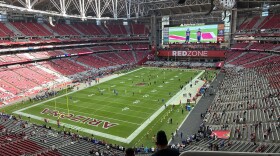 ESPN is reporting the Arizona Cardinals are finalizing a deal to trade wide receiver Marvin Harrison Jr. to a mystery team. Harrison, the son of Hall of Famer wide receiver Marvin Harrison Sr., will be inactive on Sunday against the Detroit Lions while the deal is finalized.
-
 Kerr Kriisa, an Estonian national, became a fan favorite while at UA from 2020 through the spring of 2023.
-
 Terry Greene Sterling has lived in the same peaceful neighborhood for most of her life. But recently, a sport that's allegedly grown popular has been disrupting that space.
-
 What is the purpose of these so-called military-style workouts in collegiate or professional sports? Why are they prominent today?
-
 Hunters and hikers were among almost 133,000 people opposing potential changes to the Travel Management Rule in national forests. Snowmobile groups were in the minority.


