


MARK BRODIE: The Great Arizona Puppet Theater will be hosting its September Puppet Slam (Saturday, Sept. 5), and my next guest will be one of the performers.
Matt Scott is the creator of Rasputin’s Marionettes, and he’s been a puppeteer for most of his life. He joins me to talk about his work, and Matt, can you first off describe the show that you’ll be doing here?
MATT SCOTT: The show that I’m actually doing is the first show that I ever actually built. To me, it’s very primitive, but I think for that reason, it thrives on its authenticity. What people will be seeing is a marionette show done in the style of what we call cabaret, which means that rather than be from a concealed platform, it’s performed in full view.
They’re large-scale marionettes ranging about 2 to almost 3 feet in height, and the show is actually called "Freakshow Follies." It’s really just a song and dance sort of variety show, but it is performed by characters from a turn-of-the-century 1900s, 1920s freak sideshow.
MARK BRODIE: Ha, and so when you say it’s not a concealed platform, the audience will see the marionettes and you manipulating them?
MATT SCOTT: And me, yes. It’s not uncommon for people to approach me after a show, and they tell me how delighted they have been by what they saw, they loved the music, they loved the puppets, but they were equally captivated by watching my hands and trying to understand how it’s all done. The magic is all right in full view.
MARK BRODIE: Well, so sounds like you see that as part of the show, like you are one of the performers like in view along with the marionettes doing their thing.
MATT SCOTT: Yes, for years I’ve gone back and forth on how to affect that on stage. A lot of times I’ve been costumed to fit the theme of what I’m doing. Sometimes I’ve worn simply all black or just one solid color to blend out of view, but nothing has ever really stuck.
I mean, there’s no getting away from the fact that I am in full view and people see it, and so, but audiences enjoy that part because even though they can see everything that’s happening, they’re still just dumbfounded by the intricacy of what a marionette performance actually involves.
MARK BRODIE: It’s so interesting, because I think for at least most viewers, I mean, maybe not, you know, if you’re doing like a kid’s birthday party or something like that, but most adults who go to a puppet show or marionette show know that there’s a human doing the work.
They’re like, there’s a human manipulating the marionettes, manipulating the puppets, but it’s interesting like to think of it like you can see it and maybe how that affects somebody’s, you know, if somebody sees you doing it, maybe they have a slightly different appreciation or a different experience watching the show than if they don’t see you, even though they know you’re there.
MATT SCOTT: Right, well I think that’s just part of the magic of puppetry. Nobody’s ever really fooled. Everybody knows, I think even as a kid, I was aware that puppets were something that were being controlled because I got involved in puppetry at a very young age and I always knew that somehow your hand went somewhere to make something move, and I was never under the illusion that these things were moving on their own.
But it’s the way that the audience’s brain wants to process what they’re seeing, like it’s a willful suspension of disbelief or just becoming engaged in the art form of what they’re seeing. So it’s always very interesting, you know, I never get the same reaction from somebody after a show. While everybody may like what they’ve seen, everybody’s processed it a little bit differently.
MARK BRODIE: So you mentioned you have been doing puppetry since you were pretty young, like what got you into it in the first place?
MATT SCOTT: When I was a child, there was just a much more, puppets were practically everywhere. I’m first generation "Sesame Street," I was watching "The Muppet Show" when it was originally airing, Saturday morning cartoons were actually more puppet and mascot costume heavy than they were hand-drawn animation. Sid and Marty Krofft, "H.R. Pufnstuf," "Lidsville," all of that was what I grew up on.
There were also three, three marionette theaters in the Los Angeles area that were performing shows on a daily basis. And so I would go to puppet theaters and see puppet shows as part of field trips and summer camps all throughout my childhood. So at the age of 4 or 5 years old, I was already being influenced by incredibly talented puppeteers, and it just took root.
MARK BRODIE: I mean clearly, like what appealed to you so much about it?
MATT SCOTT: It’s just so magical. Well, to come back to Saturday morning programming for kids, the fact that it was puppets versus animation takes it out of a two-dimensional world and puts it in a real, in real time. And the shows that I was watching when I was a kid were specifically usually always the same sort of plot in which there was a human child who was lost and trying to get back home, but found themselves in a world inhabited by puppets.
And I just found that so engrossing on the same level that kids are drawn to stories like "The Wizard of Oz" or "Alice in Wonderland," it’s just finding yourself in something that’s so very real and yet surreal at the same time.
MARK BRODIE: Have you found that over the years your style has evolved, the way you work with the puppets or act out the roles or manipulate them in some way?
MATT SCOTT: Oh, absolutely. I would never assume that if I keep doing this well into my old age that I will have mastered anything. There’s always going to be a new way to affect manipulation or to represent a character through the style of the sculpt or the interpretation of what it is.
I’ve moved from very stylized characters, mostly influenced by a puppeteer by the name of Bill Baird, who is famous for having been the puppeteer, the puppet builder and puppeteer in "The Sound of Music" for "The Lonely Goatherd" sequence. A lot of people, a lot of puppeteers will reference back to that as a point that really changed them and encouraged them to become puppeteers, and I would probably list that scene, that one scene as a major influence of mine.
So I took my initial puppet-building skills from trying to do very stylized versions of things as seen in something like "The Lonely Goatherd" to trying to be much more hyper-realistic in my sculpt, but it always depends on what it is that I’m performing or what it is that I’m building for and the need for a particular style, so nothing has ever been the same with me. I’ve always evolved or adapted or changed to meet the moment.
MARK BRODIE: That is Matt Scott, he’s the founder of Rasputin’s Marionettes. He’ll be performing at the Great Arizona Puppet Theater September Puppet Slam here in Phoenix. Matt, thanks so much for the conversation.
MATT SCOTT: Thank you so much.


-
 Father Panik may not be a widely recognized name in the music industry, but decades later, the band's Matt Goldman is sharing their unique sound and story at the Tucson Film Festival.
-
 Desert Design kicks off this week with a variety of speaking events, exhibits, and gatherings. This year, its theme is "Collected in Dialog."
-
 Amanda Kelly is an artist based in New York City. She has a new exhibition at The Mini Time Machine Museum of Miniatures in Tucson called “The Need to Keep.” In it, she shows scenes that have a lot of stuff in them, from bathrooms to kitchens to end tables, all in miniature form.
-
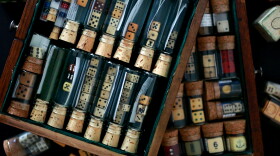 For the next several days, you can tour a huge RV trailer packed with drawers of dice, erasers and just about anything you can imagine that’s both tiny and collectible. The Show’s Amber Victoria Singer got a virtual preview from its founder and curator.
-
 New research shows the ancient site is much older than previously thought. In fact, it’s now confirmed to be the oldest known scientifically dated geoglyph in the Americas, 2,000 years older than the first Pyramids built in Egypt.


