


While we aren’t seeing headlines about immigration agents swarming U.S. cities right now, U.S. Immigration and Customs Enforcement is still detaining and deporting record numbers of people.
And, right in the middle of Phoenix, there is a temporary holding facility where detainees are being held much longer than they are supposed to be and ICE agents have called 911 multiple times.
Jerod MacDonald-Evoy had the story for the Arizona Mirror, and he joined The Show to talk about it.
Full conversation
LAUREN GILGER: Good morning, Jerod.
JEROD MACDONALD-EVOY: Good morning, and thank you for having me on.
LAUREN GILGER: Thank you for coming on. So, tell us first about these holding facilities. “Temporary” is in the name. How long are migrants being held?
JEROD MACDONALD-EVOY: Yeah, these temporary hold facilities have kind of come under scrutiny across the country. Places like New York, Los Angeles and Baltimore have made headlines for kind of the conditions at these facilities. They’re supposed to stay there between three to 12 hours. That’s what ICE has officially told past auditors of these facilities. But so far, we’re seeing that the average number in the first year of Trump’s second term has gone from nine hours to roughly 19 hours, and that’s continuing to increase.
LAUREN GILGER: So 19 hours doesn’t sound like an incredibly long amount of time, right? But these are not made for people to be there for any longer than 12 hours — like no beds, no medical services, no food. What are these places like?
JEROD MACDONALD-EVOY: Correct. These facilities, they’re known to have no beds. There are about, I believe, 10 holding rooms that are just kind of concrete rooms where people are meant to just kind of be processed and held there until they’re taken to another facility, whether that’s Florence or taken to be deported or released. But these rooms, there’s no on-site medical, hence why ICE has been calling for emergency services at this facility in the past few months.
LAUREN GILGER: Right. So as we see these kind of times people are being held in these holding facilities go up, you also are seeing medical issues go up. What kinds of things are you reporting here? What kinds of 911 calls have happened?
JEROD MACDONALD-EVOY: I was able to obtain about 11 911 calls for the past six months, and these calls varied from things like fall injuries, where it was an older individual who fell while being taken to the hold rooms, or there were multiple people who had seizures that ended up needing medical assistance from ambulances who then had to drive them to local hospitals to be treated. There was also several instances of people with chest pain who were older, who were complaining that maybe they were having a heart attack.
LAUREN GILGER: You had a story of a pregnant woman as well who they had to call 911 for, right?
JEROD MACDONALD-EVOY: Correct. There was a pregnant woman in early December of last year who they called 911 for because she was having stomach pain and there was some white mucus that was concerning to the ICE agents. They ended up calling 911, and that person was transported to a local hospital Code 3, which is when the ambulance and emergency services go with sirens. And also noted in the CAD readout, they had ALS, which means advanced life support measures were given.

LAUREN GILGER: Wow. OK. So can be very serious indeed. Jerod, have we ever seen times of folks being held in these kinds of holding facilities that are meant to be for 12 hours this long before?
JEROD MACDONALD-EVOY: Well, this particular facility has a bit of a past with holding people for longer periods of time. I looked at data that was released via FOIA from the Deportation Data Project, which is ICE’s own data on people when they come into these facilities. There’s been individuals who stayed in 2022 for — there’s an individual who stayed in 2022 for 211 days. There was one person who stayed for 97 days in 2024. That was under the Biden administration, and we’re seeing those numbers again under Trump 2.0. There was an individual who stayed recently this year for over 80 days.
And sometimes this facility has also reached over its kind of population max, which is supposed to be around 150 detainees. This year, it’s reached 155. In the past, it’s also reached 263 for a single day. So we’re seeing the number of people staying going up as well as the length of stay go up in the past year.
LAUREN GILGER: People being impacted there. Jerod, what about oversight here? Like, doesn’t Congress have oversight of ICE, of facilities like these?
JEROD MACDONALD-EVOY: Congress is supposed to have oversight capabilities at these types of facilities. ICE has kind of pushed back on that, saying that because these are temporary hold facilities, they’re not detention facilities, so certain things in regards to their oversight capabilities don’t apply here.
Courts have ruled twice now, though, that Congress does have oversight capability on these facilities, and we’ve seen the result of that here in Arizona, where we had Congresswoman Ansari, Grijalva and Stanton visit another one of these temporary hold facilities in Mesa and found some pretty horrific conditions, they said.
LAUREN GILGER: Yeah, yeah. So let me ask you about ICE’s point of view here. Like you said, they say, “You know, these don’t need congressional oversight, they’re only temporary.” But there are Inspector General reports of places like this, right?
JEROD MACDONALD-EVOY: Not Inspector General, but what are called PREA audits, which is — it’s the Prison Rape Elimination Act. It was passed in the early 2000s to address rape and sexual assault in jails and federally run detention and correctional facilities.
This facility has had two of those PREA audits — one in 2017 and one in 2022 — that found some deficiencies, but they said they were addressed, specifically with the fact that this facility also is known to hold juvenile detainees. It will often hold families and things like that. And they found two instances where there were younger people who allegedly had sexually abused someone else. Those cases were then later deemed to be unsubstantiated by ICE itself.
LAUREN GILGER: Wow, lot to watch for. Thank you for your reporting on this, Jerod. Jerod MacDonald-Evoy is with the Arizona Mirror. Jerod, thanks as always. Appreciate it.
JEROD MACDONALD-EVOY: No problem. Thank you.
-
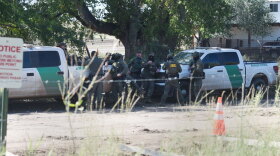 On Monday, dozens of agents swarmed a stretch of private land where the activists had been camped in and around a centuries-old cottonwood tree. Contractors tore down the tree and agents made multiple arrests.
-
 New research shows the ancient site is much older than previously thought. In fact, it’s now confirmed to be the oldest known scientifically dated geoglyph in the Americas, 2,000 years older than the first Pyramids built in Egypt.
-
 Protesters have been camped out in a plot of private ranch land in Lochiel for over two months now, trying to block wall construction as it neared a towering cottonwood tree that was the last of a grove slated for destruction to make way for two, parallel steel bollard walls.
-
 Ahmed Soliman has no ties to Equatorial Guinea. The 30-year-old man was born in Egypt and brought to the United States. when he was just 4 years old. He grew up in Phoenix. Now he’s believed to be in a hospital in the African nation.
-
Activists have spent the last 70 days camped around and inside a cottonwood tree right along the border in the tiny town of Lochiel. The tree was the last of an old grove estimated to be up to 250 years old.


