


Evelina Fernández grew up in Phoenix, but her memories of this city are less than fond.
When playwright Fernández was 9 years old, her parents got divorced and she moved to East L.A. where she still lives and writes today. Now, she is an award-winning playwright, screenwriter and actor, and a founding member of the Latina Theater Company and the Los Angeles Theatre Center.
And, later this month, she’ll be back in Phoenix as the recipient of Arizona Theater Company’s 2026 National Latine Playwrights Award for her play, “Blow Away the Clouds.” They’ll be holding a staged reading of it on Sept. 17.
Full conversation
LAUREN GILGER: Tell me about your memories of Phoenix, like what comes to mind when you think of this place?
EVELINA FERNÁNDEZ: Well, I mean, first of all, I remember it being really hot. So much hotter than it is in California. So I did, you know, go to elementary school there, and I do remember my school, Jorgensen Elementary School. And I remember that we used to walk barefoot in very hot dirt to go to the Broadway Pool. I don’t even know if that place exists anymore, right?
But yeah, the memories are not great. I mean, it was a time when my parents were going through a divorce, so that, you know, is probably the most impactful memory that I have, you know, that we left. And I remember the day that Mom and I got on a Greyhound bus, and I looked out the window, and I thought, “Wow, I’ll never see Phoenix, Arizona, again.” But I have.
LAUREN GILGER: You have, you have. And you’re back now for this, so it’s a little bit full circle.
EVELINA FERNÁNDEZ: Yeah. And I do go back, because my family owns a home in Camp Verde, Arizona, and I do go back for writing retreats. My mom was born in Jerome, Arizona, so since I do write a lot about mining towns, I do go back to Jerome, Arizona. I love that little town.
LAUREN GILGER: It’s a cool town, yeah.
EVELINA FERNÁNDEZ: And my dad is still there. He’s 101 years old, so he’s still there, yeah.
LAUREN GILGER: 101. Wow, OK. And this particular play we’re talking about here, “Blow Away the Clouds,” is set here in Arizona and in a small mining town, not unlike Jerome. And in the 1930s, tell us about sort of the the backdrop here.
EVELINA FERNÁNDEZ: Well, I grew up listening to stories from my grandmother as they were told to my mother, and then my mother told them to me, about women that lived in that little town. And so every single one of the characters in “Blow Away the Clouds” is based on a real woman — four women that really existed, and whose story I heard throughout my lifetime. I heard the stories from my mom, I heard the stories from my grandmother. A lot of my plays are based on, you know, the oral history of my family. And so this is one of them.
LAUREN GILGER: So tell us about — is it Milagros? Is that how you say her name?
EVELINA FERNÁNDEZ: Yeah, Milagros. So Milagros is the woman who, you know, she’s very religious, but she has friends who have problems, problems that deal with pregnancy, infidelity, spiritual problems. And so they all come to her because they say she’s good. She’s like the best friend in the whole town, so everybody comes to her with their problems.
And also, it’s in the middle of the Great Depression of 1932. And at that time, the conditions in the mines at that time for Mexican men were were not good, very, very bad, very dangerous. My grandmother used to talk to me about black lung and how many miners died from black lung, and and they were underpaid and overworked. And so these women are wives of mine workers.
And of course, there’s the rich families, the mine owner families, and the poor families, and they all live on different sides of town. And so many of the women work for the rich families. And there’s that conflict. There’s that feeling like life isn’t fair.
LAUREN GILGER: A perpetual theme, I’m sure, yeah.
EVELINA FERNÁNDEZ: And so she has to decide if she’s going to help her friends or not, you know, when they’re asking her to do things that she really doesn’t want to do. So it’s kind of a play about friendship, sisterhood, solidarity, society and religion. You know, how do we — how do we reconcile our religious beliefs with what is going on in our real life?
LAUREN GILGER: Yeah. Well, I wanted to ask you about that because I read that you were raised Catholic, though you don’t practice now. But you had this really great quote I read where you said you grew up thinking angels and spirits lived among us, right? This kind of melding of the real and the spiritual worlds that’s so present in Catholicism. I wonder, you know, where does that show up in your plays? How do you like to explore that in these characters?
EVELINA FERNÁNDEZ: Well, Gabriel García Márquez is my my favorite writer. And so I do use a lot of magical realism in my plays. Like for example, the last play I wrote, “The Storyteller,” is a woman who is dying of dementia. Her guardian angel sits next to her the whole time, and they have conversations.
In this one, what I use is the limpia, right, the cleansing, because one of the women believes that she’s been cursed. A lot of beliefs, right? Somebody’s backyard has fallen in because of the of the digging in the mine. And so they say that at night she can hear the spirits yelling from hell, right? And yeah, I mean, we do believe in spirits, and we believe in curses, and that’s so beautiful. And I love writing about those beautiful cultural beliefs that I grew up with and so many other, you know, Mexicans and Mexican Americans have grown up with.
LAUREN GILGER: So I wonder, because you say that you write so many of your plays kind of from your family’s oral history, from women that you grew up hearing about all the time. I mean, what does that do for, I guess, your own sense of of self and identity? I mean, does it help you understand where you come from and what that means to you?
EVELINA FERNÁNDEZ: Well, yeah. I mean, I remember my grandmother was a very strong woman. She’s the one that came from Mexico during the Mexican Revolution with my grandfather, and they landed up in Jerome, Arizona. So she was a very strong woman, and consequently we have a lot of strong women in our in our family.
And I remember my son was around — I want to say maybe 12 years old, and he realized something, right? He was like, “Hey, Mom, why do the women run our family?” And I had to think about it. I had to like, wow, we really do. And we do. I mean, it’s that’s the kind of family I have. You know, whereas other families, it’s a more patriarchal, it’s not that way in our family.
And so what was my response to my son? It was, “I think because the men like it that way.” Probably wasn’t the best answer, but that’s all I could come up with at that moment.
LAUREN GILGER: Not a bad answer, though. Not a bad answer. All right, well, we’ll leave it there for now. That is Evelina Fernández joining us, an award-winning playwright. She is the 2026 National Latine Playwrights Award winner. Thank you so much, Evelina, for coming on the show. Congratulations.
EVELINA FERNÁNDEZ: Thanks so much, Lauren. It was great talking to you.
-
 How do we go about turning casual friends into closer ones? It can be difficult to do, especially as an adult.
-
 Double Ten is the Taiwanese national holiday, and the event hosted by the city of Phoenix has been called the largest Double Ten celebration on the continent.
-
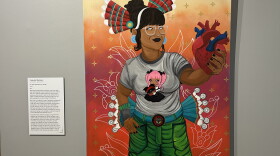 From graduation stoles to a Louis Vuitton drum, “Indigenous Identities! is a new art exhibit opening in Phoenix this week, October 8. The artists present work from a mix of their heritage, personal memory and modern circumstances.
-
 Silas John Edwards was a towering figure among the Apache people in Arizona about a century ago — until he was accused of murdering his wife and put behind bars
-
 Arizona’s history is well documented through its newspapers, and ASU English professor Vanessa Fonseca-Chavez dove deep into the long Spanish-language newspaper history here.


