


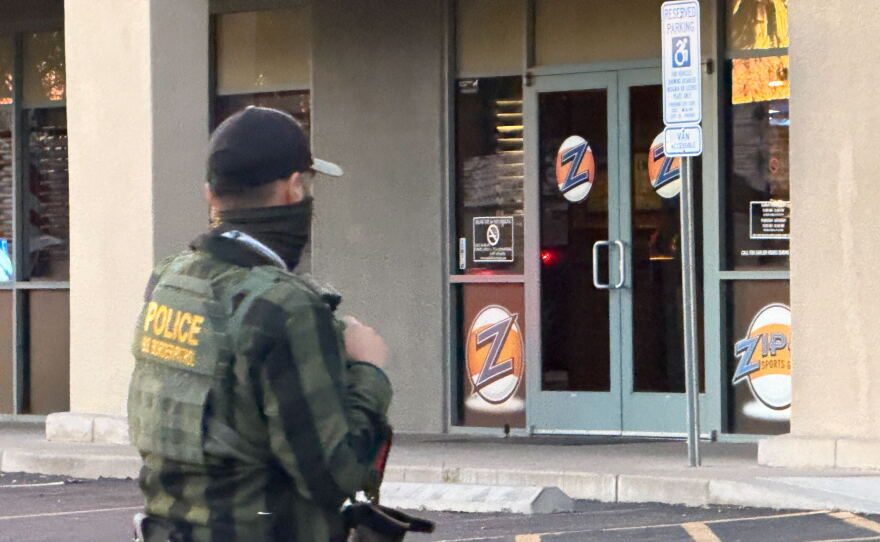


Back in January, federal immigration agents raided each of the 14 Zipps Sports Grill locations across metro Phoenix. They were looking for undocumented workers and ended up arresting dozens of them.
But now, nine months later, only one manager has been charged in connection with the hiring of undocumented immigrants. He spent time in detention and is currently awaiting deportation.
Richard Ruelas with the Arizona Republic says that manager doesn’t understand why nobody else has been charged — especially since he told investigators that higher-ups at the company knew about what was going on there.
Ruelas spoke with the manager and joined The Show to talk about it.
Full conversation
MARK BRODIE: Richard, good morning.
RICHARD RUELAS: Good morning.
MARK BRODIE: So let’s go back to January when these raids were going on. What was sort of the mood and the tenor in the Valley?
RICHARD RUELAS: People were on tenterhooks. There was an activist network that responded quickly as soon as they heard raids were there. Protesters showed up. I was outside the Mill Avenue location. There were Republic reporters and photographers at the Park Central location because people feared this was going to be the start of something, that it starts with Zipps and then they’re going to go to other restaurants, hotels, whatever, later.
It ended up not being that, but there were very tense moments outside these Zipps locations as this was taking place.
MARK BRODIE: OK. So tell us about the manager with whom you spoke. Who is he, and what was his role?
RICHARD RUELAS: His name is Diego Gonzalez-Rosales. He came here at the age of 17, 20 years ago, and told us he quickly, a couple days later, got a job at Zipps showing no identity, just signed a document, because that’s what the law allowed back then, or you didn’t have to show an ID and run through E-Verify.
And he worked at Zipps for 20 years. He said through his hustle and hard work, he was given higher and higher jobs, promoted, and last year took the job overseeing all of the kitchen operations in every Zipps location, which included some preliminary hiring questions as new applicants came in.
MARK BRODIE: And it seems as though that’s sort of where he got into trouble, based on what he told investigators and what he told you?
RICHARD RUELAS: Correct. He said everyone that he interviewed, everyone who essentially worked in the Zipps kitchen was, like him, a Spanish speaker and probably in the country illegally. He said virtually all of them were.
But he did that first interview in Spanish. He would ask the person where they lived, he would assign them to the Zipps location nearest there, and tell them go see the general manager and show up with your identity documents. He said sometimes he or another kitchen manager would help translate and help the person fill out the forms.
He did have, at least he admitted this on one occasion, on his phone, he had a picture of someone’s driver’s license and Social Security number. He didn’t exactly explain to us or authorities why he had those images, but when a person named Gato, who was applying, was having trouble getting through the verification system, he told him use this name and number. So he ended up pleading guilty to that.
At least a couple other Zipps workers said that something similar happened to them from Diego, that he gave them a name and number to use.
MARK BRODIE: And it’s worth remembering that with E-Verify, which is the law in Arizona that you have to use, it just matches a name to a Social Security number or some other identification number. It doesn’t necessarily say that the person providing that is the person to whom the identity belongs.

RICHARD RUELAS: Right. I mean, you show someone a driver’s license, it’s supposed to be you, you know, there’s a photo on it. And the thought when E-Verify was passed was, I mean, before, you just had to attest you, this was your Social. People were working under the number 000-00-0000. So obviously fake Socials that were not valid were getting through.
This was supposed to really cut down on that, but as one lawmaker told me who was instrumental in passing it, they didn’t realize how many names and numbers were floating around out there that people could use. There became a black market for someone’s full identity.
MARK BRODIE: Right. So as this manager told you, he seems like he was pretty upfront with investigators. He didn’t really hide that much about, if anything, about what was going on and his role in it. Is that fair?
RICHARD RUELAS: It is fair. I should also mention Zipps is telling us they did, they do not engage in anything illegal, they follow all the regulations and laws. Diego though said he gave a roadmap to authorities, named names, told them how they could find, told them anecdotes about what was going on. These cases are hard to prove, and Zipps also told us that they were told, Zipps was told the investigation is over and there will be no more criminal prosecutions.
The U.S. Attorney’s Office has not confirmed that to us, but according to Zipps, this case is done with no one else facing charges other than this man and three other kitchen workers who were accused of just using someone else’s name.
MARK BRODIE: And Diego’s testimony and what he said to you was that higher-ups knew that this was happening, knew that people were using identities that were not theirs, that were here in this country not legally working in their restaurants. Zipps is denying all that?
RICHARD RUELAS: Zipps is denying all of that. And Diego was, you know, he sort of said in a way that like, “Oh, just everybody knows.” He did, according to a court document, a sealed court document that we were able to review, he did tell more specific anecdotes to authorities.
But like, one anecdote, he was supposed to, someone was supposed to park for entry into a Zipps location, and the manager asked Diego, “Am I supposed to use the person’s real name or the name they’re working under?” Anecdotes like that, which he said should have let management know, you know, should have been a clue that management knew what was going on in their kitchens.
MARK BRODIE: How’s he feeling about the fact that he is the only, like he’s basically the highest-up person at this company who was charged with anything here?
RICHARD RUELAS: Yeah, he told us he feels like he’s taking the fall for the entire company. Why me? Why am I the only one facing trouble? Twenty years, from the age of 17, 20 years in this country, he did not want to go back to Mexico. He hadn’t been back. He built a life here. He became, outside of the documents, an Arizonan, an American. He enjoyed hiking and enjoyed traveling to Vegas and the Grand Canyon. Twenty years at one company, and he thought they would have, he thought, done more to fight for him.
MARK BRODIE: Interesting. All right, we’ll have to leave it there. Richard Ruelas with the Arizona Republic. Richard, thank you.
RICHARD RUELAS: Thank you.
-
 On Monday, dozens of agents swarmed a stretch of private land where the activists had been camped in and around a centuries-old cottonwood tree. Contractors tore down the tree and agents made multiple arrests.
-
 New research shows the ancient site is much older than previously thought. In fact, it’s now confirmed to be the oldest known scientifically dated geoglyph in the Americas, 2,000 years older than the first Pyramids built in Egypt.
-
 Protesters have been camped out in a plot of private ranch land in Lochiel for over two months now, trying to block wall construction as it neared a towering cottonwood tree that was the last of a grove slated for destruction to make way for two, parallel steel bollard walls.
-
 Ahmed Soliman has no ties to Equatorial Guinea. The 30-year-old man was born in Egypt and brought to the United States. when he was just 4 years old. He grew up in Phoenix. Now he’s believed to be in a hospital in the African nation.
-
Activists have spent the last 70 days camped around and inside a cottonwood tree right along the border in the tiny town of Lochiel. The tree was the last of an old grove estimated to be up to 250 years old.


