


LAUREN GILGER: All right, let me take you back now a few years for our next segment this morning to the 2024 Summer Olympics in Paris and a breakout breakdancing performance. Breakout, that is, in all the wrong ways.
[REACTION MONTAGE PLAYS]
SPEAKER 1: I’ve seen this one where people compare her to like a golden retriever, like rolling around in the grass.
SPEAKER 2: Oh. This looks like an imitation of breakdancing mixed with like interpretive dance. What the ...?
SPEAKER 3: It’s very different, yes?
[END OF MONTAGE]
LAUREN GILGER: They are, of course, talking about Rachael Gunn, better known as Raygun, the Australian academic who somehow ended up competing for her home country in the Olympics’ first breakdancing competition and failing pretty badly. Raygun’s notoriously bad performance became a global meme that started out as funny and then turned pretty hateful. And now, Netflix is out with a new documentary all about her: “Untold Raygun: Breaking Badly,” it’s called.
And our next guest this morning says the internet dialogue around it and Raygun herself reveals a lot about us, our culture of participation trophies and if we really can do anything we put our minds to. Amanda Kehrberg is The Show’s very own pop culture expert, a Ph.D. student at ASU’s Walter Cronkite School of Journalism and Mass Communication. She studies digital culture. Good morning, Amanda.
AMANDA KEHRBERG: Good morning, Lauren.
LAUREN GILGER: OK, so remind us about Raygun. Why did this become such a thing? Like, how bad was it?
AMANDA KEHRBERG: It was so bad. She did not get a single vote from a single judge.
LAUREN GILGER: Wow.
AMANDA KEHRBERG: She did the sprinkler. She did indeed roll around on the floor like a golden retriever. It was just, it was such a terrible, terrible example of the art of breakdancing.
LAUREN GILGER: Right. And in the first Olympics.
AMANDA KEHRBERG: Yes.
LAUREN GILGER: Yes. It was the first time this was ever in the Olympics, too.
AMANDA KEHRBERG: Yes, the first time and possibly the only time. Yeah. Oh my gosh, yeah. What else did she do? She ends up on her hind legs kind of like a kangaroo at the end. I mean, there were so many moments of it that just went viral, became sort of jokey dances, became a meme that you would throw into, you know, anything that would cause …
LAUREN GILGER: It was a pretty popular 2024 Halloween costume, right?
AMANDA KEHRBERG: Yes, absolutely. Yeah, it was probably the biggest meme to come out of the Olympics that year, and there were a lot. The Paris Summer Olympics had the Turkish shooter, had so many memes that then went on to become Halloween costumes.
But I think what we saw with this was not just an example of that kind of humor that we see spread across social media and that kind of joy and community building, but also just really, really, really extreme bullying and hateful rhetoric targeted at one individual.
And when we talk about the ethical ramifications of digital media and this just extremely fast spread globally of information, what that does to an individual when it’s pointed at an individual can be extremely scary. And that’s a conversation we’ve had in digital media for 20 years at least now. What does it look like to be globally shamed, and how do we have those conversations about systems and issues without focusing it in on one specific person?
LAUREN GILGER: Well, and this is exactly what is focused on in this new Netflix documentary about Raygun where they kind of tell her story behind the whole thing. It’s part of this “Untold” series. The reviews of this though are mixed, too, right?
AMANDA KEHRBERG: Absolutely. Yeah, and they raise a lot of incredibly good points about how the documentary, by focusing and centering Raygun’s story, it’s telling one aspect of this broader narrative, but it’s not talking about what was she doing there to begin with. It’s not talking about breakdancing as an art form and a dance and its roots in hip-hop, its roots in Black culture, specifically starting in the Bronx in the 1970s.
And that’s another thing that I would point to. This is characteristic of digital media. Digital media platforms decontextualize art, they decontextualize discourse, they decontextualize all of these things. And what happens when you take something out of its context and then this sort of culture vulture, cultural appropriation conversations, that you assume then it’s yours, it’s something you can mix and mash up and do as you see fit. And there was a lot of very, very apt criticism of that.
And I think also about what that meant in terms of that being one of the main things we talked about after the Olympics. And we see that with the Winter Olympics, too. You know, we have incredible stories that we came away with of triumph in a sport, someone like Alysa Liu in figure skating, but we also have Boopgate, which made an absolute mockery of curling.
So there are a lot of, yeah, really, really important conversations there again about how digital media filter our access to the world and what we do with the way that we can mix and mash things up and feel like they belong to us.

LAUREN GILGER: Yeah, that’s really interesting. So one of the things that stands out to me about Raygun’s story in particular is that it sort of gets at this idea of the participation trophy, right? And there’s a political divide there, there’s a sort of a criticism of coddling a generation, right? And this is a generational divide, too. Like there’s a scene in the documentary where she gets a most improved trophy, right?
AMANDA KEHRBERG: Yes. Yes, that one definitely hit home for me as someone who got multiple most improved trophies. I was most improved in cheerleading, I was most improved in swimming, which was never a commentary on how good I was at the end, as it was how bad I was at the beginning. And you’ll note, I do neither of those things professionally on the world stage now, as I ought.
But yeah, that’s one of the things I’ve seen, I think particularly because of the thematic focus where this documentary put its time, that’s one of the major conversations that’s come out on social media is people talking about participation trophies again, people talking about toxic positivity.
And as you said, yeah, it’s so funny how throughout at least the last century, so many of our conversations about generational divides and political divides turn on this idea of who was too coddled, who was told they could do anything, who got soft, who had it hard, who walked five miles in the snow uphill every day to school versus, yeah, who showed up and got a participation trophy for doing precious little.
LAUREN GILGER: But it does raise the question of how she ended up there. There’s also this conversation, I think, in this narrative, Amanda, about surveillance culture, right? About like what it’s like to grow up in a world in which you know that literally everything you do could end up on a world stage.
AMANDA KEHRBERG: It’s so scary, and I know as Millennials, we had a very different experience of this. Yeah, we were in the trenches before we really understood what the war was.
And I think, so there are a lot of studies coming out about this right now that Gen Z, 55% said they were too afraid to be cringe to really share their authentic emotions, including enthusiasm. How much do we want people to show enthusiasm? I mean, it’s sad. 73% said they were too afraid of being recorded to dance in public.
LAUREN GILGER: To dance in public.
AMANDA KEHRBERG: Yeah, yeah. And so like I think that that’s one kind of thread and commentary that comes out of this is like we need to find ways to kind of celebrate the joy of just being cringey and not feeling this overwhelming surveillance state.
Now, that does not mean go to the Olympics. That does not mean compete and take up space where you shouldn’t be. That’s a different conversation.
LAUREN GILGER: Absolutely. All right, last minute for you here. I want to ask about AI and, you know, like this idea that tools like ChatGPT will really, you know, make you feel pretty good about yourself, right? Like there’s got to be a cultural impact of that.
AMANDA KEHRBERG: Oh, absolutely. Way, way, way too sycophantic, and that is such a serious problem. That of course is a structural thing to keep you engaged, but they’re so much more likely than a human to tell you what you want to hear. And that, a new study from Stanford found, can diminish prosocial behaviors because it’s just telling you act however you want.
Now, I will say when I watched this, because Raygun’s husband is sort of a ChatGPT himself, right? He tells her everything she wants to hear. My boyfriend looked at me and said, “Oh, I love you like that.” And so my best friend said my boyfriend is the helium in my balloon and she’s the little sandbag tied at the bottom. And I think we all need that. We can’t just have ChatGPT helium, but we can’t have too big of a sandbag either.
LAUREN GILGER: We need both, we need both. All right, that is Amanda Kehrberg, a Ph.D. student at ASU’s Walter Cronkite School of Journalism and Mass Communication. She studies digital culture. Amanda, thank you as always, appreciate it.
AMANDA KEHRBERG: Thank you so much.
-
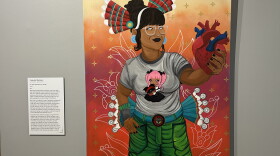 From graduation stoles to a Louis Vuitton drum, “Indigenous Identities! is a new art exhibit opening in Phoenix this week, October 8. The artists present work from a mix of their heritage, personal memory and modern circumstances.
-
 Silas John Edwards was a towering figure among the Apache people in Arizona about a century ago — until he was accused of murdering his wife and put behind bars
-
 Arizona’s history is well documented through its newspapers, and ASU English professor Vanessa Fonseca-Chavez dove deep into the long Spanish-language newspaper history here.
-
 The painter, whose artwork focuses on Arizona landscapes during its stormiest seasons, says her paintings are representative of life.
-
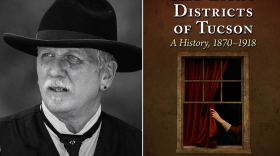 Red light districts operated years after they were outlawed in Tucson. An Arizona historian explored in his recent book what these areas looked like and how women who worked there were treated.


