LAUREN GILGER: Our next guest this morning says Phoenix could be a model for climate change instead of a victim of it. Greg Kats is the founder of Smart Surfaces Coalition, and he told me he got involved in this work because the billions being invested in these problems weren’t working.
GREG KATS: Despite billions in foundation funding, cities over the last 20 years have gone hotter, darker, more unequal, higher electricity bills, more prone to flooding, larger contributions to climate.
LAUREN GILGER: So he came up with the term “smart surfaces” to describe a set of solutions that solve for both extreme heat as well as extreme rain events. They fund cities like Phoenix to help change their trajectory in terms of heat.
And they were a big part of developing Phoenix’s latest shade plan, dubbed the Shade Phoenix Plan. It’s a five-year, $60 million plan to add 27,000 new trees and 550 new shade structures, particularly in low-income parts of the city over the next decade or so.
They say a combination of trees, reflective roofs, and roads, as well as green stormwater infrastructure, could save our city $3 billion over the next several decades and help us get cooler as the rest of the world is heating up. I spoke with Kats more about it and the possibilities for a quickly heating city like ours.
GREG KATS: If you were in Phoenix 100 years ago, you would see a number of these solutions. You would see reflective surfaces, you would see porous surfaces, you’d see shading of windows, you’d see use of thermal mass, and AC came in, we forgot all about it. So in some sense, this is a reversion to common sense.
What’s smart for a city is to really think about all the surfaces of the city, the full range of solutions, and how you deploy those in a very intelligent, intentional way to get the biggest heat reduction, biggest flood risk reduction, and that in turn has a lot of other benefits, health and aesthetics and, you know, well-being, livability.
LAUREN GILGER: What’s a cool roof, for example?
GREG KATS: A cool roof is a sort of widely used term for a reflective roof. So if you fly over an average American city, it absorbs about 80% of incoming sunlight, and it can mean that the building is hotter so you’re using AC, or it radiates that heat back out and heats the city up.
So the average American city is 5 to 8 degrees hotter because it’s covered in dark and impervious surfaces. And interestingly, that heat is not equally distributed. Low-income neighborhoods, minority neighborhoods tend to be 10, 12 degrees hotter. This is one of the great structural inequalities in the country, that if you’re from a poorer family, you’re going to have to raise kids in environments that are 10 to 15 degrees hotter outdoors and less shade, and that’s tough for kids.
LAUREN GILGER: So it’s interesting, you’re talking about the idea on rooftops. I’ve heard about it many times on roads. I always think this when they’re putting down black tar on roads here, why, right? Like, we’ve had lots of talk about and testing of cool pavements in the Valley. It seems to be a solution, but maybe not a perfect one. Porous pavements, another idea here. It sounds like roads are another big sort of opportunity.
GREG KATS: Absolutely. The average road and parking lot is asphalt, and when that’s laid down, that absorbs 90% of the sunlight. So in the afternoons in Phoenix, that’ll get to 160 degrees. You fry an egg at 158. So these are places where if you fall down, you literally get second- and third-degree burns.
We’ve been working with a number of cities to support them in adopting much more reflective surfaces so that the light is bounced back into space, it doesn’t get as hot, and because it doesn’t get as hot, you don’t get the expansion-contraction, so it actually lasts longer. So it’s a cost-savings measure for the city if they’re able to think about it on a life-cycle basis rather than a first-cost basis.
LAUREN GILGER: Interesting. So let’s talk about the Shade Phoenix Plan. This is a five-year, $60 million roadmap to kind of address some of these big-picture issues in terms of heating in the city. I know you were involved in creating this here. Talk first for us, Greg, just about some of the unique challenges facing Phoenix in particular, not just because, you know, we’re the fastest heating city in the country, the hottest big city in the country, and it’s getting hotter, but also because, you know, we don’t have a lot of big trees. We’re in this desert environment.
GREG KATS: Yeah, it’s a particular challenge. The shade plan itself will cool the city in measurable ways. It’s smart because it’s got multiple different solutions and not just one. It’s smart because it’s thinking about where people walk and where people are outdoors and concentrating cooling solutions and shade solutions to provide protection to where people, you know, actually work or walk or play. So all of that is really smart.
Taking a step back, the analysis we’ve done indicates that a moderately aggressive citywide smart surface strategy — and by smart surfaces, we mean reflective, porous and green — can cool the city about 2.7 degrees, but up to 4.6 degrees in low-income neighborhoods.
And one of the most appealing aspects of this strategy is it would cut electricity bills over the next 30 years by about $2.1 billion. So that’s about $6,000 per household, and that’s a significant savings at a time when there’s a lot of concern over rising electricity bills.
LAUREN GILGER: Right. That’s a lot of money and a lot of investment. I mean, I have to ask, like, how much of this is just shade though? Like, should we be thinking about some of these other ideas that you and I just talked about? Like, you know, can you put in enough trees in enough areas or cover enough unshaded bus stops to really cool the city in a significant way?
GREG KATS: The most efficient cooling, a lot of it comes from making surfaces much more reflective. That’s easiest to do on low-sloped roofs, so commercial roofs, there’s a lot of those in Phoenix. Roads and parking lots can be made more reflective, and kind of when you do the sort of technical analysis on it and the cost-benefit analysis, it actually ends up saving the city quite a lot of money.
You absolutely want to do trees, it’s a great strategy. When you think about trees, how much does it cost to water them? Which is pretty expensive. Well, why is it expensive? Well, because on the times when you do have rainfall, that water runs off the city rather than going into the ground. It goes somewhere else.
But if you create more porous surfaces, the water goes into the ground, you have a higher water table, the trees can sustain themselves with less additional feeding. So it’s an example of the sort of systems benefits of having an integrated, full approach.
LAUREN GILGER: So $60 million, five-year plan here. It’s a big investment, but how do you measure success?
GREG KATS: Yeah, it’s a great question. Trees are tough to quantify the benefits for, because so much of it is psychological and a sense of well-being, a sense of safety. The benefits are somewhat complicated, but they certainly include things like lower air-conditioning bills, sort of health benefits.
So if you think about heat, the hotter it is, the more low-level ozone you have, and so more smog, and that has respiratory impacts, especially for children and elderly, and you can quantify that. You’ve got reduced 911 and 311 calls, so the cost to the city of dispatch services for those go down. Phoenix is a tourist town, and, you know, tourism really suffers when it gets too hot.
So in the cities we work with, a dozen big cities, so Atlanta, Dallas, New Orleans, those cities, like Phoenix, can all get on a pathway where they can cool 4, 5 degrees. So rest of the world’s getting hotter, Phoenix is getting cooler, that’s a very powerful story for a city to tell, you know, to its kids and to investors, companies that want to move in, and to tourists.
LAUREN GILGER: How long might something like that take, and how much more investment than this initial $60 million plan?
GREG KATS: Ten years, you could really transform the city. A lot of this does not have cost to the city. So take roofs, for example. If you require that roofs be more reflective, because there are products out there that are more reflective and they don’t cost any more, so going through the City Council or having a mayor do an executive order or doing a code change doesn’t cost anything.
LAUREN GILGER: Yeah. So last thing I want to ask you, Greg, is just how Phoenix compares to other major cities, not just in the U.S., but around the world, in terms of, you know, really addressing the problem of this era, which is heat and climate change?
GREG KATS: Because of the extreme heat, the risks I will say for Phoenix are very large. There was a recent study indicating a heat wave in Phoenix that combines with electricity power failures would result in over 10,000 deaths. So there’s a structural risk in Phoenix which a lot of other cities don’t have.
I would say Phoenix is on a path already that makes it a leader. Imagine being able to say, “The world’s getting hotter, we’re not getting hotter.” Or “The world’s getting hotter, we’re going to not only not get hotter, we’re going to get cooler.”
LAUREN GILGER: OK, leave it there. Greg Kats, CEO of Smart Surfaces Coalition, joining us. Greg, thank you so much for coming on The Show. Appreciate it very much.
GREG KATS: It’s a pleasure. Thank you.
-
 As part of the series called Throwing Shade, The Show brought you a conversation about how residents of that city were deciding to ditch their evaporative coolers in favor of air conditioning. That conversation prompted a response from Mark Dix, who wrote in defense of evaporative cooling.
-
 If you need to get from point A to point B, an app can show you the fastest route, or the shortest route. But, until now, you’ve not really been able to see the shadiest route.
-
 There’s a pretty fundamental question that those of us who live in metro Phoenix have to ask ourselves in order to live here: How much heat can the body handle? Scientists like Rob Meade are working hard to come up with a definitive answer.
-
 As part of the summer series Throwing Shade, The Show wondered — why does metro Phoenix have so many palm trees? And, is it time to plant something else?
-
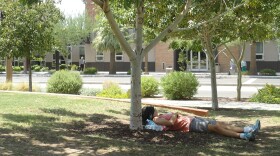 One of the main goals of shade is to get us out of the sun and cool us down. And while that can make us feel better on a hot day, it can also be important for our health.