


The second book in a series of mysteries set in northern Arizona takes on some contemporary themes.
"Mountain Campus Murder" is the latest in the Flagstaff Mysteries series written by Mary Tolan.
She’s a retired journalist and journalism professor, which also plays a role in her fiction books.
Tolan joined The Show to talk about the book.
Full conversation
MARK BRODIE: Mary, without giving too much away, since it is, after all, a mystery — can you give us kind of a thumbnail synopsis of what this book is about?
MARY TOLAN: Well, it’s about an unpopular professor who goes missing in Chapter 1, and right away we know something bad has happened to her, and, of course, many people disliked her. So there are many suspects.
And this professor has wanted her students to write “humankind” instead of “mankind.” This is back in 2010, 2011 when this is set, and that sets off all kinds of responses. It goes viral and — so that’s part of part of this.
But basically, it’s a detective, a journalism person — I guess I could say journalist — and a woman who is in the original “Mars Hill Murder.” They’re trying to help solve this crime and then two crimes that happen on the university campus.
MARK BRODIE: So at the risk of of maybe putting you in a tough spot here, it sounds like you kind of drew on some personal experience. Hopefully not the part where, you know, the professor is disliked, but it sounds like the saying “write what you know” kind of comes into play here.
MARY TOLAN: Yes, it does as far as journalism goes, and also as far as teaching at our campus at Northern Arizona University, but I can’t use that name, so it’s a little bit different in this book.
But, yes, there are some personalities. Some people, if they come to my readings, will be thinking, “Is this me?” And I’ll just say, “It’s fiction.”
MARK BRODIE: Why did you decide to base it in Flagstaff?
MARY TOLAN: Well, I’ve lived here going on 40 years now. I love the mountain town. It just came natural for me when I was first getting into writing fiction and I wrote “Mars Hill Murder” about a murder that happened up at what I call the Flagstaff Observatory, which is Lowell Observatory in reality. And that’s not based on a real murder, by the way. These are all made up from my brain. And I just think Flagstaff is such a great setting, and we got plenty of things set in New York, L.A., maybe down in the Valley, and why not Flagstaff?
MARK BRODIE: So I’m so interested in the fact that you spent so many years as a journalist and a journalism professor basically doing nonfiction. What was the thought process in terms of transitioning to writing things that didn’t actually happen, and I’m curious how that transition was for you.
MARY TOLAN: The transition has been beautiful. You know, with, as you know, as a journalist, you have to get everything right, check all your facts, and it’s not that I haven’t made any errors in my fiction writing, but it’s just so freeing.
And to tell you the truth, I’d been writing fiction for years, but not full time and nothing that got published, and so when I did retire, I had the bones of one of these books, the first book, and I just started working on that, you know, several hours every day, like a job, but I’m my boss. But it’s just been — it’s just been so much fun to write fiction. You should try it. It’s just great.
MARK BRODIE: So I’m curious about some of the themes that come up in this book, and let’s start with the victim of this crime, who was a sort of an unpopular college professor, but, you know, the crime in the story kind of gets to what I suspect is happening at a lot of colleges and universities on campus these days is conversations about, you know, we read about, you know, what is the role of free speech? What — how much DEI should there be or should there not be? How did you try to incorporate some of those themes into a basically a murder mystery story?
MARY TOLAN: Yeah, that’s really insightful. I try to just look at social issues and how can I bring them into a mystery. Now, this was set in 2011, so it wasn’t exactly what we’re going through now with DEI, but it was still important.
You know, the first book, “Mars Hill Murder,” my secondary theme, you will say — besides you might say besides the murder mystery — was about illegal immigration and immigrants, and that’s so big now. And then, as you say, this one, it’s about what’s going on on various campuses, DEI, and also there’s a another theme, which is people that are homeless that are living in their cars.
So I try to, instead of just writing a mystery, which is so fun to do, I want to have some kind of important themes so the book is more than just a whodunit. Does that make sense?
MARK BRODIE: Yeah. I’m curious why that’s so important to you, that it isn’t just a whodunit, that it’s — there’s maybe a little something deeper in there.
MARY TOLAN: Maybe it does go back to me being a journalist. It’s just those issues are just so important to me. And in fact, I’m just starting on book three, I mean, in my head I’m starting it, I haven’t started writing, and I’m trying to think what’s going to be that other theme that is so important to our community or, you know, American communities. So I guess that’s probably why.
MARK BRODIE: So, OK, so you mentioned you’re starting to sort of toss around ideas in your head for a third book, and at the risk of, you know, putting the cart before the horse here, how do you try to come up with what is going to happen next?
MARY TOLAN: Well, I think about my main characters and where they might be. There’s a potential romance in — not a romance novel, don’t worry, although those are giant big sellers now — but, you know, there’s a couple characters, are they going to get together? What’s going to happen to this older woman who’s been in both books? What’s going to happen with the detective? And then what would be a natural something to happen with one of those issues.
And then while I’m taking walks with my dog or while I’m just sitting at home kind of thinking, I just think, what do I want to happen? I just start thinking and playing with things in my head, to tell you the truth.
MARK BRODIE: So Flagstaff is obviously — it’s not a tiny town, but it’s certainly not as big as, you know, the Phoenix area or or Tucson or some of those other cities. You kind of alluded to this, you know, people come to your readings and think or maybe even ask you, “Is this character based on me?”
Like, I’m curious what response you get, you know, when you base a murder mystery in a particular place, especially a place that’s not a huge city. What kind of response do you get from people in that community?
MARY TOLAN: I have gotten the most amazing response. That’s sort of a cliché answer, Mark, but so many people have come up to me and say, “Oh, we love this book.” I’m talking about the first one, the second one people are just learning about.
But, so what I had to do, because my first publisher I’m no longer with, they had a rule that you couldn’t use the names of businesses, just lawsuit stuff. So I took all the businesses that I wrote about and I changed the names. For instance, one of the favorite coffee shops in both books — there’s many coffee shops here, of course — but is Late for the Train, so I called that Caboose Coffee. And all these people were kind of reading it like a puzzle, like, “What’s that? Which place is that?”
And, you know, I couldn’t say NAU. I couldn’t say Lowell Observatory, as I mentioned before. So that’s been really fun, and people like that. Yeah, I’ve had great responses. And, of course, the people that don’t like it probably haven’t wanted to tell me to my face, so maybe there are a lot of people who don’t, but I hope not. But it’s been really fun.
And so Flagstaff, you didn’t quite say it this way, but I do think Flagstaff is almost a character in these books. It’s the setting, of course, but it just becomes something for people who’ve traveled here or, obviously, who live here, they’re fired up about seeing it in a in a mystery, in a novel.
MARK BRODIE: All right. That is Mary Tolan, whose newest book is called “Mountain Campus Murder,” part of the Flagstaff Mystery Series. Mary, so nice to talk to you. Thank you.
MARY TOLAN: Thank you so much, Mark. It was a pleasure.
-
 Silas John Edwards was a towering figure among the Apache people in Arizona about a century ago — until he was accused of murdering his wife and put behind bars
-
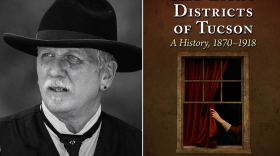 Red light districts operated years after they were outlawed in Tucson. An Arizona historian explored in his recent book what these areas looked like and how women who worked there were treated.
-
 Chelsey Luger and her husband, Thosh Collins, have spent their careers teaching wellness in tribal nations all over North America.
-
 Most of us have heard of aviators like Charles Lindbergh and Amelia Earhart. But most of us have probably not heard of another pilot of that era, named Lester Maitland.
-
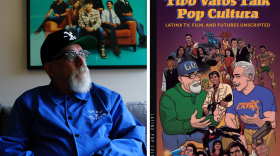 Emmy-winning writer-producer and ASU professor Peter Murrieta is releasing a book this October based on his pop-culture focused podcast with Frederick Luis Aldama.


