


An area of Nogales, Arizona, has made the list of the 2026 Endangered Latinx Landmarks, put out by the group Latinos in Heritage Conservation.
The Morley Avenue District is on this year’s version of the list, and as Alessandra De Zubeldia explains, some building plans near the border could have an impact on the area’s future.
Full conversation
MARK BRODIE: Alessandra, for those of us who haven’t been to Morley Avenue, where is it and what’s it all about?
ALESSANDRA DE ZUBELDIA: So the Morley Avenue Arts District is in Nogales, Arizona. It was once bustling with commerce. There were a lot of stores. It was the place to be in Nogales, Arizona, and it was also the place to be for a lot of people in Nogales, Sonora. So that commerce strip actually existed before the actual border fence was put up, and for a long time, it was a place that attracted people from the other side of the border to come over and shop.
Over the years, it hasn’t been as bustling, there hasn’t been as much investment in the area. Some people believe simply, you know, there isn’t enough encouragement from city officials or county officials to make it, you know, an attractive place to to set up a business, but there’s been many factors over the years. Now, if you go, it’s definitely much quieter than what I just described it being in, you know, decades before. But it still is considered, you know, a very important and special part of Nogales, Arizona, and despite it slowing down in in more recent times, there has definitely been a investment in the arts and in the nonprofits by people that are really trying to bring life back to Morley Avenue.
MARK BRODIE: Well, it sounds like even though maybe it isn’t, as you reference, what it once was, it’s still considered a pretty significant, important and maybe even symbolic part of town. Is that accurate?
ALESSANDRA DE ZUBELDIA: Oh, definitely. Yes. As someone who’s, you know, still rather new to Nogales, being there since February, that is a place that you hear about right away from locals. If there isn’t an event going on, it’s usually on Morley. It looks historic, it looks quaint, it’s colorful. So, yeah, it’s definitely still very relevant to to people.
MARK BRODIE: OK. So what about the the plans to expand the Deconcini Port of Entry? Like, how might that impact what happens on on Morley Avenue and and what else might be able to be there?
ALESSANDRA DE ZUBELDIA: Yeah, so the current footprint for the port expansion, if it moves forward as is, which it’s still in, you know, the early stages, so the footprint could change, but the current one would be removing the first block of Morley. And then for the other ones I mentioned that technically wouldn’t be torn down and taken through eminent domain, there still would be impacts, you know, during this six- to 10-year construction period.
There’s definitely going to be impacts to to the strip that isn’t technically being torn down, whether that be, you know, noise or just anything that comes with construction, you know, not having as many places to park or losing access to the entry of Morley from the side that’s closest to the border, which I think would be shut off during construction. So even those places that wouldn’t be torn down, they definitely would be experiencing the impacts of this, you know, big construction project for about a decade.
MARK BRODIE: What are folks on Morley saying about that? Because I would think there’s sort of like this duality of thinking that, like, the port is so important to their businesses in terms of allowing people to legally cross the border and shop and go to their restaurants and everything. But at the same time, as you reference, that’s a big sort of disruption to what they’re doing to expand the port.
ALESSANDRA DE ZUBELDIA: Yeah, so I would say people have a a nuanced take on it. So very few people I’ve spoken to are completely against to any form of port modernization or expansion. They understand that there has to be updates, that, you know, there’s technologies and such that aren’t currently fitting what CBP needs. But what I continuously hear from people on Morley and throughout Nogales is that they want responsible expansion that really is tailored to what Nogales is and what Nogales needs.
MARK BRODIE: What about the the placement of the Morley Arts District on the Endangered Latinx Landmarks list? Like, what are folks in in that community saying might the impact of that be?
ALESSANDRA DE ZUBELDIA: Yeah, so people were pretty excited about that, even though it doesn’t necessarily mean direct funding or it doesn’t, you know, necessarily mean that it’s going to put a stop to it. And actually, the the person that applied for it, her name is Martha Barrón — she goes by Chiquis Barrón — she made it clear that she, this movement for her is not anti-port in any way, but again is more so growth from a responsible viewpoint that that centers the people of Nogales.
So they’re excited about it as an opportunity mostly to bring attention to the issue because the organization that issued it is called the Latinos in Heritage Conservation, and they’re a national group that has a pretty good network. So mostly what they’re doing here is they’re seeking to bring awareness nationally about a, you know, small, rural community where most people not may not really be aware of of the port expansion or even of what Nogales is, Morley Avenue.
So the goal is for this new designation to bring that awareness. They do so through storytelling, through videos and, you know, putting out that information to to their partners. And then beyond that, they’re also a key player in helping these groups, these community groups, apply for the National Registry of Historic Landmarks, or National Register of Historic Places.
And while that list doesn’t assure that, again, that it will stop the project, it doesn’t cancel out eminent domain, however, it does add more guardrails and more hoops that the federal government would have to to work through, and potentially more protections for people that, you know, could be losing their businesses in the area.
MARK BRODIE: Well, it sounds like they they see it as sort of maybe a way to protect the area and maybe forcing a a rewrite of the the expanded port, right? Like to get it maybe expanded, built in a different location or a different way to protect this area. Is that is that a fair assessment?
ALESSANDRA DE ZUBELDIA: Yes, my my understanding of their goals with this is definitely beyond bringing awareness to the area and its value, it is to have more of a documented say of what Morley Avenue is, its value, and then that to potentially influence, you know, the next footprint.
MARK BRODIE: All right. That is Alessandra De Zubeldia with the Nogales International. Alessandra, thanks so much.
ALESSANDRA DE ZUBELDIA: Thank you.
-
 Father Panik may not be a widely recognized name in the music industry, but decades later, the band's Matt Goldman is sharing their unique sound and story at the Tucson Film Festival.
-
 Desert Design kicks off this week with a variety of speaking events, exhibits, and gatherings. This year, its theme is "Collected in Dialog."
-
 Amanda Kelly is an artist based in New York City. She has a new exhibition at The Mini Time Machine Museum of Miniatures in Tucson called “The Need to Keep.” In it, she shows scenes that have a lot of stuff in them, from bathrooms to kitchens to end tables, all in miniature form.
-
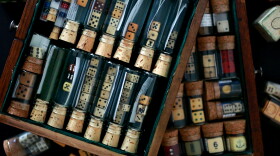 For the next several days, you can tour a huge RV trailer packed with drawers of dice, erasers and just about anything you can imagine that’s both tiny and collectible. The Show’s Amber Victoria Singer got a virtual preview from its founder and curator.
-
 New research shows the ancient site is much older than previously thought. In fact, it’s now confirmed to be the oldest known scientifically dated geoglyph in the Americas, 2,000 years older than the first Pyramids built in Egypt.


