


A little girl named Elsa plays outside her house in the desert on the Tohono O’odham reservation and comes across another little girl just her age. She’s a migrant who’s been separated from her father in the desert, and she’s all alone.
But none of that matters to Elsa, and she can’t understand anything her new friend Eda says. She takes her along with her that day — eating tortillas, playing inside a gas station/casino — and to her grandmother’s house for dinner, where the grown-up world gets involved.
It’s all part of the short film “Burros.” It was shot entirely on the Tohono O’odham reservation with a cast entirely from the community. The film made a real splash on the festival circuit: Premiering at Tribeca, playing 76 festivals and winning 20 awards. It will be released digitally this week for everyone to see.
Jefferson Stein wrote and directed the film, and he told The Show he wrote it after he got interested in the cross-border reservation.
Full conversation
JEFFERSON STEIN: I think it was like just a way for me to kind of process how I was feeling about everything with no real inclination that it would ever get made. I’m not from there. I’m not not Native. I’m a filmmaker, and I kind of shelved it.
And then I met a producer Liz Cardenas in Dallas and was telling her about the project. She is Latina. Her father was born in Mexico City, and she was really moved by it and said, “We have to make this film. We have to make it.” I was like, “How are we going to do that?”
So that kind of began the journey of driving to the Nation. We tried meeting people and started forming connections.
LAUREN GILGER: So you go to Sells. You’re on the reservation down there trying to meet people, tell them about this idea you have. How did you get people on board? Like were the tribal members there relatively skeptical of you at first?
JEFFERSON STEIN: Yeah, so I actually did have a friend who is Tohono O’odham, and she was kind of like saying, you know, “Expect skepticism, expect these things.” And that’s kind of how I went going in.
And we ended up getting onto the community council’s agenda. So it was a Saturday morning, 8 a.m. We drove from Los Angeles, Liz and I, and we presented the film to them and just said like, “This is something that, what do you guys think? Is this something you guys would want to do, be interested in?”
And I think we were scheduled for 20 minutes on the agenda, and we ended up having this like, this hour-and-a-half-long conversation, very emotional, stories were shared, and it was extremely moving. And they ended up passing a motion to approve the film in that meeting.
LAUREN GILGER: Well, I mean, you cast it entirely from the reservation, right? Like everyone there is a member of the tribe, everyone in the film is like a real person, which is kind of amazing, too. How did you decide how to do that? Why cast it from that place? Why not bring in actors who can play the part?
JEFFERSON STEIN: Yeah, that’s a really good question. It’s something that I thought about really early on. Is it going to be this thing of bringing in Native actors from Los Angeles? And very quickly in even in the writing process, I said if this ever happens, it needs to be non-actors from the nation if at all possible, right?
People playing versions of themselves and community members because, again, the film is about connection and language, and O’odham is spoken in the film, as well as Spanish and English. It’s this sort of story where Elsa speaks O’odham and English, and Ena speaks only Spanish. And Elsa’s grandmother is the trilingual bridge who speaks all three. Virginia Patricio is O’odham, but born in Mexico, and so she and a lot of women in that generation spoke all three languages.
And very few people on the nation, to my knowledge, speak all three today. And together, we really wanted to show this like multi-generational progression of language, and really the preservation of the O’odham language as well because it’s a language that’s being spoken — I think there’s 6,000 something like that, 6,000 members that live on the nation. It’s a language that they’re really trying to preserve.
LAUREN GILGER: Yeah. There are a couple of moments I think are really amazing. I want to ask you about how you came up with them, what this was like. I mean, specifically, the two girls are playing with the stick, right, which is sort of a sport they play on the reservation down there. And one of them, Elsa, picks up the empty can, which was left by migrants in the desert, and they start playing with it.
[CLIP OF CHILDREN PLAYING FROM “BURROS” PLAYS]
But that’s like clearly a sign of people just like her friend there who were going through and maybe was left by her father or something like that, right?
JEFFERSON STEIN: Yes. Yeah, it’s quite stark. I wanted to place the girls in the foreground. I wanted it to be a story about really being lonely and finding a friend is really what it’s about at its core, and to show that side from a child’s perspective, untainted really by a lifetime of news and media and all of just biases and all these things we sort of develop as we age, and to kind of show what it could be without all of that.
[CLIP OF CHILDREN PLAYING FROM “BURROS” CONTINUES]
And so putting the literal news stories in the background of the film, seeing the helicopter flying in the background of Mondo’s, was a way to kind of place the adult world on the periphery and put us sort of inside of the viewpoint of two children’s perspective.
LAUREN GILGER: Right. That’s interesting now that you say that, I’m remembering: It’s shot like at their eye level, right? They look up at the grown-ups, right?
JEFFERSON STEIN: Yeah. And it’s amazing, it’s this thing in film, too, is like a lot of times actors are much shorter than you expect in real life, you know? And it really is a testament to point of view, you know, and perspective and where you place the camera.
I saw when I was much younger a film by Benh Zeitlin called “Beasts of the Southern Wild.” And I remember him talking about placing the camera always at her eye level, and that was like one of the first things I decided. And I really stuck with that.
When I had many conversations with Cole Graham, our cinematographer, it’s like we will always be at their level. We’re never looking down at them, we’re never really looking up at them, we’re always at the eye level. And they’re small, they’re 5 or 6 years old, you know? And they look giant, I guess, on screen, especially when you see it in the cinema.
LAUREN GILGER: Right. So let me ask you just lastly about about getting this film out there, right? Like it’s about to have kind of a digital release, so more folks can watch it, but it’s gone through the festival circuit, won many awards, garnered a lot of celebrity attention. What are your goals here for this and getting it into the world?
JEFFERSON STEIN: Yeah, I want the film to be seen. I think when anyone makes something, whether it’s like any type of art, the goal is to get people to look at it.
And, yeah, I think like this has just been a very long journey for all of us from this whole thing essentially for me starting in 2015 to festival premieres. It was invited to the United Nations Permanent Forum on Indigenous Issues last year, so I went and talked at NYU about the film.
It’s just had this life that I never expected. And I know that really none of us really did, you know? You make a short film and then get some festivals, and etc. So I’m just blown away, truly. I think all of us are, at the attention and and just that people care, truly, you know?
You get your friends together and you meet some amazing people and you make something you hope a couple of people see it, and I think we’re all just more than more than happy of what’s happened with the film and and hope now that it’s finally in its online release, anyone will be able to see it online forever.
LAUREN GILGER: Yeah, anyone will be able to see it. All right. That is Jefferson Stein, the writer, director, producer of “Burros,” the short film we’re discussing. Jeff, thank you so much for coming on The Show. Congrats on the film, it’s great.
JEFFERSON STEIN: Thank you so much, I appreciate it.
-
 For the next several days, you can tour a huge RV trailer packed with drawers of dice, erasers and just about anything you can imagine that’s both tiny and collectible. The Show’s Amber Victoria Singer got a virtual preview from its founder and curator.
-
 New research shows the ancient site is much older than previously thought. In fact, it’s now confirmed to be the oldest known scientifically dated geoglyph in the Americas, 2,000 years older than the first Pyramids built in Egypt.
-
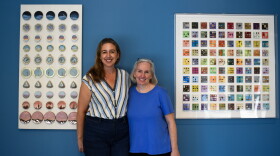 For years, mixed-media/ceramic artist Heidi Dauphin and painter/muralist Laura Spalding Best were casual acquaintances and fans of each other’s work. In 2024, they were paired up for an installation for a gala benefiting the nonprofit Artlink. When they got together to brainstorm for their project, they made a list of things they had in common — including multiples, found objects, collections and numbers.
-
 How do we go about turning casual friends into closer ones? It can be difficult to do, especially as an adult.
-
 Double Ten is the Taiwanese national holiday, and the event hosted by the city of Phoenix has been called the largest Double Ten celebration on the continent.


