


Peter Murrietta has had a long and successful career in film and television. He is a multiple Emmy winner, known for series like “Mr. Iglesias,” “Lopez,” “Greetings from Tucson” and Disney’s “Wizards of Waverly Place.” Today, Murrieta is deputy director of Arizona State University’s Sidney Poitier New American Film School.
Now Murrietta is out with a new book alongside leading Latinx media studies scholar Frederick Luis Aldama called “Two Vatos Talk Pop Cultura.” It came out of their podcast, Mighty Peter and Professor Latinx.
Full conversation
PETER MURRIETA: I realized when you pick up these academic books, a lot of times there are assumptions that media analysts make about how we do what we do and how it really works inside. And so we started doing this podcast together, and then we started talking about, like, should we write a book?
And my favorite thing about the book is, I don’t remember what the other title was, but when we sent it to the publisher and they got a look at us, they were like, “That’s not the title of this book. The title of this book is ‘Two Vatos Talk.’” They were like, “That’s what the title is.”
LAUREN GILGER: OK, so let’s talk about it a little bit, right? Like, you’re looking at 70 years of history here, which is a heck of a lot to squeeze into a book. But let's talk about a little bit of the — some of the highlights, maybe, along those many decades. When we talk about some of the oldest examples that you look at in the book, what are we thinking of?
PETER MURRIETA: I’d love to talk about “I Love Lucy.”
DESI ARNAZ (AS RICKY RICARDO): Lucy, what are you doing?
LUCILLE BALL (AS LUCY RICARDO): Honey, remember what you said to me the first time you met me?
DESI ARNAZ (AS RICKY RICARDO): I sure do. I said you were a cute little chicken.
LUCILLE BALL (AS LUCY RICARDO): Well, I got something to tell you about this cute little chicken. She has crow’s feet!
PETER MURRIETA: Desi Arnaz had so much to do with the beginnings of television and how to rerun a show, how to syndicate a show, how to shoot a show live with a studio audience. Like, he had so much to do with the creation of that business model. And he and Lucy made so much money they ended up buying a studio.
Like, that to me is an example of sort of behind the scenes, but in front of the camera as a crazy husband. But behind the scenes, the two of them just were a force to be reckoned with.
LAUREN GILGER: Right, right. I mean, and such a huge cultural impact in so many ways. I have to ask you about Zorro if we’re talking about kind of older film and TV here, right? Because you’re actually related to him, or at least to the real guy that character was based on, is that right? That’s crazy!
PETER MURRIETA: Yes! That is absolutely correct. That is absolutely correct. There’s a book that traces the history of the character of Zorro and traces it all the way back to my ancestor, Joaquin Murrieta, who was this person who was in the California Gold Rush and lived a very colorful life. He fought for what he thought was fair, and he ended up being an influence on several people, but among them, the creator of Zorro.
THE ZORRO THEME SONG: Out of the night, when the full moon is bright, comes a horseman known as Zorro.
PETER MURRIETA: Who made him a little bit more Spanish than Mexican and a little bit more wealthy than — I certainly would love to have had that wealth and have it handed down to me. But no, it’s really amazing. And to find that out is just incredible. And I’ve actually co-written a novel about that, but that’s not what we’re here to talk about.
LAUREN GILGER: I mean, obviously, you are very well known for “Wizards of Waverly Place.” You were a writer, producer, showrunner on this for a long time. This launched Selena Gomez’s career. But it was about putting a Latina on the Disney Channel, right, when that really hadn’t happened before. What was the conversation like around that back in the day?
PETER MURRIETA: Oh, wow. That was, well, you know, I got a videotape a couple years before that. Do you want to develop for Disney Channel? And they had this young girl on it, and I chose not to at that time. And then a couple years later, this opportunity came up, and it was a script called “The O’Malleys.” And it was about an Irish family, and I said, “I’ll do it, but I want to do it if I can make it Latina.”
SELENA GOMEZ (AS ALEX RUSSO): ... After you see how good we’re doing, maybe you can graduate everyone and I can get back in the wizard competition.
DAVID HENRIE (AS JUSTIN RUSSO): Yeah!
SELENA GOMEZ (AS ALEX RUSSO): But if you don’t think we’re doing very good, we’ll just settle with putting me back in the competition.
DAVID HENRIE (AS JUSTIN RUSSO): Oh, yeah.
PETER MURRIETA: And they were like, “Well, who would that be?” And I was like, “What about that that girl you showed me video on a couple years back? Is she still around? Is she still available?” And it was a fight to get them to recognize that, not because they didn’t recognize her talent, but they had already promised her to another show that was shooting a pilot. And I was like, “Well, you greenlit ours first, so let’s go.” So we brought her in and it was magic, literally.
LAUREN GILGER: That’s amazing. Right. But I mean, like, it was supposed to be an Irish family. Was there pushback to making it a Latina script?
PETER MURRIETA: I think there’s little bits and pieces inside it. You know, I remember going to a run-through where there was a poster on the wall, and someone was like, “What is that?” And I was like, “Oh, it’s a travel poster for Mexico.” And they’re like, “Could it be more nondescript Latino?” And I was like, “Where’s the country of Latino? I don’t know where that is, but this is a Mexican family, and they can be Mexican, and that’s cool.”
I think it’s really about educating folks about that we’re not a monolith and that we are many people. You know, when I was a child in the west part of the country watching “Chico and the Man” on TV, we thought because he was portrayed as such, that that was a Mexican guy in East L.A. who lived and worked as a mechanic.
JACK ALBERTSON (AS ED BROWN): Chico! Chico!
FREDDIE PRINZE (AS CHICO RODRIGUEZ): Buenos días.
JACK ALBERTSON (AS ED BROWN): What's that?
FREDDIE PRINZE (AS CHICO RODRIGUEZ): The bathtub.
JACK ALBERTSON (AS ED BROWN): What's it doing here?
FREDDIE PRINZE (AS CHICO RODRIGUEZ): Waiting to be installed.
JACK ALBERTSON (AS ED BROWN): Right next to the pump? Listen, kid, washing their windshields is as far as I go.
FREDDIE PRINZE (AS CHICO RODRIGUEZ): It's for me. I'm going to connect it up in the closet in the bathroom so I can take a bath.
JACK ALBERTSON (AS ED BROWN): What's the matter with the bathroom upstairs?
FREDDIE PRINZE (AS CHICO RODRIGUEZ): Well, it's inconvenient, especially when I'm getting dressed for a date.
JACK ALBERTSON (AS ED BROWN): You don't get dressed, you get upholstered.
PETER MURRIETA: And didn’t know until I met friends from New York that, oh no, that guy Freddie Prinze, he’s Puerto Rican. And those are the kinds of things where it’s just about educating people, just educating people, and that’s what this book is trying to do.
LAUREN GILGER: Yeah, absolutely. You have a whole chapter on Latinx and sci-fi. I have to ask about that. Give us an example or two there.
PETER MURRIETA: Oh, my god, my favorite anecdote about that. Unfortunately, it didn’t didn’t see the light of day yet, but I wrote a movie for DreamWorks, and it was based on a book, and it was called “Lowriders in Space.” And Salma Hayek was one of the producers along with me, and she told me a story that she was up for some big part in some sci-fi franchise — she wouldn’t say what — but somebody told her, “Well, there’s no there’s no Mexicans in space.” And so she was like, “All right, we’re going to put Mexicans in space, man.”
LAUREN GILGER: “Lowriders in Space” is amazing.
PETER MURRIETA: Yeah, yeah, yeah. But I think I think the “Star Trek” future that we were promised of equity and non-conflict is still out there for us, still out there for us.
LAUREN GILGER: Well, so let me ask you about that, because part of the premise, right, of this book too is that representation of Latinos, Latinx people in the culture and pop culture maybe has stagnated. Talk a little bit about where you think that stagnation has happened, you know, what that looks like, yeah.
PETER MURRIETA: Sure. 2003 and ’04 is like the year it almost happened. We had “Resurrection Blvd.” on Showtime. George Lopez’s show had just debuted. ”Greetings from Tucson,” my first show, had just debuted. “Ugly Betty” was coming. There were these opportunities, and it felt like it was inevitable that we would land with our proper and due representation.
I think that you can watch and follow the economics as we’ve had contraction due to the streaming wars and less shows being made and less people advancing. All that hard work of getting people mentored and trained to become showrunners and writers and actors who can carry a whole show, we’re kind of still here, kind of in a holding pattern, kind of waiting for opportunity, and we just have to keep celebrating the opportunity when it comes.
LAUREN GILGER: Yeah. Do you think those opportunities continue to come? I mean, are you concerned that the stagnation will continue in the future?
PETER MURRIETA: Yeah, I’m always concerned. Of the two of us, I’m always concerned.
LAUREN GILGER: You're the one.
PETER MURRIETA: Yeah, yeah. You know, when I started in this business many, many years ago, I remember thinking if somebody had told me when I was 20, like, “Oh, you’re going to be signing up to be in a freelance business for 30 years,” I would have gone, “Oh, no, no, no, no, no, no, no.”
But that’s what it is, right? It’s a freelance business. And every time you work, you think to yourself, no matter how young or old you are, you’re like, “That’s it. That’s the last job I’ll ever have. Oh boy, I didn’t save enough.”
But I think I am concerned because the avenues are getting smaller. But where I’m not concerned is the technology is making it easier and easier and easier to get your story out there. I’m working with someone right now — I can’t say who it is — we’re working on a show idea, and we are entertaining very, very deliberately like the idea of do we go pitch this show to all the places or do we just make four of them and then have it and put it out on your social media, person who has a big social media? And then it’s a different conversation. So I’m very excited about that future.
LAUREN GILGER: That’s very interesting. Yeah, the game has changed, for sure. But I mean, so you’re teaching now, right? Like you’re teaching this next generation of students.
PETER MURRIETA: I’m teaching, I’m writing, yes.
LAUREN GILGER: Right. So so that’s got to be hopeful to you as well. Like, are there kids who come up through your classes who you’re like, these guys, these girls, these gals are going to make the next history of this? Like, they’re going to throw the gauntlet down and do this entirely differently and and change the industry again.
PETER MURRIETA: A hundred percent. I mean, it gets me almost emotional, I would say — my family would say he’s never emotional — but it almost gets me emotional about the the hope for the future is based on these people. When when people in my professional life say to me, “What are you doing teaching?” I’m like, “I am building a wave of people that never I could do a show at a time with 180 people. I’m educating hundreds and hundreds of people every semester, and it’s going to become a wave that you can’t turn back.”
LAUREN GILGER: OK. Peter Murrieta, deputy director of the ASU Sidney Poitier New American Film School and professor of practice there as well, also obviously a longtime TV producer and writer. Thank you very much.
PETER MURRIETA: Awesome. Bye.
LAUREN GILGER: The new book, “Two Vatos Talk Pop Cultura,” is out next month from the University of Arizona Press.
-
 Arizona voters will decide the fate of two propositions aimed at restricting taxes. But where will funding for city services and state roads come from without them?
-
 he event, called PhiusCon, is being put on by a nonprofit called Phius, which certifies professionals in its passive building standard. This is the first time in the conference’s more than two-decade history that it’s taking place in the Southwest.
-
 Amanda Kelly is an artist based in New York City. She has a new exhibition at The Mini Time Machine Museum of Miniatures in Tucson called “The Need to Keep.” In it, she shows scenes that have a lot of stuff in them, from bathrooms to kitchens to end tables, all in miniature form.
-
 Democratic state Sen. Brian Fernandez was appointed to fill his mother’s seat in the state Legislature in 2021. And since, he’s faced two allegations of conflict of interest in his work as a lawmaker.
-
 The Forest Service is closing off a long stretch of the border to protesters and the public alike, raising issues of transparency as they claim its unrelated to confrontations.


-
 For the next several days, you can tour a huge RV trailer packed with drawers of dice, erasers and just about anything you can imagine that’s both tiny and collectible. The Show’s Amber Victoria Singer got a virtual preview from its founder and curator.
-
 New research shows the ancient site is much older than previously thought. In fact, it’s now confirmed to be the oldest known scientifically dated geoglyph in the Americas, 2,000 years older than the first Pyramids built in Egypt.
-
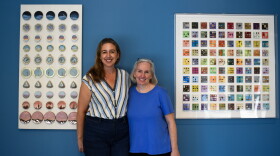 For years, mixed-media/ceramic artist Heidi Dauphin and painter/muralist Laura Spalding Best were casual acquaintances and fans of each other’s work. In 2024, they were paired up for an installation for a gala benefiting the nonprofit Artlink. When they got together to brainstorm for their project, they made a list of things they had in common — including multiples, found objects, collections and numbers.
-
 How do we go about turning casual friends into closer ones? It can be difficult to do, especially as an adult.
-
 Double Ten is the Taiwanese national holiday, and the event hosted by the city of Phoenix has been called the largest Double Ten celebration on the continent.


