


Public education advocates in Arizona have been railing against inadequate state funding for a decade.
There are numerous statistics that say Arizona consistently ranks among the lowest for per-student funding — Currently, Arizona is 49th in the nation, according to the National Education Association.
When it comes to teachers salary, the picture is a little better. The NEA ranked Arizona 29th in the country in teacher pay in 2024, with an average teacher making about $62,000 a year.
But, as Republican lawmakers point out, districts spend just 52% of their budgets on instructional expenses like teacher pay. And now, they’re hoping voters will force schools to up that number to 60% — or face the consequences. It’s the subject of Proposition 320, and KJZZ’s Wayne Schutsky joined The Show to talk about it.
Full conversation
LAUREN GILGER: Good morning, Wayne.
WAYNE SCHUTSKY: Good morning.
LAUREN GILGER: OK. So Prop. 320 was put on the ballot by conservative lawmakers like state Sen. Jake Hoffman, Freedom Caucus, who argues that putting just over half of state funding toward the classroom is just not enough. It doesn’t seem like a lot, right, Wayne, if you kind of put it that way? Where do districts spend their money?
WAYNE SCHUTSKY: Yeah, it’s been on the downward trend for years. I believe we got as high as 59% at one point; now we’re down closer to 52%. They want this 60% threshold that they say would be the bare minimum needed for things — we’re talking about direct classroom expenses, like you said. So teacher pay, substitutes, athletics — things that are directly what the students are doing at school. I would say that overall classroom spending is like 68%; that includes some other support services that don't fall into that instructional bucket.
LAUREN GILGER: Right. So that’s part of this debate, which we’ll get to. But tell us about the argument that the Republicans at the state Legislature who put this on the ballot are making. Why 60%?
WAYNE SCHUTSKY: Because they say instructional expenses ... go to the kind of the heart of what should be happening in a school. So, you know, students are going to school for what? Instruction. And so these are things like textbooks, teacher pay — these are the direct expenses. And that if we’re falling below that 60% threshold, then that basically means money’s being diverted to too many non-education items that might be needed to help a school, but aren’t the core mission of a school.
LAUREN GILGER: Yeah. So there was a debate about this proposition on Arizona PBS. Let’s hear what that side had to say. They were represented by Matt Beienburg with the Goldwater Institute.
MATT BEIENBURG: You have school districts like Tucson Unified spends $200 more per kid, Roosevelt $500 more per kid on administration than some of their peers. So there’s a lot of opportunity to cut the fat and say, “Let’s reorient this back toward student instruction.”
LAUREN GILGER: So we heard there he mentioned administrators. Is this kind of all about what administrators make?
WAYNE SCHUTSKY: I wouldn’t say all about. Administration makes up a little over 10% on average in the state of these school budgets. So it’s a good chunk, but it’s not the biggest chunk. But I will say that, especially in school districts I’ve covered over the years, what administrators make has always been a point of contention. You know, superintendents make hundreds of thousands of dollars a year. And part of that is it’s just a job where there’s a smaller pool of people you’re pulling from. It’s a contentious job. You deal with a lot of public backlash whenever you do something they don’t like. And so they’re having to pay these superintendents especially more and more just to entice them to take these jobs.
LAUREN GILGER: Yeah, it’s hard to get people to take them. This comes, Wayne, ... a bigger chunk of the state budget is going toward state funding, even though we mentioned we’re still 49th in the nation when it comes to per-student spending. The chunk of the budget that goes toward funding public schools is a lot higher than it used to be.
WAYNE SCHUTSKY: Yeah, I mean, it’s almost half of the entire general fund at this point. I think we’re at like 46% the last graphic I saw put out by the Legislature. So, yeah, we spend a lot of money on this. And so this debate is really about how we’re divvying up that money. And, you know, we don’t have enough time today to get into all of the disagreements about how we’re divvying it up. ... But this is just talking about that chunk going to public schools and, again, where should that money be going.
LAUREN GILGER: OK. So let’s talk about what the other side of this debate has to say here. Public school advocates are very opposed to this idea of kind of forcing districts’ hands when it comes to how they spend their money and where their budget goes. Tell us why.
WAYNE SCHUTSKY: Yeah, this goes back to what I mentioned before. Instructional spending is at around 52%, but overall classroom spending closer to 70%. And so they’re saying that this instructional spending definition is just too restrictive and that it’s going to force them to cut things that a lot of people might assume is part of instructional spending. We’re talking about speech pathologists, therapists, nurses, school security, things that —
LAUREN GILGER: Counselors.
WAYNE SCHUTSKY: — counselors. Some of the infrastructure that allows for teaching to happen, air conditioning, you know. And they’re saying, you know, these expenses aren’t going to go away. So we’re either going to have to cut something, if we’re forced to bump up in one area up to 60%, then all these other expenses that don’t fall in that bucket are going to see cuts.
LAUREN GILGER: Yeah. Let’s hear from the other side on that Arizona PBS debate. This is Jimmy Arwood with the Arizona School Boards Association.
JIMMY ARWOOD: And the fact is schools spend close to $7 in $10 on classroom spending. And classroom spending is different. Classroom spending is special education educators. It’s nurses. It’s instructional supports to ensure that teachers are getting the resources that they need.
LAUREN GILGER: So, Wayne, there would be a financial penalty for districts that don’t kind of hit this 60% threshold if this passes?
WAYNE SCHUTSKY: There is a financial penalty included, but ... before they get there, there is a kind of a pathway where they have to increase their spending by a certain percentage each year until they reach that 60%. Now, if they don’t, then, yes, there’s a potential that they could lose what’s called classroom site funding, which is this tranche of state funding that goes to schools.
There’s also an opportunity for the state superintendent to give them waivers ... if they don’t meet it by that certain timeframe. So there is a penalty ultimately, but there are a lot of pathways to, I guess, mitigate that before they get there. But, again, critics say that even getting there at all is going to cause pain. So even if schools are able to accomplish it, it’s going to cause cuts somewhere else.
LAUREN GILGER: Yeah. And we should say this doesn’t apply to every district school; it’s to the big ones in the biggest counties, right?
WAYNE SCHUTSKY: That’s right, yeah. I believe it would apply to all the schools in Maricopa and Pima counties, and then in other counties, it would be any [school district] with more than 7,500 students.
LAUREN GILGER: OK. One of the ways that districts in our state have often raised money to sort of supplement that state spending in Arizona is with bonds and overrides, Wayne, which are also on your ballot, right? And those have also raised questions recently about how districts spend public money. I’m thinking of a proposed, I think, $80 million domed football stadium in one district, right?
WAYNE SCHUTSKY: Yeah. And when I talk to people, a lot of people kind of get confused about what each of these things are. They kind of get lumped together as school funding on your ballot. But, yes, Arizona has always relied on bonds and overrides to allow school districts to go out and seek extra money that isn’t being provided by the state.
Now, the bonds typically go to things like school buildings, like or an $80 million domed stadium, which was voted down. But and and kind of those hard like, you know, infrastructure buildings, that kind of thing. And then the overrides are actually allowing school districts to spend a higher percentage on their maintenance and operations, which is more of that stuff on the school site, the daily expenses. It can go towards teacher pay, it can go towards after-school programs, full-day kindergarten, all of those types of things.
So they’re kind of very two separate things, but they both fall in that realm of helping bump up school pay. It just shows how complicated school funding is in Arizona and difficult for the average person to understand, because you’ve got this state money coming in and then all these extra potential funding sources depending on the district, depending on where you live and if voters approve it.
LAUREN GILGER: Yeah. Well, we’ll see what voters do in November. KJZZ’s Wayne Schutsky with our Politics Desk joining us. Wayne, thanks as always.
WAYNE SCHUTSKY: Thank you.
EDITOR'S NOTE: This interview has been updated to correct that Proposition 320 penalties would apply to districts with more than 7,500 students.
-
 Kerr Kriisa, an Estonian national, became a fan favorite while at UA from 2020 through the spring of 2023.
-
 Long before the National Science Foundation ever looked up to the starry sky searching for answers about the mysterious cosmos and universe, O’odhams like Jacelle Ramon-Sauberan stood atop I’oligam Du’ag — or Manzanita Shrub Mountain.
-
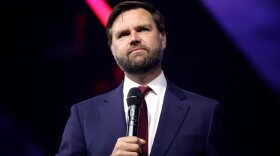 Vice President JD Vance says ASU — along with nine other universities across the country — are using the J-1 visa program to employ foreign workers as researchers, while paying them less than Americans in the same job.
-
 The University of Arizona suspended all fraternity activities this week in order to address a backlog of misconduct reports.
-
 The Tolleson Elementary School District is one of several districts implementing new strategies to fight chronic absences. The superintendent says they saw a 12-percentage-point decrease in chronic absenteeism from the 2024–2025 school year to the 2025–2026 school year.


