


The U.S. Immigration and Customs Enforcement (ICE) has signed a series of contracts worth up to $7.3 billion to expand detention in five states. In Arizona, that adds up to a $1.2 billion contract to expand detention facilities in Florence.
The move comes after ICE’s nationwide plan to buy up commercial warehouses and turn them into immigration detention facilities failed. One of those warehouses was located in Surprise, where residents banded together to protest the move. Since, ICE has abandoned the plan and moved to sell some of the warehouses.
Full conversation
LAUREN GILGER: Good morning, Michael.
MICHAEL WRISTON: Hey, good morning, Lauren. Thanks for having me back.
LAUREN GILGER: Thanks for coming on The Show. So ICE abandoned its plan essentially to house immigration detainees in warehouses like this one we saw in Surprise. You’re reporting that ICE is now moving toward basically building facilities on land that it already owns. Is that what we’re seeing happen here?
MICHAEL WRISTON: Yeah, that’s an accurate assessment. Essentially with the warehouse plan, you know, hesitating to say falling apart, but essentially running into obstacles, ICE is looking for options to capitalize on land that they already own, maybe the site of existing prisons or ICE field offices, to begin building detention capacity that would be under the purview of the federal government, owned and operated by the federal government. And so that’s what this contract is demonstrating.
LAUREN GILGER: OK, so one of those contracts here in Arizona in Florence, $1.2 billion, it was awarded. What do we know about what those plans might look like?
MICHAEL WRISTON: Sure. So earlier this summer, the government sent out a solicitation to contractors asking if there would be anybody available to begin building — what it was asking for were secure housing units — what it described in its contract documents as single-story jail cells that could hold, you know, one to two detainees per room with cameras pointing inward, some recreation yards for people to go outside, clinics, administrative offices to support it, things of that nature.
But essentially what they were looking to do is build a number of these secure housing units on existing federal detention space. So lots of that in Florence, obviously. And so what that would do is, again, this would be a federally owned, federally operated facility that wouldn’t run into many of the issues that the warehouses did earlier this year.
LAUREN GILGER: OK, so this contract in Arizona in Florence was awarded to GardaWorld, this company — the same company, in fact, that was supposed to retrofit the Surprise warehouse. What do we know about that company?
MICHAEL WRISTON: Yeah, GardaWorld is the U.S. branch of a Montreal, Canada-based company that actually has its leadership in the UK. But they do a number of services across the United States, from armed guards, you know, bank ATM armored truck-type work, and they also do a lot of guard services for the federal government.
The contract that they got for the facility, the warehouse in Surprise, was their first federal contract for ICE. And since then, they’ve been awarded several hundred million dollars to continue doing work for ICE. But this is the big one. This is $1.2 billion that they would get over the next couple of years to build detention facilities from the ground up.
LAUREN GILGER: OK, so that’s just here in Arizona. But as we mentioned at the top, this is part of a much bigger plan that adds up to more than $7 billion across the country in other states. Where else are these contracts being awarded?
LAUREN GILGER: OK. What’s the timeline on this? Has any of this been built yet?
MICHAEL WRISTON: No, but the timeline that ICE outlined is very specific. They want these facilities built within one year of the money being allocated and what they call a task order being sent out. A task order essentially being an order for the construction itself. So with the contracts awarded, we could see these facilities begin construction as soon as, you know, next week, and then they would have to be done within the next year.
LAUREN GILGER: Wow, OK. So, Michael, what does all of this say about the need for detention capacity from DHS? Like, is ICE running out of space? We know this is all happening as there is this massive deportation effort from the Trump administration.
MICHAEL WRISTON: And as of this summer, you’re absolutely right, up to 60,000 people were arrested in a single month. The expectation is that about 100,000 people were arrested over the course of the summer. And ICE only has an estimated 65,000 detention beds at any given time. So if the numbers hold, they are short on detention space, and their need to increase has not gone away since the warehouse initiative earlier this year. So this is very much in line with expanding their detention capacity to hold as many people as they can at a time.
LAUREN GILGER: We are two years into the Trump administration, but there could very likely be a change of guard in the future as the next election approaches in 2028. If that were to happen, if a Democratic administration took control and didn’t want to do this kind of stuff, what could happen to all of these construction projects, all of this public money that’s being spent?
MICHAEL WRISTON: Admittedly, very little. The way that the "One Big Beautiful Bill Act" — the appropriation bill and the reconciliation bill that was passed last summer — is structured is that this money is good until January of 2029, so effectively when a new administration would be coming into office.
By that time, the expectation is that all of the money would be spent and any work ordered would be completed. And the timelines that ICE have set, finishing construction within a year, fit that. So if they award a contract next week or next month, and ICE has it completed by this time next year, and that facility exists on federal land, there’s no walking it back. There’s no unbuilding the building unless the next administration makes it a priority to demolish the buildings that it just spent billions constructing.
As for contracted detention space, that’s probably where a new administration would have the most flexibility. If it’s contracting private detention space from a GEO Group or a CoreCivic, some of ICE’s largest ... for-profit prison providers, they could cancel those contracts and they would have more control over that.
LAUREN GILGER: OK. We’ll leave it there for now. Michael Wriston with Project Salt Box joining us. Michael, thanks so much for coming on, appreciate it.
MICHAEL WRISTON: Thanks again.
-
 Thousands of refugees in the U.S. lost health coverage on Oct. 1 as new Medicaid eligibility rules took effect. In Arizona, unlike in most states, even children and pregnant women are being dropped.
-
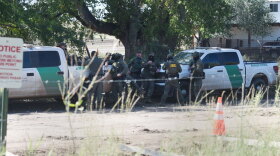 On Monday, dozens of agents swarmed a stretch of private land where the activists had been camped in and around a centuries-old cottonwood tree. Contractors tore down the tree and agents made multiple arrests.
-
 New research shows the ancient site is much older than previously thought. In fact, it’s now confirmed to be the oldest known scientifically dated geoglyph in the Americas, 2,000 years older than the first Pyramids built in Egypt.
-
 Protesters have been camped out in a plot of private ranch land in Lochiel for over two months now, trying to block wall construction as it neared a towering cottonwood tree that was the last of a grove slated for destruction to make way for two, parallel steel bollard walls.
-
 Ahmed Soliman has no ties to Equatorial Guinea. The 30-year-old man was born in Egypt and brought to the United States. when he was just 4 years old. He grew up in Phoenix. Now he’s believed to be in a hospital in the African nation.


