


LAUREN GILGER: During the pandemic, musician Joshua Hill returned to his hometown of Flagstaff, Arizona, to help take care of his dad, who was suffering from dementia. He began playing music with him and discovered he could sing, and that the music seemed to calm him. Their collaborations turned into a project called Song Cycle and culminated in him on stage with his ailing father, improvising a song in front of hundreds of people.
At the same time, Hill was writing his own music — music that turned into his newest album, “Cowboy Dream,” which is out this month. I spoke with Hill more about the album, his dad, dementia, and music, and it’s today’s Deep Dive.
JOSHUA HILL: My father’s dementia and the pandemic at the same time really was like a reckoning of reality for me, and I think for a lot of us. I mean, it was — I can’t believe, all the time I’m just like, we had this global thing happen, everybody. It seems like we’ve sort of moved on, but like I’m still kind of catching up to that.
LAUREN GILGER: I think a lot of people have that feeling. So yeah, it was a moment of crisis and reckoning in many ways, it sounds like. I mean, talk more about that writing process and the way that you conceptualized these songs, right? It sounds like you almost reverse-engineered it, like you’d start with a sound first. Was that sort of starting with an emotion first for you?
JOSHUA HILL: I mean, it could be anything. One of the songs, “I Am Tree,” was literally me walking up to a pond and looking at a tree every day.
[SONG “I AM TREE” BY JOSHUA HILL PLAYS]
JOSHUA HILL (SINGING): Tree sits at the edge of a pond and it sees itself in the still water
[“I AM TREE” CLIP FADES OUT]
JOSHUA HILL: And then I would take photos of it, and then I would kind of like turn the photo around and then, like turn the photo upside down, and then depending on what the reflection looked like, sometimes it looked like it wasn’t upside down or sometimes it just had like a characteristic. And so I kind of like go and walk up to a tree and then walk home and then kind of like futz around with sounds, and then that would become something.
[“I AM TREE” FADES BACK IN]
JOSHUA HILL (SINGING): And the birds start drinking And the fish start swimming And the tree can no longer see itself And it says, “I don’t know why” “I don’t know why”
[“I AM TREE” CLIP ENDS]
LAUREN GILGER: And as you’re saying, this is happening as you’re watching your dad go through dementia, which is so I think difficult for so many people who have experienced that kind of caregiving role. Can you tell us about your dad, Joshua?
JOSHUA HILL: Oh yeah. So Greg Hill, he was a painter, and he lived in Flagstaff, Arizona. And he would tell you the first time he met you that he was born in Oklahoma, and at the age of 8, he moved to Roswell, and then he would tell you his whole life story the first time he met you. And he was a very charismatic, just like really full-of-life person. Very complicated person, too, you know, but just like much loved.
He was an engineer for most of his working life, and then in I would say in about his 40s or so, he started painting. And painting became the rest of his life really up until memory loss, until dementia came in in 2020. And kind of around the time that his diagnosis came on, that’s kind of when I discovered that Greg had this secret talent for music.
LAUREN GILGER: So he became a musician very late in life, it sounds like.
JOSHUA HILL: Very late in life, but it’s like he always kind of wanted to do it, but maybe just didn’t have the discipline to like learn to play guitar or something. Like, I started playing guitar because he had a guitar hidden in the closet that he had bought in the ’80s and then never could quite get the chords figured out.
LAUREN GILGER: Right. Well, so this brings us to this kind of really innovative and very beautiful project that you created with him as he was suffering from dementia called “Song Cycle.” You and your dad performed this together. He came out on stage as part of this performance and played and sang with you.
[CLIP FROM GREG AND JOSHUA HILL’S “SONG CYCLE” PLAYS]
JOSHUA HILL: All right, let’s give it up for Greg Hill, everybody. How you doing, Dad?
GREG HILL: OK, how about you?
JOSHUA HILL: OK. I heard you have a thing in your pocket, a piece of paper. Can I — I heard you have a — we were looking for a starting place here. Let’s see, what do we got here? “Life is what you make it.”
GREG HILL: “Love is what you make it.” To say, or whatever.
JOSHUA HILL: Ooh. Life and love are what you make it.
GREG HILL (SINGING): Love is what you know, light is what you give it
JOSHUA HILL (SINGING): Love is what you know, it’s what you’re given
GREG HILL (SINGING): Love is what you know ... and it gives
[“SONG CYCLE” CLIP ENDS]
JOSHUA HILL: Really the origin of that is I discovered when I was in my mom’s house kind of taking care of him that when I could get him to sing, that he would kind of release a lot of emotion, or he would just kind of like it would just kind of almost like calm his body. And he was just kind of able to express, and it didn’t always make logical sense, but it seemed powerful.
[ANOTHER “SONG CYCLE” CLIP PLAYS]
JOSHUA HILL (SINGING): How can I know if I’ve made it?
GREG HILL: You don’t.
JOSHUA HILL: (Laughing)
[“SONG CYCLE” CLIP ENDS]

JOSHUA HILL: And so I was able to — there’s a short film I put out called “What Would You Say” that was really the first time he ever sang. And then that led to applying to some festivals, and probably the most kind of prestigious performance was at REDCAT, which is in the Walt Disney complex in downtown Los Angeles. It’s a kind of ragtag 200-seat theater down there.
And we got into a festival, and yeah, I worked with a team, and we kind of built this show, and the whole idea was that there would be a moment where Greg and myself would go on stage and we would improvise.
And we started the show by saying, “OK, we’re being careful, we don’t want to exploit this person, but here’s what’s going on. You know, I think we’re going to be OK,” and we were really careful that he was dignified in his performance. But we basically just had this performance where it was kind of like there was a framing around it of documentary footage I had shot and stories and poetry my mom had written. And then this kind of improvised performance.
[ANOTHER “SONG CYCLE” CLIP PLAYS]
GREG HILL: I’ve been some of the people in the last year or two that some of the illnesses we didn’t even know about it, and I didn’t know about it, and I still kind of don’t know about it. And like I can’t drive my car anymore, and that sort of thing. And at first, I just cried a lot, you know, and that didn’t seem to do much. So I’m crying again. But I just know that there are a lot of people that have needs that they didn’t need to have, and hope that everyone gets whatever need they need to have that.
JOSHUA HILL (SINGING): Life is what you make it. Life is what you make it . Life is what you make it. Sing if you want. Fly if you want. It’s gonna be all right.
GREG HILL: Mmm, thank you.
[“SONG CYCLE” CLIP ENDS]
JOSHUA HILL: So my dad, never a musician, basically his first show was for a couple hundred people and he’s like getting a standing ovation, and he loved it. He was so happy.
LAUREN GILGER: It’s really amazing to watch, honestly.
JOSHUA HILL: Yeah. Yeah, thank you, thank you.
LAUREN GILGER: But it says so much about this link that I think has been well researched now between music and memory, right, and how powerful music can be in dementia. What did it mean to you, not just to get to kind of do that with him, which I’m sure was really moving for you, but also to like watch music impact him in this way in this time in his life when, you know, he probably needed it?
JOSHUA HILL: You know, it’s interesting because I think the fact that we were able to share that experience together — I mean, music has always been my primary language. Like I’d be much better just playing this interview on violin to you or something rather than talking.
LAUREN GILGER: I’m sure it would be great.
JOSHUA HILL: But basically I think the fact that he was really able to just kind of like take a stand for who he was and express himself, I think that was so important to him as an artist and as an artist who just — I think he just really like needed that, and I needed that, too, because just to be able to kind of step onto the biggest stage that I had been on and to have him with me there was honestly one of the greatest honors of my life.
And I think it also was just something that we could do up until the end, you know, even if it was—there was a certain point where I decided I was going to stop filming him and I was going to just kind of do it, like just play music with him and kind of just have it be private.
And even until his passing, like the day he was passing, I mean it’s like music was part of that. And it often is at the end of life. Music is something that is — it affects us and it just kind of like calms us to our core. And it explains the unexplainable.

LAUREN GILGER: Yeah. Yeah, that’s a really good way to put that, I like that. So your dad has since passed away, as you’re getting at there. And now you’re out with this new album, which is, you know, kind of full of these songs that you began exploring as you were caring for him. Was producing, getting this album out into the world, I mean, was this part of your grieving process?
JOSHUA HILL: I mean, I’m still in it. You know, I think like, yeah, definitely. I mean, I think the thing that really happened when he passed, and I’m sure happens for anyone who loses a parent or someone so significant, is it’s like you have to kind of rediscover your life. You have to — you just have to like find a new energy and flow for how you’re going to navigate the world. And so I just feel like I’m ready for a new chapter, and I really just wanted to put out this, just kind of throw my hat out into the ring of like these songs are what my experience has been, and it’s kind of helped me through this like valley.
[SONG “GATHERED IN WINTER” BY JOSHUA HILL PLAYS]
JOSHUA HILL (SINGING): Gathered in winter, gathered as one, to welcome the longest night, and bury the sun.
[SONG CLIP FADES OUT]
JOSHUA HILL: The kind of arc of the album is that there’s this kind of transformational — it’s like a sunrise. It’s almost like it goes all into a deep valley of kind of difficulty and facing a lot of dark truths, but then you kind of wake up out of the dream and there’s another day. And I think a lot of those lessons you learn through caregiving, that it’s so hard and it’s impossible.
And I have to shout out my mom, who did the bulk of the caregiving, that—and she’s just like, she’s in Wales right now, like she’s having her life, you know, she’s doing it. You want to just kind of like not let that experience take away the fact that there’s another—there’s going to be a new day. There’s going to be another chapter.
LAUREN GILGER: So is there a song we should end this interview on, Joshua?
JOSHUA HILL: Oh my goodness. Why don’t we do “For a Little While.”
[SONG “FOR A LITTLE WHILE” BY JOSHUA HILL PLAYS]
JOSHUA HILL (SINGING): This will be my home for a little while. This will be my home for a little while.
[SONG CLIP FADES OUT]
JOSHUA HILL: There’s almost very few words, it’s almost like a mantra, and it’s just like, this is my home. This is what I have for right now. This is my body and my heart and my love, and this is it. This is it, and that’s like, let’s make the best of it, you know?
LAUREN GILGER: A good note to end on. Joshua Hill, multidisciplinary musician and artist, joining us. Thank you so much, Joshua, for coming on The Show. Thanks for telling us your story and congrats on the album.
JOSHUA HILL: Thank you so much, Lauren. Really appreciate you.
[SONG CLIP FADES BACK IN]
JOSHUA HILL (SINGING): These will be my hands for a little while. These will be my hands for a little while. These will be my hands for a little while. For a little while.

-
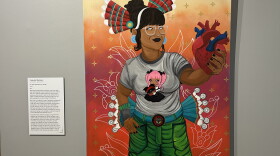 From graduation stoles to a Louis Vuitton drum, “Indigenous Identities! is a new art exhibit opening in Phoenix this week, October 8. The artists present work from a mix of their heritage, personal memory and modern circumstances.
-
 Silas John Edwards was a towering figure among the Apache people in Arizona about a century ago — until he was accused of murdering his wife and put behind bars
-
 Arizona’s history is well documented through its newspapers, and ASU English professor Vanessa Fonseca-Chavez dove deep into the long Spanish-language newspaper history here.
-
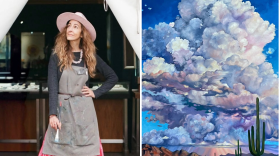 The painter, whose artwork focuses on Arizona landscapes during its stormiest seasons, says her paintings are representative of life.
-
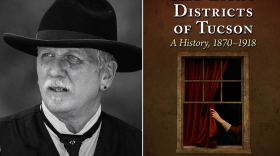 Red light districts operated years after they were outlawed in Tucson. An Arizona historian explored in his recent book what these areas looked like and how women who worked there were treated.


