


Most of us have heard of aviators like Charles Lindbergh and Amelia Earhart. But most of us have probably not heard of another pilot of that era, named Lester Maitland.
A new book sheds light on his life and career, including his time spent in the Valley — it’s called "Stone Age Astronaut: The Astonishing Adventures of America’s Forgotten Flier."
Liam Callanan is a professor of creative writing at the University of Wisconsin–Milwaukee and the book’s author. He’ll be talking about it on Sunday at Poisoned Pen Bookstore in Scottsdale.
Full conversation
MARK BRODIE: Liam, let’s start with who was Lester Maitland?
LIAM CALLANAN: Lester Maitland was a rather extraordinary person from early days of aviation. He flew to Hawaii just a few weeks after Lindbergh flew to France. They were almost equally famous at the time. They both went to the White House together to be honored, but then Maitland slipped from view and has never been heard of since. And I argue it's because some interesting twists and turns his life took.
MARK BRODIE: OK, so let's talk about some of those twists and turns because, as you say, he was equally as famous as Charles Lindbergh for a time. So like, what happened?
LIAM CALLANAN: I'm not sure, exactly. In some ways, I think it's a story about fame. Lindbergh was actually flying in a contest to get to Paris first, and so it was all about the publicity, whereas Maitland was flying at the behest of the Army to prove that you could fly from the west coast of the United States to the Hawaiian Islands without stopping, which the Navy had tried before.
And so, I think because it was a military achievement as opposed to a publicity one, that might be why they faded from the register. But it might also be because Maitland took a different path. He was, he went back to testing airplanes in the 1930s. He was something of a daredevil pilot, then he wound up in World War II as the, perhaps the oldest bomber pilot in Europe at the time.
Then was relieved of command for mysterious reasons in 1943, came home, worked in the civil service of Wisconsin and Michigan, and then around age 50, and this may be why his story is so quiet, he became, he decided he'd, I think quote, "done enough bombing in his life and wanted to do good." So he became an Episcopal priest and he lived to be deep into his 90s, and so he was, he had almost a 40-year career as an Episcopal priest.
MARK BRODIE: Huh. Did it seem as though he felt like he had to make amends in some way, or something like that, for what he was doing while he was a pilot, in terms of why he why he turned to religion?
LIAM CALLANAN: It's hard to say, and I put together a few different scenarios in the book. One thing that he did do was he witnessed the atomic bomb test in Nevada, and I think that really took him back. The bombing that he'd seen before was from the cockpit of an airplane, but then to be on the ground and see the danger that atomic weapons posed, I think it really took him not by surprise, but it took his breath away, and he was really taken with that.
And so he told people that, like, things had changed for him after that. In some ways, I don't necessarily know if that's true. When the Vietnam War came along, he was staunch on the side of the administration and thought that people had to do their duty and go to fight, but at the same time he was also a very spiritual person.
He believed in hands-on healing, the prayer of healing, and he also was very moved by the experience of people who had suffered in war. So I think it's best that I take him at his word when he said he wanted to do some good with the remainder of his life.
MARK BRODIE: It's such an interesting juxtaposition because, as you point out, he spent much of his early career and life in the military, you know, not just flying planes, but sort of doing it, as you say, for a military purpose to then, you know, toward the end of his life, you know, try to make amends for some of that. So it's a very interesting juxtaposition, I think.
LIAM CALLANAN: It is an interesting juxtaposition, and I don't think it's a, in some ways all that rare one. There's many people, in fact, there's almost a tradition of military officers who later in life go into service, particularly in the Episcopal Church, for whatever reason. And I don't necessarily know that it's a way of atoning so much as a way, they come from a life of service and then they want to personalize or broaden that service with a spiritual element. That's my guess, anyway.
I think Maitland had a lot of things going on in his life. He grew up when aviation meant almost certain death. In World War I, there was a period where one out of every four British pilots was dying. And so, Maitland himself on his first 14 attempts to take off from an airfield in Texas as a student pilot crashed or his plane failed. And so I think he had so many close brushes with death that he had to be in touch with what it meant to be a pilot, what it meant to be alive, and what it meant to be I guess that fortunate time and again.
He had, he also had like a nice spiritual description later in life when he talked about flying into Hawaii that morning and seeing the roiling clouds of blue and orange and green and red, and just all the way the sun was playing with the horizon. He said it's hard to be up there and not be a believer. And so I think that really spoke to him throughout the decades.
MARK BRODIE: Huh. It's also probably worth noting that at the time he was getting into aviation, and you alluded to this, like pilots were some of the more famous people in this country, and the fact that humans could get into a machine and fly was like really a subject of public fascination.
LIAM CALLANAN: It was fascinating, and I think it's even more fascinating for us today when we look back and see the planes that they were flying. They're basically glorified lawn furniture, you know, in some ways, just sticks and fabric, and the pilot was out in the cold air.
There's one episode where Maitland was practice flying between the Hawaiian Islands, his plane caught fire, and it was plummeting towards Earth, and the only rescue equipment they had, they were trying to put out the fire, his crew members pulled out a pigeon from a cage that they had, carefully wrote a note while the plane's smoking and burning all around them, tied the note to the pigeon's leg and sent it off. It was a homing pigeon, it flew back to base and said, "Maitland's in trouble, send a ship to get him," and it did.
And so I think daredevil stories like that, just people marvel at the luck and fortune and courage of these folks to actually fulfill their duty. There's a quote from Maitland that I like, I have some access to some of his old manuscripts, which I looked at at the U.S. Air Force Academy in Colorado in their archives, and he wrote, "There is a certain type of daredevil who will gamble with death for purse, publicity or both. For a time he occupied a prominent place in aviation."
And then he penciled in beneath that, "He has no place there any longer." So Maitland was never into flying for fun or for stunt work, but always for a higher purpose.
MARK BRODIE: So, am I right that at a certain point in his life, Maitland made it down to Arizona and was living here?
LIAM CALLANAN: He did. In fact, part of this book, I was down at the Pima Air & Space Museum doing a little work down there and researching it. And on his way to Hawaii, he actually took a long way from Ohio, stopped in many places from Texas to California, but one of those places was Tucson.
But later in life, he retired as a Episcopal priest, worked as a pastor for a long time up in Cave Creek, Arizona, just north of Phoenix, where he was pastor at Good Shepherd Church, and he's buried there in a columbarium beside his wife.
MARK BRODIE: So, when you look at Maitland's life and career, and you sort of look at it maybe in the context of other famous aviators of that time or or other times, where do you, like how do you see him? How do you how do you rate him?
LIAM CALLANAN: I rate him pretty highly. I think I rate him most highly for courage, that he was able to go up in these planes that had no business staying aloft. He went on these World War II bombing missions in Europe when they were actually asking senior commanders like himself to stay on the ground just for survival's sake. He would go up if the men needed a additional boost of confidence and he would continue to go there.
I think that he didn't necessarily achieve a flight over the North Pole or a flight around the world or, for that matter, a flight to Paris, but I also think he wasn't interested in that. I think he was interested in flying for flying's sake, flying for the military, certainly flying for America, but also just I think he believed in the power of flight to redeem a man stuck on his life on the ground. It allowed him to fly higher and dream higher as well.
MARK BRODIE: That is Liam Callanan, a professor of creative writing at the University of Wisconsin-Milwaukee, author of the book "Stone Age Astronaut: The Astonishing Adventures of America's Forgotten Flyer." Liam, thanks so much, I appreciate it.
LIAM CALLANAN: Mark, I appreciate you, thanks so much.
-
 Jackie Alpers is a Tucson-based cookbook author and food photographer and Sonoran cuisine expert, and she just came out with a free digital salsa cookbook outlining her essential salsa recipes, ingredients and more.
-
 Silas John Edwards was a towering figure among the Apache people in Arizona about a century ago — until he was accused of murdering his wife and put behind bars
-
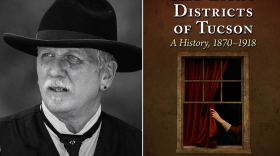 Red light districts operated years after they were outlawed in Tucson. An Arizona historian explored in his recent book what these areas looked like and how women who worked there were treated.
-
 Chelsey Luger and her husband, Thosh Collins, have spent their careers teaching wellness in tribal nations all over North America.
-
 Emmy-winning writer-producer and ASU professor Peter Murrieta is releasing a book this October based on his pop-culture focused podcast with Frederick Luis Aldama.


