


MARK BRODIE: California Gov. Gavin Newsom has declared a state of emergency in advance of what is expected to be a Super El Niño — bringing heavy rains and flooding. Arizona is also anticipating wetter-than-typical conditions over the next several months.
That extra water presents both challenges and opportunities to an area in the midst of ongoing drought.
Ian James with the Los Angeles Times joins me to talk more about this. Ian, good morning.
IAN JAMES: Thanks for having me.
MARK BRODIE: Thanks for being here. So do we have a sense of why the California governor declared a state of emergency at this point? Like, what does that mean? What does that do?
IAN JAMES: Yes, it’s to mobilize state resources ahead of possible flooding, and to basically be ready for it. Be ready for inland flooding in low-lying areas as well as coastal flooding and heavy waves that could come from El Niño, which can be quite destructive. So it’s to have resources in place to prepare for the potential emergency in the first place.
MARK BRODIE: Maybe preposition some of that stuff to maybe mitigate some of the worst impacts?
IAN JAMES: Right.
MARK BRODIE: OK. So you’ve been writing about sort of what all this extra rain and water that California and Arizona are expected to be getting over the next several months could mean. Obviously, this part of the world could use some more water. But how are officials in California trying to prepare to not sort of let this opportunity go to waste, that, you know, all this extra water potentially falling from the sky?
IAN JAMES: That’s right. There could be this bonanza of water, and it’s important to recognize that, of course, El Niño doesn’t necessarily guarantee a winter of wet storms. But the idea is that if a lot of water comes with this El Niño, that California should be prepared to take advantage of that water and capture as much of it as possible to help in the next drought.
MARK BRODIE: How are they trying to do that?
IAN JAMES: Well, there are several major ways. One is by having recharge basins that have been built over the years. They’ve expanded in areas like the Central Valley. Los Angeles County has 27 spreading grounds to capture runoff from the flood control system with these constructed recharge basins that also exist in Arizona that can be used to capture those surges of floodwater when it comes in.
And there’s also been a growing emphasis in California on capturing water and sending it to farm fields where it can be done and where it won’t damage the crops. And farmers have been putting more effort and resources into that in recent years, partly because of the state’s groundwater law, which is incentivizing people to capture more stormwater.
And in 2023, it was a big test of California’s ability to do that, and many more farmers and irrigation districts put floodwater onto farm lands and effectively helped recharge more water during that flooding period when water was also going underground in large quantities naturally. And, of course, 2023 was not an El Niño year, but the idea at the state level and at a number of water agencies in California is: Let’s prepare for this year in case it’s that wet or even possibly wetter.

MARK BRODIE: What kind of infrastructure is needed to get some of that rainwater — I mean, obviously if it falls on a farm, that’s great, you don’t need anything. But, you know, if it falls sort of somewhere outside of the agricultural areas, how do you get it from there to where it can be used on farms?
IAN JAMES: A lot of these efforts do require investment and planning for years. And I spoke with one farmer near Fresno who has invested a number of — he’s invested about $13 million, received a state grant, put in about 5 miles of canals to direct floodwater when it’s available to the farm fields. And in 2023 was able to put as much water underground as basically a small city and is looking to do more of that.
It does require the canals. It requires having pumps in place. You know, last time, they used a number of diesel pumps that they brought in quickly to respond to the flooding. And this time, that farm has in place some electric pumps that will be able to handle a large volume of water quickly.
MARK BRODIE: So it sounds like, at least in some cases, it’s a matter of like dusting off equipment that had been there for some amount of time and making sure it still works?
IAN JAMES: Right. And last time, Gov. Newsom did declare a state of emergency ... during the heavy storms in 2023 — to facilitate the movement of water on farms. And the state did help both buy and rent dozens of pumps to get water where it needed to go quickly. And so part of what irrigation districts and the state are looking to do again this time, and with the governor’s order again, is to help local agencies and farmers figure out how to move water quickly where it needs to go.
MARK BRODIE: Obviously, one even super El Niño is not going to necessarily pull California or any other state out of what has been a very, very long drought. But do water officials there have a sense of like best-case scenario, how much water they might be able to get, like how much of a dent into the shortage they might be able to put?
IAN JAMES: I think that’s just a big question mark. A large part of California, about 70% of the state, is currently classified as being abnormally dry. And so how much this year could make a big dent in that or swing things back the other way is really a question mark. In 2015 and 2016, it was an El Niño year, and there was a lot of talk about potentially a deluge, but it turned out to be more of a disappointment.
MARK BRODIE: The other side of this, of course, is the possibility of flooding — in some cases, severe or life-threatening flooding. Do the efforts to try to get water to where it can be used and to collect it to seep underground, does that also have the effect of potentially mitigating some of the effects of flooding?
IAN JAMES: Definitely. And one of the big solutions that I’ve spoken with experts about is restoring natural floodplains along rivers, especially in the Central Valley, where farmland can be repurposed to become a natural floodplain with vegetation.
And basically, if levees are cut into or set back in these areas and the land is dedicated to giving water more space, it can allow water to spread out, slow down and sink into the ground, and also help reduce flood risk downstream.
And in the last several years, California has made progress on several thousand acres of new floodplain restoration, and that basically gives water more space for these flood periods, and there are plans to do quite a bit more of it.
MARK BRODIE: That’s interesting. All right, that is Ian James with the LA Times. Ian, thanks so much.
IAN JAMES: Thank you.
-
 Some communities remained difficult to access after flooding from Tropical Storm Polo.
-
 The painter, whose artwork focuses on Arizona landscapes during its stormiest seasons, says her paintings are representative of life.
-
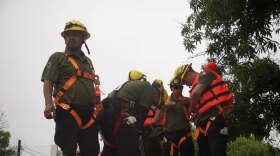 Tropical Storm Polo left coastal areas in Sonora flooded Tuesday, but left other parts of the state with little rainfall as it began to dissipate.
-
 The National Weather Service has issued a flood watch for most of Arizona through Tuesday evening as remnants of Hurricane Polo move inland from the Pacific.
-
 The National Hurricane Center predicts the storm will remain a strong hurricane as it moves into mainland Mexico early this week.


