


LAUREN GILGER: Chelsey Luger and her husband, Thosh Collins, have spent their careers teaching wellness in tribal nations all over North America. It’s part of their organization, Well for Culture. Their first book is called “The Seven Circles,” and it outlines their model for balance and wellness. They want to reclaim and revitalize Indigenous health and wellness.
Now Luger is out with a new book: “Native Home: The Ancestral Art of Creating Healing Spaces.” It takes that idea of wellness one step further, into the home.
The Lakota and Anishinaabe wellness expert will be at Changing Hands Bookstore this weekend, and she told me, she was raised with wellness without ever having heard the word.
CHELSEY LUGER: In Lakota spirituality, there’s an understanding that our life is comprised of mental, physical, spiritual and emotional health. And we aim to be in balance in all of those areas. So being raised in ceremony and being raised in my culture, I had a really good understanding of wellness from that perspective. And that’s kind of how I got into the wellness industry and realized that I had something to offer there.
LAUREN GILGER: That’s really interesting. So I mean, it’s very — this sounds very different than the kind of wellness industry stuff that I often see on social media, right? Like, I mean, you’re thinking about this in a more profound, maybe a more spiritual way.
CHELSEY LUGER: Absolutely. Spiritual health is integrated in all of those. All of the circles are mental, physical, spiritual, emotional. And it is very different from, I think, what’s often marketed as wellness because we’re not selling anything, and we don’t believe that it’s my way or the highway. We believe that there are about a million different ways to approach health, but it’s quite individual and it’s quite community-based.
LAUREN GILGER: So you and your husband will teach wellness in Indigenous communities. But I know you’ve also spoken about kind of the whiteness of the wellness world, especially on social media today. And you’re on social media and kind of doing this stuff, but what do you make of the wellness world online today?
CHELSEY LUGER: I think the wellness world online today can be really gimmicky, and it can be very commercialized, which ultimately doesn’t necessarily help anyone. In fact, it can be harmful. But there’s also a positive side in that it has become a lot more diverse since diverse creators have the ability to put themselves out there.
Before social media, you would have never seen Indigenous voices, or often Black voices or Latino voices in some of the bigger health magazines and stuff like that. And so I think it has diversified quite a bit, and it’s become a little bit more egalitarian.
LAUREN GILGER: Yeah, and you’ve, I’m sure, found your audience in that, right? Like, who are you talking to? Are you talking to just people who have Indigenous roots or, you know, anybody who’s interested?
CHELSEY LUGER: You know, our primary audience is always going to be our communities because our communities have been disenfranchised and sort of excluded from the wellness conversation for so many years. And so that’s going to be our priority, and that’s who we’re accountable to. That’s who we were raised by, and it’s who we feel responsibility toward.
But at the same time, I believe firmly that Indigenous teachings are simply good for anyone. And so, of course we address that topic of cultural appropriation and we don’t encourage that, but there are many ways that anybody can learn from the philosophies that go hand-in-hand with Indigenous wellness. And we feel pretty proud of the fact that we’ve been able to teach that, I think, in a good way for all people.
LAUREN GILGER: That’s really interesting, right? Like, there’s a very fine line there. But let’s talk more about this new book, right? This is about wellness as well, but sort of about wellness in a different realm in terms of home design, right? There’s a connection there that I was surprised to hear, I think, and I don’t think you hear very often. Tell us about your approach to designing a home and how you think it’s connected to something like your mental, physical, spiritual, emotional wellness.
CHELSEY LUGER: So caring for the home, curating the home, creating a home is a huge part of our wellness because our environment impacts how we feel. My ancestors would say that we have a reciprocal relationship with our surroundings. What we put into our surroundings is what’s given back to us.
And so there are many beautiful teachings from across Native Country about caring for the home and loving the home and really treating the home as a living, breathing relative and entity so that you get to experience that reciprocity. While we often look at housework and chores as simply that, a chore, if we reframe it, we can realize that it’s this wonderful opportunity to feel better in our days.
LAUREN GILGER: Yeah, you have the space that you want to be in and you can function so much better in other ways. Tell us about your grandmother and her home on the Standing Rock Reservation, which I read inspired much of what you are writing about here in this book.
CHELSEY LUGER: Yeah, so my late Grandma Thelma lived in this neat, beautiful little red ranch house on top of a hill, overlooking the rolling hills and the prairies in Standing Rock. And she was an incredible woman in her own right. And I thought her house was such a wonderful balance of being beautiful and clean, but also inviting and warm and not too stuffy. It was well-decorated, but it was comfortable.
And I think experiencing her home planted the seeds of my interest in the way that a home can make a person feel. So Grandma Thelma’s house was definitely a big inspiration for me when I started to think about the way that our home and our surroundings can impact our health.
LAUREN GILGER: Right. You reframe here the idea of minimalism, right? Like, it’s not a design trend, but it’s sort of a way of life. And that strikes as so countercultural in today’s world, like this culture of consumerism that we live in in which you can always buy more and instantly, right? I mean, are you meaning for this to be something that is a little bit pushing back against the mainstream?
CHELSEY LUGER: Absolutely. I think there’s a few things that are super mainstream and very common and even aspirational in American home life that I think that we can rethink. So for example, I think the American goal is often bigger is better. We want the biggest footprint of square feet, we want the highest ceilings and the best house on the block is considered the biggest house.
I would argue that that’s been really counterproductive for the environment and also for our mental health, as there’s a competitive aspect there. It puts a financial burden on a lot of people. And the bigger the home is, the harder it is to care for and the more stressful it becomes.
And so I think our goal should be, how about I have some restraint and I’m going to choose the smallest house that is comfortable for my family? Those of us who are millennials and younger are experiencing the hardest time economically with not having as much purchasing power to buy a home. And so I think, hey, let’s take some pride in the fact that it’s cool to live in a smaller house. My ancestors did it for thousands of years, and why not do it again today?
LAUREN GILGER: So let me ask you lastly then about how this applies to anyone who picks up the book and reads it, right? Like, as you said, your main audience is always going to be the kind of Native communities that you come from that have been left out of this conversation for so long. But you do, it sounds like, want other people to benefit from this knowledge. Where is the line, you think, between doing this and adopting these ideas in a way that’s useful, but not crossing the line into cultural appropriation?
CHELSEY LUGER: I think that anybody who is aware of that is already probably going to be respectful about it, you know? And no one is a stranger to learning something from another culture while also respecting that culture. So we learn about many home teachings from the Danish and the Japanese and the Chinese. Most people know something about feng shui or about hygge — I always say it wrong.
So I think it’s absolutely a good thing when people are somewhat mindful of that. And I think hopefully, you know, it’s my responsibility as an author, and I think I’ve done a good job of it over the years with our previous wellness teachings and with this book, “Native Home,” in teaching folks and guiding folks through: how do I learn from Indigenous teachings while also just being myself? And that’s all I can hope for.
LAUREN GILGER: All right. Well, leave it there. Chelsey Luger, the new book is “Native Home: The Ancestral Art of Creating Healing Spaces.” Chelsey, thank you so much for coming on The Show. Appreciate it very much.
CHELSEY LUGER: Thank you.
-
 Jackie Alpers is a Tucson-based cookbook author and food photographer and Sonoran cuisine expert, and she just came out with a free digital salsa cookbook outlining her essential salsa recipes, ingredients and more.
-
 Silas John Edwards was a towering figure among the Apache people in Arizona about a century ago — until he was accused of murdering his wife and put behind bars
-
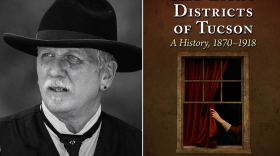 Red light districts operated years after they were outlawed in Tucson. An Arizona historian explored in his recent book what these areas looked like and how women who worked there were treated.
-
 Most of us have heard of aviators like Charles Lindbergh and Amelia Earhart. But most of us have probably not heard of another pilot of that era, named Lester Maitland.
-
 Emmy-winning writer-producer and ASU professor Peter Murrieta is releasing a book this October based on his pop-culture focused podcast with Frederick Luis Aldama.


