


LAUREN GILGER: Today is the final day of the monsoon season, an iconic Arizona phenomenon that our next guest this morning loves to paint.
Tina Roy’s monsoon paintings are big — often really big. She thinks the scale of the sky and the power of storms is important to illustrate.
Roy grew up in the Valley but spent much of her life travelling the world before deciding to raise her kids here. Now, she is a full time artist. Her latest show opens this weekend in Palm Springs.
She came into our studios recently to tell me more about her work — and how growing up in Arizona shaped it.
TINA ROY: One of my favorite childhood memories is when the monsoons would come, my parents would call my brother and I out, and we would all sit on the porch watching the storms. And it was this really nice thing that we did as a family.
And it’s so cool because now I do that with my children. So when there’s big storms and we’re all home, it’s like, “Come on, let’s go watch it.” And we sit out and watch the lightning, wait for the thunder to come, listen to the rain. It’s always so exciting.
LAUREN GILGER: Yeah, yeah, I agree. It’s the best time of year here. So, let’s talk about your journey outside of Arizona though, because it sounds like you have traveled extensively. You lived many years in other countries, in many other countries. You come at this work about Arizona with a very global perspective, it sounds like.
TINA ROY: I do. I definitely spent many years traveling around the world and absorbing different cultures, different lands, different peoples, different art forms. And so I’d like to think that that all contributes to what I do now.
LAUREN GILGER: Where have you lived?
TINA ROY: Well, when I turned 16, I moved to Argentina for a year as an exchange student. And then I went to school in Paris. I did all four years of college in Paris studying art and art history. And then I took a backpack and bought a round-the-world trip ticket — I don’t know if they still exist — and I lived with a tribe in Africa, and I had a house on the beach in India, and I spent time in Australia. And I love New Zealand. So, a couple years later, I went back and lived in New Zealand for a year. So that was exciting. I lived in London for a year, and then I married a Frenchman, so we go back to France pretty often.
LAUREN GILGER: Wow. OK, so definitely have lived all over the world. What did that teach you about not just, you know, yourself, but about your art and and what art means?
TINA ROY: Oh, it’s so incredible to see how it’s such a universal thing to have art and decoration, whether it comes out in beautiful bright clothing or jewelry or murals or the pottery. I mean, every culture has a different way of expressing that creativity, but what is universal is that it is always expressed. It always is an important part of culture is the the art.
LAUREN GILGER: So, what brought you back to Arizona of all places? I mean, I know you grew up here, but you left at a very young age, it sounds like.
TINA ROY: I left at a young age, but my parents and my brother are still here, and we stayed here. And I was just coming back to visit, and I happened to meet my husband, who was also visiting, and he’s French. And because I lived in France when we met, I said like, “Oh, of course we’re going to go live in France.” And we did.
And then somehow we both decided that we preferred being here. We’re both — we both love the outdoors. We like that it has all the opportunities of a big city with the access to nature.

LAUREN GILGER: Yeah, yeah. I mean, that’s a I think a surprising decision. I think if people hear you say we chose Arizona over France.
TINA ROY: Yes, yes, it was surprising.
LAUREN GILGER: So, the outdoors are one draw. But what about the outdoors here? Like it sounds like you spend a lot of time in the outdoors hiking, walking in the desert, things like that.
TINA ROY: Yes, I love it. I have always loved it. Before I had kids, I would try to be outside for sunset every night. I love sunset. Now that’s like when I’m making dinner and helping with homework, so I see more sunrises now. But I just think it’s so magical.
LAUREN GILGER: So, how does that manifest in your art? The love of Arizona, the return here, that kind of full-circle journey that you’ve been on?
TINA ROY: Right. Well, I think I try to capture that magic in my paintings. Especially now, people don’t — we’re so consumed with our jobs and work and our phones and screens that I really want to bring that feeling into people’s homes and workspaces or wherever my paintings end up. You know, I work quite large, so I think the scale is important.
LAUREN GILGER: How big is one of your paintings? I can’t tell online.
TINA ROY: Well, the biggest one I just just did, just finished is 7 by 8 feet.
LAUREN GILGER: My goodness, that’s not just big, that’s really big.
TINA ROY: That’s really big, yeah. I do really enjoy 3-by-6, 3 feet by 6 feet horizontal, so you really have this feeling of the vastness of the sky. And I just try to convey emotion in my painting, the emotion of being out in the desert.
I remember this one time I was out hiking, and it was at sunset, and I thought that there might be, you know, it was monsoon season, but it didn’t seem too crazy. And over the mountains, I could see this storm coming. And I’m watching it going, “OK, I have this much time, and it’ll take me this much time to get back to my car, and it looks pretty far away.”
And then it just came so fast, and you watch like the mountains disappear behind this wall of rain as it gets closer. And I’ll never forget just hauling back — I mean, I’ve never run so fast to my car. And right as I got to my car, it hit, and it’s like so powerful and it’s really exciting. It’s really exciting.
And so I love capturing that in my paintings, you know, the big storms. You’ll usually see some rain coming down. There’s also usually like some light, you’ll see some light. I think that it’s it’s very representative of of life, you know? It can be scary, the monsoons can be scary, they can be hard, but then they also bring life and they bring rain, and that is such a relief and is very needed. It’s always needed here.
And that’s a good lesson I think for life is we need those challenges. We need the hard times because they — that’s what helps us grow.
LAUREN GILGER: There’s beauty in the harshness of these storms.
TINA ROY: Yeah, yeah.

LAUREN GILGER: So, let’s talk about the style that you paint in itself because it’s — I mean, it’s very effective, but it’s it’s not photorealistic, but it is realistic. You call it stylized realism?
TINA ROY: Yeah, it’s interpretive. I’m not trying to portray it exactly. I want people to feel the sky, not just recognize it. And so that’s I think why I heighten the color, play with the forms of the clouds. It’s to create that emotion.
LAUREN GILGER: Right. It’s almost like chopped up or pixelated. It reminds me a little bit of like a Cubist painting, but not in cubes necessarily.
TINA ROY: Right, yeah. Yes, exactly. And I I just love to play. For me, painting is such a joyous experience. I do like to walk the line between representation and abstraction.
LAUREN GILGER: So, this has not always been your full-time job though, do I understand? You’ve done a lot of things, lived all over the world. But it was not that long ago, it sounds like, you sort of quit your day job and said, “I will dedicate myself full time to art.” That’s a big leap to make.
TINA ROY: It was such an amazing moment, and I do really believe that once you make the decision to follow your dreams, that the universe will conspire in your favor, you know, that old Paulo Coelho idea. So, I kind of did everything else until I just realized this is literally the only thing I can do and want to do.
And then yeah, once I made that — and it was like a very definitive decision of, “Now I’m going to do this or spend every penny of my savings trying to do it.” You know, like I’m not going to stop until like it’s this, this or bust.
LAUREN GILGER: But that’s an amazing moment in life to do it, right? Like you’ve lived this whole international life. You’re married, you have kids, it sounds like young kids. To do this at this moment must have been a little scary, too.
TINA ROY: Yes, but I don’t like to give too much attention to fear.
LAUREN GILGER: What do you think that teaches your kids?
TINA ROY: Yeah, to follow your dreams. I mean, that’s hopefully what they get from it, and to do what you love and to find the thing that you love, and then do that to your best and devote yourself to it.
LAUREN GILGER: Quite a lesson.
TINA ROY: Yeah.
LAUREN GILGER: Tina Roy, thank you so much for coming in. I really appreciate it.
TINA ROY: Thank you so much.
-
 Father Panik may not be a widely recognized name in the music industry, but decades later, the band's Matt Goldman is sharing their unique sound and story at the Tucson Film Festival.
-
 Desert Design kicks off this week with a variety of speaking events, exhibits, and gatherings. This year, its theme is "Collected in Dialog."
-
 Amanda Kelly is an artist based in New York City. She has a new exhibition at The Mini Time Machine Museum of Miniatures in Tucson called “The Need to Keep.” In it, she shows scenes that have a lot of stuff in them, from bathrooms to kitchens to end tables, all in miniature form.
-
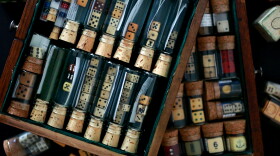 For the next several days, you can tour a huge RV trailer packed with drawers of dice, erasers and just about anything you can imagine that’s both tiny and collectible. The Show’s Amber Victoria Singer got a virtual preview from its founder and curator.
-
 New research shows the ancient site is much older than previously thought. In fact, it’s now confirmed to be the oldest known scientifically dated geoglyph in the Americas, 2,000 years older than the first Pyramids built in Egypt.


