


LAUREN GILGER: Arizona’s history is well documented through its newspapers, and our next guest dove deep into the long Spanish-language newspaper history here.
ASU English professor Vanessa Fonseca-Chavez is out with a new article in the Journal of Arizona History about Spanish-language newspaper editor Lázaro Acosta, a Mexican-born teacher, writer, community leader and newspaper editor in Arizona and New Mexico during the territorial period.
I spoke with Fonseca-Chavez more about it and how she came across his story.
VANESSA FONSECA-CHAVEZ: You know, I was looking at historical newspapers in Apache County during the ’60s, ’70s, ’80s. I’ve been working on a book about Concho, New Mexico, and I ran across this column in the newspaper called Concho Chatter, and it was written by an individual named E.M. DeGlane, who wrote the very first book about Concho’s history, and that was written in the 1980s. And I went a little bit further back in the newspapers before the ’80s, before the ’70s, and I wanted to know what else was being written about Concho during that time period.
And so I then started looking at Lázaro Acosta and noticing that he was showing up more in the newspaper archives. And so I started wondering, well, who is this person who was writing for the Snips and St. Johns Herald, that was the name at the time. So I started to just learn more about this Acosta family and just looking on public blogs. And then I ran into a person whose ancestor was Lázaro, and he lives in the West Valley.
And I’ve never met this person, but I’ve been sharing the story about his, you know, great-great-grandfather over the past few years, you know, just little snippets of information that I’ve been learning about him. And so that has been really fun to kind of look into someone’s history and share it with somebody where it matters.
LAUREN GILGER: Yeah. I mean, that’s kind of amazing. I mean, so you’re just able to, what, send him a note every once in a while and be like, “Hey, I found this cool thing about your great-great-grandfather,” right?
VANESSA FONSECA-CHAVEZ: And it’s been a fun journey. I’ve sent him, you know, newspaper articles I found years ago, and I hadn’t realized it until the other day and after this article was published, the only issue that I know of that exists of Las Nuevas de Magdalena, and it happened to be this person’s birthday who is living in the West Valley.
So I said, “Happy birthday. Here is the only newspaper from Las Nuevas that I’m aware of that I’m sharing with you today.” And so he was really excited, and he’s sharing this with his family members, and it’s created this really cool effect of, you know, why do we do this work? We do it for community engagement.
We believe that it has an impact on the lives of people today, and it’s really filling in a lot of gaps for his family about the lives of these people that they, of course, never met, but they’re able to learn about through the research that I’m doing. I think that’s the other really interesting part about it is how much of Lázaro’s life is available through these archives.
LAUREN GILGER: Yeah.
VANESSA FONSECA-CHAVEZ: There’s so much of it.
LAUREN GILGER: Right. So tell us about the process, right? Like you studied a decade, essentially, of newspaper archives from the state to kind of piece together Acosta’s story. And that’s a painstaking process, I know, although many of these papers, I know, have been digitized as well. Talk a little bit about just how this worked, how you did it.
VANESSA FONSECA-CHAVEZ: So the first step was really to figure out what years was he working for these newspapers and what portion of his life was able to be accessed through newspapers, and that ended up being about 1901 to 1911. He did pass away in 1911, and so part of the part of the thing I talk about in the article is he died just before statehood, and that’s a really interesting period in sort of the the last years of transition for both Arizona and New Mexico in becoming states.
But the Library of Congress has these newspapers digitized, as does the Arizona Memory Project. So there was a lot of weekends and nights just looking through the newspapers. And that was really fun, because I think when you’re first looking through them, you’re not really sure what you’re looking for, but I was looking for any kind of knowledge that I could obtain about the life of Lázaro as a person, as a community member, as a family member, as a teacher, and what was his sort of approach to being a newspaper editor in line with other major newspaper editors during that time period, of which there were many in New Mexico, but a lot fewer in Arizona.
So this is really a different area of the state that I think a lot of people are not aware that possesses a lot of kind of Spanish-language community, knowledge, archiving, newspaper history, and I think that’s a real contribution to just what we know about Apache County.
LAUREN GILGER: Yeah, 100%, a different part of the state. Tell us more about the context, like the historic context in which this was all happening, in which Acosta was working. Like, this was kind of a pivotal era in the history of this region.
VANESSA FONSECA-CHAVEZ: Yeah. And, you know, New Mexico and Arizona developed very differently politically in the sort of rush to statehood, and that’s well documented, of course. But what Acosta was writing about during that period surprisingly didn’t reflect the push toward statehood, and I was surprised to know that, because so many Spanish-language newspaper editors in New Mexico were really advocating for the inclusion of Spanish within this new kind of configuration, how to protect the literature, language and culture of local communities in this sort of quest for statehood.
And surprisingly, Acosta doesn’t touch a lot on those topics. And so I think it’s a deviation from what other periódicos or newspaper editors were doing at that time.
LAUREN GILGER: Hmm. So what was he writing about? I mean, was it just hyper-local, what’s going on around town kind of stuff?
VANESSA FONSECA-CHAVEZ: Yes and no. So there is a section within that two-page spread that’s called local and personal, or local y personal. And that section was specifically dedicated to people who subscribe to the newspaper. So he wrote about them because they were subscribing to the newspaper, and that’s an interesting community engagement strategy. Pay to play, right, is what it sounded like to me.
And that’s OK, you know, there’s a lot of humor in there also about him saying like, “Hey, make sure you pay your newspaper editor and make sure,” you know, he was making a lot of pitches for please be involved with this. Of course, the research shows that having Spanish-speaking newspapers was a really important strategy because a lot of the folks who were living in Concho, Springerville, St. Johns were Spanish-speaking communities who had migrated from New Mexico specifically to become sheepherders.
So the economy, the configuration of the community was such that a Spanish-language spread was really necessary. In the research, it says, you know, Anglo editors would be well advised to create Spanish sections for these communities. You see this really big shift after Acosta leaves the Snips and St. Johns Herald where everything is almost exclusively English, and there is a really big cultural shift that happens in the newspaper, and I thought that was really interesting as well.
LAUREN GILGER: So, I mean, obviously, he wasn’t writing about the big political issue at the moment, but he was writing about his own community, and he’s doing it in Spanish. What do you think the impact of that was, maybe at the time, but maybe also kind of in the evolution, development of of the Spanish-language press in our state?
VANESSA FONSECA-CHAVEZ: I think people really just want to see themselves represented, and that was a really good moment of belonging and representation for that particular community. Of course, we know that some portion of that community was not able to read, and that a lot of the individuals who were represented were likely of a higher socioeconomic class.
And so that’s part of the conversation that I don’t really tease out in this article, but it is, you know, well known that there was a newspaper-reading public and then there was not a newspaper-reading public, and the people who were included in that were a certain demographic of the larger population.
LAUREN GILGER: Hmm, interesting. All right, we’ll leave it there. Vanessa Fonseca-Chavez, joining us, associate professor of English and assistant vice provost of the ASU Polytechnic campus. Vanessa, thanks for coming on The Show. I appreciate it.
VANESSA FONSECA-CHAVEZ: My pleasure.
-
 New research shows the ancient site is much older than previously thought. In fact, it’s now confirmed to be the oldest known scientifically dated geoglyph in the Americas, 2,000 years older than the first Pyramids built in Egypt.
-
 Silas John Edwards was a towering figure among the Apache people in Arizona about a century ago — until he was accused of murdering his wife and put behind bars
-
 On Wednesday, the U.S. Senate unanimously passed a measure out of its upper chamber that would transform the Chiricahua National Monument into the Grand Canyon State’s newest national park.
-
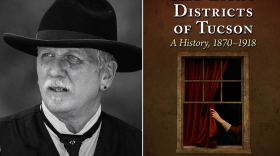 Red light districts operated years after they were outlawed in Tucson. An Arizona historian explored in his recent book what these areas looked like and how women who worked there were treated.
-
 Meet the two Arizonans who worked to preserve a small piece of history in Phoenix's Sunnyslope neighborhood.


