


MARK BRODIE: The baseball playoffs are moving to the divisional series round this weekend, and the Arizona Fall League kicks off tomorrow. But looming in the background of all these games is the expiration of the current collective bargaining agreement on Dec. 1, and the expectation that MLB owners will lock out the players on that date.
As the sides work toward a new CBA and negotiate over issues like a salary cap, there are predictions that baseball could miss games next season, possibly even lots of games. And any change in the schedule could have an impact on the Cactus League.
With me to talk about this is Bridget Binsbacher, executive director of the Cactus League Baseball Association. And Bridget, how do you try to even plan for the next season when you don’t really know what’s going to happen?
BRIDGET BINSBACHER: Well, obviously, it does affect the planning and thinking about it as we approach the 2027 season. But, looking at the history, a labor stoppage, the collective bargaining agreement, that is part of the industry. It happens every five years, and we’ve shown from past history that we can be ready, like that.
And so our facilities are planning for the season, and the collective bargaining agreement, all that discussion is between Major League Baseball and the Players Association. So, we’re not involved in those conversations. We can’t really speculate. But like fans everywhere, we’re just hoping that the two parties come to an agreement so that we can have a season.
MARK BRODIE: So, are the facilities and the other folks involved sort of planning as if it will go on as planned, and then adjust when it gets closer based on what’s happening at that time?
BRIDGET BINSBACHER: Absolutely. Yes, and we’ve talked about this in our operations discussions, which is primarily from facility operators. And they’re all planning and preparing like they would any other year, obviously waiting to hear the latest update.
But, you know — and I hate to say “business as usual” as though this isn’t something significant, because it is. I mean, we know what the impact is to the state of Arizona. That’s what we’ve been talking about for the past week. It is significant. And so, we want to make sure that we’re ready so we can make the most of this opportunity, whatever it brings.
In 2022, that was the last season that we went through this. And the season was delayed a little bit, but we were ready to open our gates as soon as we could, and made the most of that opportunity. And I would repeat the same thing for 2027.
MARK BRODIE: I was going to ask if you take lessons from past instances where this has happened. It sounds like that is very much the case.
BRIDGET BINSBACHER: Well, that was very, very unusual, because we had the season canceled because of the pandemic — I believe it was March 12, 2020. And then in 2021, we had a modified season, reduced capacity, and all of that. And then 2022 was the last CBA. So, yeah.
MARK BRODIE: So you look back to sort of how operations went, at least maybe the 2022 — not so much COVID, but the 2022 season, and maybe look at that and say, “OK, this is what happened, this is how we handled it, this is what worked, this is what didn’t work,” and maybe try to adjust based on that?
BRIDGET BINSBACHER: Yes, and really, it’s just about being ready. And our facilities have shown time and time again with unforeseen circumstances that we can be ready at a moment’s notice. We can adjust and do whatever we need to to make the most of the opportunity.
I mean, last season we recorded an increase for the fifth consecutive season, and we had record-breaking temperatures, heat waves last season. We adjusted quickly. This is the same. We’ll do what we have to to make the most of the opportunity.

MARK BRODIE: What are the biggest challenges in terms of not knowing when the season might start, and maybe to an extent, not knowing if there will be a season?
BRIDGET BINSBACHER: I think for anyone anticipating or participating in any way, directly or indirectly, with spring training, uncertainty — uncertainty is just, it’s challenging for our facilities, for our municipalities, for surrounding businesses. It’s difficult.
And, you know, the Cactus League, again, when we just put out our numbers, this is an $806 million impact, total impact. Nearly $500 million gross domestic product. We generate 5,500 jobs as a result of spring training.
And so, planning for all of that, teeing up all of those seasonal employees, facility staff, all of that, concessionaires, box office — so they’re working, starting to work on that now. Knowing when Opening Day is, based on what schedule we have at this point in time, that’s what they’re doing like they would any other year. And then, as they get closer, they’ll be watching it every day and planning accordingly.
MARK BRODIE: Yeah, I would imagine, especially on the employment front, it would be difficult to hire folks or have them say, “Look, we don’t know when necessarily you’re going to start.” And, you know, people need jobs, they need to earn money, and maybe some of the folks, you know, these facilities that hire take other jobs, and then they get the word, “OK, season’s starting in X number of days,” scrambling maybe to try to hire people.
BRIDGET BINSBACHER: Yeah, very real issue. For spring training, historically we’ve had a lot of these employees are seasonal employees, same thing with our volunteers. There’s over 2,000 volunteers, and then some, representing our nonprofit partners. And, you know, they come from wherever, following their team, winter visitors, whatever it might be, and they’re, too, anticipating what they’re going to do and when the season’s going to start.
MARK BRODIE: How nervous are you about what spring of 2027 is going to look like?
BRIDGET BINSBACHER: Gosh, you know, I’m optimistic. My glass is half full all the time, and in my lifetime, just watching this, I have not experienced a cancellation of spring training. And I started paying attention back in the ’90s when there were some challenges.
And I just, we haven’t seen anything like that, but again, you know, it’s hard to speculate, and I don’t want to think the worst, because we don’t know that the worst is going to happen. And so, we just want to keep moving forward and be as prepared as we can be to make the most of the opportunity. I keep saying that over and over, don’t I? But it’s true, we don’t want to miss this opportunity.
MARK BRODIE: So you referenced the economic importance of the Cactus League to the Valley and to the state. Is it possible, do you think, to make that up? Like, if spring training is shorter than average, or maybe it doesn’t happen at all, is that just a total loss for the state, do you think? Or are there other ways, and maybe some of the facilities can sort of work to attract people from Chicago and Seattle and everywhere else that comes to spring training to see their teams to do something else?
BRIDGET BINSBACHER: I don’t know if we could make it up. The impact is monumental, and we know that 6 out of 10 fans come from somewhere else. And our attendance was 1,753,000, I believe. Six out of 10 fans come from somewhere else in the country. And we know that they’re here for spring training. They’re staying four nights, they’re seeing at least three games, they’re spending nearly $400 a day. And it’s a huge impact.
And our economic impact study, the number we put out, it’s very important to note that strictly measures money and dollars and impact coming from out of state. So the question is, what would the Arizona fans that are already here spending money do?
I also want to point out these facilities do not go dark in the off-season. There are things, thousands of events, activities, tournaments, happening in these facilities all year long. And that drives an impact as well. And this only, we’ve only measured what happens for spring training, which is a mega event. It’s a mega event like a Super Bowl. The big difference is that it happens year after year after year. I don't see how we can make it up.
MARK BRODIE: All right. That is Bridget Binsbacher, executive director of the Cactus League Baseball Association. Bridget, thanks so much.
BRIDGET BINSBACHER: Thank you for having me.
-
 This will block at least $25 million worth of projects in parks such as the Grand Canyon, Yellowstone, Joshua Tree and Yosemite.
-
 Nicknamed the “Pride of the Navajo Nation,” Cody Jesus has long been on the radar of the Arizona Ridge Riders — a Glendale-based team within the Professional Bull Riders league.
-
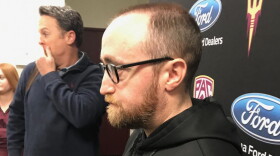 The lawyer for the family of the ASU hockey player who collapsed from heat stroke says the head coach reportedly got rid of his cellphone due to ongoing death threats.
-
 An ongoing lawsuit between two former Arizona Cardinals staff members and the team’s principal owner Michael Bidwill is heading to arbitration.
-
 ESPN is reporting the Arizona Cardinals are finalizing a deal to trade wide receiver Marvin Harrison Jr. to a mystery team. Harrison, the son of Hall of Famer wide receiver Marvin Harrison Sr., will be inactive on Sunday against the Detroit Lions while the deal is finalized.


