


Collections is a series from The Show devoted to the things we acquire and treasure.

LAUREN GILGER: This week on The Show, we’re hearing from people who think a lot about collections.
For years, mixed-media/ceramic artist Heidi Dauphin and painter/muralist Laura Spalding Best were casual acquaintances and fans of each other’s work. In 2024, they were paired up for an installation for a gala benefiting the nonprofit Artlink. When they got together to brainstorm for their project, they made a list of things they had in common — including multiples, found objects, collections and numbers.
In the resulting project, the Curiosity Chapel, Dauphin and Best’s artwork was displayed alongside their odd collections. From pennies to bowling pins to shoes that no longer fit, the cabinets and drawers were practically overflowing with unconventional art supplies.
Now, two years later, the Curiosity Chapel has evolved into an installation that fills the entire 1,800-square-foot space of the Chandler Vision Gallery. Best and Dauphin's newest collaboration is called "The Collectionists," and the show’s Amber Victoria Singer recently spent an afternoon at the gallery with the artists.
AMBER VICTORIA SINGER: When you step into the Vision Gallery in downtown Chandler, the first thing you see is two large white canvases on a dark blue wall. The square canvas on the right holds 100 smaller, colorful square canvases in a perfect grid pattern. Each colorful square has 10 tiny found objects arranged in neat rows and columns — odds and ends like bread tabs, buttons, match tips and pencil shavings.
HEIDI DAUPHIN: It is not a new piece. It is from 2019, but I think Laura found it at a gallery and that’s what made Laura interested in me.


LAURA SPALDING BEST: Yeah, this is when you could say I fell in love with Heidi with this piece, ’cause if you look closely at this piece, there’s just so much happening, and there’s so much like rewarding um to explore as a viewer.
AMBER VICTORIA SINGER: On the left is a piece Best made in response to Dauphin's “10x10x10=1000.” There are 50 paintings on 50 metal objects, which Best calls “paintings in waiting” before she uses them as vessels for her work. There’s a row of vintage coasters, a row of pastry molds, a row of small hardware vents, a row of jelly jar lids and more.
LAURA SPALDING BEST: You start with a sunrise and then the rows lead you up to like the middle of the day in blue sky, and then they shift up to the evening and sunset. So each row of five represents the same subject. So you start at the top, and it’s like a a nighttime skyscrape and it’s featuring clouds. Then we go to airplanes and then birds, and it’s all things that I include in my landscape paintings.
AMBER VICTORIA SINGER: Dauphin and Best had one big rule for the show: Everything had to be made from objects that had been included in the Curiosity Chapel, collections each artist gathered to one day use in their work. Back in 2024, they told me they discovered that they share a philosophy about collecting.
HEIDI DAUPHIN: The products that we generate as artists are very different, but they are — they do have an obsessive nature at times, and they are definitely derived from collections.
AMBER VICTORIA SINGER: Best first started using found objects when she ran out of canvas on a painting trip.
LAURA SPALDING BEST: And that set me on this path where I now really carefully choose them, became a way to not have to frame my paintings, became a way to not waste materials.
AMBER VICTORIA SINGER: The makeshift room of the Curiosity Chapel was mostly made up of old furniture.

HEIDI DAUPHIN: There were a lot of printer’s drawers in the Curiosity Chapel, but they were kind of more background.
AMBER VICTORIA SINGER: Back at the Vision Gallery, to the left of the entrance, two printer’s drawers hang on a white wall. The brown wooden drawers have lost their small rectangular slots, and when hung up on a wall, they look like odd shelves. Again, Best’s interpretation is to the left of Dauphin’s; 89 tiny landscape paintings are divided up in three sections: sunrise, midday and sunset.
LAURA SPALDING BEST: The object is what kind of makes the paintings feel more precious, the way that they’re like divided and held.
AMBER VICTORIA SINGER: In Dauphin's printer’s drawer, two rows and two columns of No. 2 pencils are perfectly sharpened to fit into the skinny slots. One hole holds just a tiny, sharpened graphite tip. Three have only a green metal sleeve and small pink eraser.
LAURA SPALDING BEST: Of all of Heidi’s pieces, this is among my my top favorites um ’cause I love the attention to detail to make them fit to this existing piece, which is kind of really interesting dimensions.

AMBER VICTORIA SINGER: On the other side of the wall, most of the floor is taken up by a spiral maze of shoes on a white platform. It’s a piece by Dauphin called “18 Years.”
HEIDI DAUPHIN: The shoes are all from my daughter. I saved every pair of shoes that she ever wore from birth till 18 when she left home. And I know that sounds crazy, but I did it.
AMBER VICTORIA SINGER: The shoes are organized chronologically, starting with tiny red velvet booties and ending with black Converse high-tops with paint stains. In between, there are flip-flops, tap shoes, high heels, slippers, rain boots.
HEIDI DAUPHIN: This is the first time they have ever been displayed. I’ve had this idea for a while.
AMBER VICTORIA SINGER: Time is a recurring theme in Dauphin’s work. On the wall to the right of the shoes, 56 rows of pennies make a huge triangle.
HEIDI DAUPHIN: I just installed um 1,653 pennies on the wall, organized by date, and they represent my life from 1970 to 2026.
AMBER VICTORIA SINGER: The top row is just one penny from 1970. The next row has two pennies: one from 1970 and one from 1971. And it goes on and on until 2026.
HEIDI DAUPHIN: The last penny is not a penny, it’s a nickel, because there are no more pennies in made in 2026.
AMBER VICTORIA SINGER: Next to each row, Dauphin's hand wrote something that happened to her in the year that it represents. 1970: Born. Earth Day started one day later. 1985: Saw Madonna for the first time. 2007: Hiked Grand Canyon. 2024: Curiosity Chapel. 2026: "The Collectionists."
Visitors are encouraged to add their own memories to the timeline. Next to the wall of pennies is a small table with strips of paper, pencils, magnifying glasses and poster putty next to a large glass jar and wooden box full of pennies. A sign on the wall instructs people to pick a penny at random and write down the first thing that comes to mind about that year.

HEIDI DAUPHIN: I’m looking at one that says, “My daughter was born in 1982.” And then I’ve got some little kid writing, and it’s just their name down at 2022. And so I think that’s just that person was here. And that’s OK. That’s that — I love the variety, and I’m really excited to see how it continues.
AMBER VICTORIA SINGER: Best has an interactive piece, too. It’s called “Trading Post,” and it invites participants to trade an item for one of her small found-object paintings — picture tiny pink and purple sunsets, cacti and power lines on little metal tags, bottle caps and jam jar lids.
LAURA SPALDING BEST: There are no rules to the trades. Every single thing that you would offer as a trade is completely acceptable. I wouldn’t put it out here otherwise. The only thing that I won’t accept is currency.
AMBER VICTORIA SINGER: On the same wall as the "Trading Post," on the other side of the doorway, Best’s paintings take a larger, more out-of-the-ordinary form on 30 bowling pins.
LAURA SPALDING BEST: This piece is called “Turkey,” which is if you get three strikes in a row in bowling, you get a turkey.
AMBER VICTORIA SINGER: Each pin has a vibrant purple, pink, orange, blue, or yellow sky painted on it. The bottom row is trees, mountains, and cacti. The middle row is mainly power lines and streetlights. The top row is mostly airplanes and clouds.
LAURA SPALDING BEST: The bowling pin is an incredible symbol, right? Because it’s meant to be knocked down. It’s vulnerable. You want to knock them down when you see them. There’s a lot of tension in this piece, even though it’s this very candy-colored, satisfying piece.

AMBER VICTORIA SINGER: The final two pieces in the exhibit, “License Plate Quilt” and “License Plate List Quilt,” merge into each other. Best’s piece has 39 license plates painted over with power lines, palm trees and cacti against colorful skies. They’re arranged in a square, quilt-like pattern.
Dauphin’s side of the wall is painted blue, and her quilt is arranged in the same pattern. The blocks are made of handwritten notes and lists that have been sewn together in the shape of license plates, including small metal rivets to complete the illusion.
HEIDI DAUPHIN: I have a my dad’s writing, and it’s one whole quilt square. And I have my mom’s writing. And then I just integrated a lot of my daughter’s and my husband’s. And then I was like, “Laura, I want your writing. I want your lists.” And so she gave me a lot, and I made two square squares of hers.
AMBER VICTORIA SINGER: The wall fades in the middle from blue to white, and detached pieces make the quilts appear to be reaching toward each other.
HEIDI DAUPHIN: Each quilt has 11 extra pieces that are floating in the middle that kind of start to talk to each other and move back and forth. And each quilt contains 39 pieces. There are 100 license plate pieces on the wall. That was important to us.
AMBER VICTORIA SINGER: If you look closely at Dauphin’s side, you can see the original list she wrote when their collaboration first began.
HEIDI DAUPHIN: I was writing it the night that Laura and I met at the Phoenix Art Museum to plan out our space for the Curiosity Chapel. I made a copy of it, and it’s hanging in my studio ’cause I just like that list. But but it is the original.
AMBER VICTORIA SINGER: On the list: curiosity cabinets, multiples, found objects, domestic, personal history, objects with history, documenting, collections and numbers.
LAURA SPALDING BEST: With Heidi, like that, it’s very different. It really is not like anyone I’ve ever worked with before, because there’s like a feedback energy.
HEIDI DAUPHIN: It can be challenging to work with a a partner or a collaborator. But there’s something different about our collaboration. Working with Laura and talking through ideas, it it pushes me to new places.
AMBER VICTORIA SINGER: "The Collectionists" by Laura Spalding Best and Heidi Dauphin is on view at Vision Gallery through Nov. 7. For KJZZ’s The Show, I’m Amber Victoria Singer.

EDITOR'S NOTE: Due to an editing error, the headline has been modified to correct the name of the art project and the story has been modified to correct the spelling of Heidi Dauphin's name.
-
 Artists who work with found objects are notorious for having strange collections of random items waiting to be turned into art. An installation by two local artists spotlights their unusual collections and chronicles their time making art in the Valley.
-
 Amanda Kelly is an artist based in New York City. She has a new exhibition at The Mini Time Machine Museum of Miniatures in Tucson called “The Need to Keep.” In it, she shows scenes that have a lot of stuff in them, from bathrooms to kitchens to end tables, all in miniature form.
-
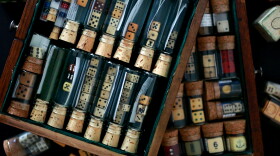 For the next several days, you can tour a huge RV trailer packed with drawers of dice, erasers and just about anything you can imagine that’s both tiny and collectible. The Show’s Amber Victoria Singer got a virtual preview from its founder and curator.
-
 The man behind Pollack Cinemas — packed with life-size figures of movie stars and characters — has a whole other collection behind closed doors at an office building in Mesa.
-
 Most collectors of presidential items have a specific niche. Maybe it’s campaign buttons, bobble heads or White House Christmas cards. Maybe they focus on a handful of select presidents or a certain time period. Not Steve Ferber. He just likes collecting what he calls "pieces of history."


