MARK BRODIE: The aging process can be a difficult one. But my next guest has decided to push back on some stereotypes of aging, including in her own family.
LAURIE NOTARO: My name is Laurie Notaro and I am the bane of my parents’ existence. How’s that? Was that enough? I can go on.
MARK BRODIE: Notaro grew up in Phoenix, and her parents still live in the Valley. She’s written many books. Her latest is called “I’ve Got a New Complaint: Essays on Aging Disgracefully and Other Small Disasters.”
I caught up with Notaro earlier, and we started with what it was she wanted to say with this book.
LAURIE NOTARO: I guess what I wanted to say with this particular book — the one that I did before on aging was "Excuse Me While I Disappear," and that was basically, it was kind of wonderful because I was getting older and I was able to be more of myself because people weren’t paying attention to me, right? I was invisible. I’d become like this human ghost. Where you kind of do, people see you as this harmless, benign entity, where in truth, you’re not.
But in this book, I’m diving deeper into that and really encompassing the fact that I was in my 60s and still in a workplace who really, you kind of aged out of civilian existence, right? It’s kind of like you join this new demographic where all of a sudden like the last little avatar that you had was like a cute little girl and like, you know, gray hair and like cute little spectacles.
And now the one in my age bracket is an old lady who who will not let go of her purse. Right? It’s like all of a sudden I’ve changed within like two years. So I’m investigating that more, and I’m I’m being, I’m learning that I’m being more bold and I really don’t care what I say to people anymore. I’ve lost whatever fear I had left.
MARK BRODIE: Well, so you talk about, you know, feeling a little bit maybe out of place in the workplace. But you start the book walking into your parents’ house where, you know, as you say, you know, you’re a couple of years away from getting Social Security and then you feel back like a preteen when you walk into that house.
LAURIE NOTARO: I still get in trouble. I still get in trouble. I still have a curfew when I go to my parents’ house and I stay. I still have a curfew.
MARK BRODIE: That you abide by?
LAURIE NOTARO: Yes, I have to, or I will still get in trouble. But every time I go there I break something because the house is really old and they’re in their 80s and they’re not, it’s not necessarily my fault, but I’m the first person who’s actually used something in 10 to 15 years. So of course the ceiling fan is going to break. And but they blame it on me just being, you know, a child.
MARK BRODIE: It sounds like the word that keeps coming to my mind, you talk about like you’re going to wear what you want and do what you want and say what you want and not really care what other people think. The word that keeps coming to my mind is it all sounds so freeing for you.
LAURIE NOTARO: I yeah, I agree. I don’t think people really, when they retire, so much of their identity is kind of like wrapped up in their job and then their occupation is gone, when they should have just been focusing on themselves. And the freedom that you get by being invisible and being this old is remarkable. It is remarkable. It is the freest I think that I’ve probably ever felt in my life.
And I have to tell you, Mark, I really do get a kick out of someone who’s looking at me, assessing me as a stereotype, as an old lady. And this happened last week in Safeway. This this girl was, it’s a long story, anyway, she was snarky to me and she said to me in a very snarky way, “Have a good day,” because she was taking up the aisle and I couldn’t get by her. She was much younger, in her 30s. And so I said, “Yeah, you too.” And then I was just like, “Oh my god, you’re trying to out-snark me.” Oh no, no, no, no. That is not going to happen.
So I looked around the store until I found her. And then I went up to her and I said, “Have a good day,” just like she said to me. And the look on her face was so worth it. She was never expecting that. She expects me to be defenseless and just not aggressive, right?
And my husband says I’m going to get shot one day, and he’s probably right. But I am now letting that aggression go because at this age, I don’t want to take it anymore.
MARK BRODIE: What was it do you think that gave you the the freedom to do that, that that led you to think, “OK, look, I don’t care. I’m going to be me. I’m going to say what I want. I’m going to do what I want. I’m going to wear what I want.” Like, was it one thing that happened, or like was it like a series of things?
LAURIE NOTARO: I think what happened was when I entered the workforce again in 2017, my book deal had just dropped, I could not make an income, so I went to work at the University of Oregon, and they put me in the old lady row. And I was not in the young lady row. You know, and so I was in this row of people, it was gray, gray, gray. And on the other side of us was blonde, brunette, blonde. And I was just like, “Wow, I’m in that class now. So hopefully they see me as someone with a lot more experience and I’m going to flex that muscle.”
And that’s when I realized that that was the really big wake-up for me. I’d let my hair go gray because I just, I wasn’t, I just wasn’t going to dye it anymore. I was like, why am I pretending, not only that, but spending the money to stay young? And I think it was that, you know, that I was not included in the young ladies at work. They saw me more as like not even a mom, like as a grandmother.
And I was just like, “Yeah, no, I’m going to I’m going to set off a couple F-bombs here and see how you react and let you know that someone my age can talk back to you or give you a good idea or give you a piece of advice that you’ve never thought about before.” So you have this fearlessness and you have the wisdom because I learn something every day.
MARK BRODIE: So you mentioned the person at the grocery store, like what other kinds of reactions have you had? Like when you drop those F-bombs at work, like what did people say? And I wonder if you’ve had reactions where people maybe have underestimated you or maybe not even thought that much about you, but then really come to realize the kind of experience and and wisdom that you must have.
LAURIE NOTARO: Constantly, constantly. Just like, you know, in a road rage incident where a guy was tailgating me, like he said something like, you know, “Come on, Grandma, you know, take take off your oxygen mask and move forward.” And I hurled an F-bomb at him. And just the look on his face was worth everything. His mouth dropped and he was, he, it was like a cattle prod that I was able to use to silence him.
MARK BRODIE: What do you think that you have learned about yourself in this process of kind of freeing yourself to be yourself and to say and do whatever it is you think is right?
LAURIE NOTARO: Oh goodness. I’ve always been, I’ve always been an antagonist, right? Always throughout my whole life. But I also knew that there were places where I couldn’t do that, like in the workplace or to an editor at Random House.
But now I’m just like, you know, “Come on, I’m 60 years old. Don’t play that game with me because you think you’re pulling one over on me and you’re not.” And now I feel the absolute freedom to say that. I have the right, I have the ability, and I have the want to say that.
My like I said, my fear has just diminished with every year that I’ve been alive, which is not necessarily a good thing. But it makes me happy. And so that, yeah, I if someone talks back and they’re wrong, I will correct you now. I will no longer be like that polite and say, “You know what? That’s not really how you pronounce that,” or, “You have your facts wrong.” You know, it’s yeah, just the freedom to express yourself on a whole different level.
MARK BRODIE: All right, we’re unfortunately going to have to leave it there. That is author Laurie Notaro, maybe best not to mess with her. Her new book is called “I’ve Got a New Complaint: Essays on Aging Disgracefully and Other Small Disasters.” Laurie, so great to talk to you, thank you.
LAURIE NOTARO: It was great to talk to you too, Mark. Thank you so much, always a pleasure.
-
 Janelle Molony has delved into that history in her new book "Birds Gone Wild (And Other Stories of Arizona Ostrich Ranching)."
-
 Seth Rachlin is an assistant teaching professor in ASU’s School of Social and Behavioral Sciences and co-author of the new book "Social Capital at Work: Building the Hidden Asset that Drives Trust, Engagement and Performance."
-
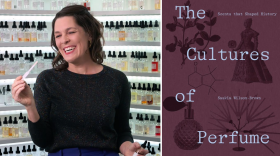 The founder and executive director of The Institute for Art and Olfaction has released a new book diving deep into the impact perfume has had on history.
-
 Carlos Alonso Nugent is a scholar of the U.S.-Mexico borderlands and author of the new book “Imagined Environments: The Making of Borderlands.”
-
 “Operation Sparrow” tells the heroic story of Florimond Duke, who helped quite literally win World War II by undertaking what many thought would be a suicide mission — and then retired to Phoenix.