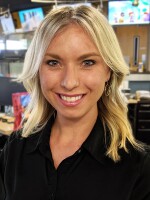
LAUREN GILGER: Local writer Melissa Dunmore may have spent the last few decades of her life in the Valley of the Sun, but she’ll always identify as a New Yorker. Born and raised in a big Puerto Rican family in the city, Dunmore often writes about family, identity and cultural legacy. And, in two stories included in the inaugural edition of Palabra magazine, she writes about two of her grandparents.
She came into our studios recently to tell me more about them. And, she told me, she sees herself as a matriarch in training.
MELISSA DUNMORE: I coined that a few years ago, even before I became a mom, because I felt like the powerful and amazing, resilient women in my life have been training me to be them one day, like whether I realized it or not, you know? Just nothing is meant to be taken for granted or thrown away, and then if you can make light of the small things in life, then the harder things are easier because you’ve been training, right? It’s like strength training, where you stress test, you know, yourself, and then when someone else is watching you, like a little girl who’s learning how to be a person, how to be a girl in this world, how to one day be a woman, she’s in training, too.
LAUREN GILGER: So you’ve got two pieces published in the inaugural edition of this Palabra magazine, it’s called Devotion, this edition. Let’s start with "Trunk Milk," the first piece you have in here, which is not about your grandmother, we’ll get to her, but this is about your grandfather, right?
MELISSA DUNMORE: Yes, my abuelo.
LAUREN GILGER: And the milk that he literally kept in the trunk of his car!
MELISSA DUNMORE: Literally for decades and generations, not the same jug of milk! A fresh jug of milk most days. I guess he did this with my mom and my aunt, too, yeah.
LAUREN GILGER: So this was unrefrigerated milk in the back of the car all the time?
MELISSA DUNMORE: Mm-hmm, yeah, in a like a box. Not a like a full cooler, which would have made, you know, more sense, but like a box of ice, you know, he tried, and it would always have a cool paper towel draped on it, like a little scarf or a little ascot.

LAUREN GILGER: What was the idea?
MELISSA DUNMORE: The idea was that he was driving kids around, it was myself, my sibling, my cousins, all over New York. He would drive my mom to the bus stop so she could take two buses, to the train, to downtown Brooklyn to get to work. Then he would drive us to school, elementary, junior high and high school.
The man was driving all the time, and he would run errands for my abuelita. We would get hungry, you know, and he would just pull, “Oh, I’m good.” He would have a thermos, which could have soup, could have hot chocolate. There was always the milk, and then like a sandwich or something.
But the amount of times, especially if we would pass, you know, a Burger King, a McDonald’s, a Wendy’s, and we were like, “Oh, that looks good, we’re so hungry,” he’s like, “ah, I got what you need right here. You’re hungry, say no more.” Trunk milk, yeah!
LAUREN GILGER: Trunk milk it is.
MELISSA DUNMORE: It raised us. It raised all of us, and I didn’t know that it was unusual or whimsical or maybe not the most hygienic snack solution! It was just life, you know, and it made sense. Food was expensive, they were on a limited budget.
If they were going to buy food, it was going to go to feed everybody because my abuela would cook all the time these massive Puerto Rican meals. I mean, we would drive around all day sipping on trunk milk, taking a bite of a sandwich, and then walk in to like an amazing stew, you know, or rice and beans for days. So it’s how he survived, I mean, and how we all survived.
LAUREN GILGER: So that story’s about the trunk milk, but it’s also about you, right, and how he supported you in becoming what you have become, which is the, what, the highest-educated member of your family ever?
MELISSA DUNMORE: That’s right, yeah, the highest-educated, I have a master’s, and he had a sixth grade education, and my abuela had, if not the equivalent, then a little bit less, because in rural Puerto Rico in the ’30s and ’40s, it was not accessible to be in education a long time. You were either helping your family on the farm or in construction, and the girls and women were feeding everybody and raising everybody’s kids together.
So it wasn’t for lack of wanting a formal education either, but it’s about — "Trunk Milk" is really about a full, whole, whole milk education, right, that you can learn just as much from life and from being, you know, in a big city driving around in a car with your grandfather as you can in a more standardized Western concept of a classroom.
So much of what I learned about life and problem-solving and literally navigating is from him. And so, yeah, this was the fuel that got me to be where I am today, where I am the highest-educated member, and he would be so proud to see that.
LAUREN GILGER: 100%. OK, so let’s talk about your other piece that’s being published here. This is about your grandmother, right, and your memories of her, her memories of recipes.
MELISSA DUNMORE: Yes.

LAUREN GILGER: And the family memories that kind of tied it all together, and her losing them, right, as she suffered from Alzheimer’s?
MELISSA DUNMORE: Yes, "La Memoria," which in Spanish means memory, and it’s a lot of different aspects of looking at memory, like memory as a whole or the fractured sense of memory that we all have that create this, you know, unifying memory of a person. Because she was — she was the youngest daughter of 14 kids, and she cooked for everybody, and on the island, her food is still famous. Nobody cooked like Pancha did, that was her nickname.
And me being her only granddaughter, I really got to absorb so much of that, her like physical recipes that we would eat, but also just like the way she lived her life and the way that she raised and loved all of us. Yeah, so all of that, like, osmosis, I feel like I absorbed it, and then I was like the container, like I was like the pot that held it all as she lost it, because she forgot all of her recipes, she forgot that she used to cook things. Her most famous things, she had no concept of it.
It’s a really cruel disease, Alzheimer’s. My abuelo also had dementia, and Puerto Ricans actually suffer in disproportionate numbers from Alzheimer’s and dementia.
LAUREN GILGER: Wow.
MELISSA DUNMORE: Yeah, so this is not — it’s not uncommon, especially in Puerto Rican families of multiple generations to have experience with caretaking for someone with dementia or with Alzheimer’s. And then that loss of cultural memory is like another mini death on top of the loss of the person, right, because then you become their tether to the homeland, to the culture, where it used to be the other way around.
LAUREN GILGER: So I want you to read the very end of that essay for us, because it hits on a lot of those things that you just outlined. This is about the idea, right, that smell is tied to memory, and you thought maybe it would reawaken some of the memories, the cooking. Read that part for us.
MELISSA DUNMORE: Sure.
"It is said smell is strongly tied to memory, and music lights up parts of the brain unaffected by dementia. Maybe the melody of the mangoes, quizás, the guinepas could, perhaps the plantain, suppose the starfruit, or certainly the ceiba knows what to whisper to the wind to make coquís in the trees trill their tiny voices to write her recollection, if even for a moment. And for safekeeping, I can preserve her in a pastel for posterity, wrap her in a banana leaf blanket on sugarcane sheets and hibiscus pillows."
LAUREN GILGER: That’s such a beautiful ending.
MELISSA DUNMORE: Thank you. I read this part and modified it slightly for her eulogy. Yeah, it felt really appropriate, yeah.
LAUREN GILGER: So let’s end with a question about that theme, right, of motherhood, of matriarchy, that is definitely in this piece of writing of yours, but is in a lot of your writing. Do you as a mother now to a little girl, do you pass that on to her? Do you feel like, again, that maybe that responsibility to do that?
MELISSA DUNMORE: Yes, I do, and I find myself doing it, it’s like breathing. Like I’m going to talk in Spanglish, I’m going to, you know, reference, “Oh, my abuelo used to sing this song,” or “This reminds me of that.” I’ve become folksy like they were, and it feels really nice, and then I feel like I’m closer to them now that I’m in this place where I’m the knowledge bearer, and we’re creating our life together, and I feel like I feel some of the the joy and the love, the joyful responsibility of raising the next generation.
And it’s not something that I take lightly, you know, like depending on who you talk to, like, “Oh, kids are just, you know, they’re just kids, and like just keep them alive,” or I feel like it’s so much more than that, and there is a level because she is a girl, because she is multicultural, because we have this rich heritage, because I’m raising her in diaspora, like I grew up in diaspora. So I want her to feel that pride. I’m really determined to fill her cup, you know, as much as she can hold, I’m willing to pour into her.
LAUREN GILGER: All right. Melissa Dunmore, local writer, storyteller, joining us. Melissa, thank you so much.
MELISSA DUNMORE: Thank you so much for having me.
-
 The open enrollment period for the Affordable Care Act opened this week, and will stay open through Dec. 15 for policies that take effect on New Year’s Day. But this year, there’ll be some changes — both in the sign-up process for some policies, and how much they cost.
-
 Carlos Alonso Nugent is a scholar of the U.S.-Mexico borderlands and author of the new book “Imagined Environments: The Making of Borderlands.”
-
 The Major League Baseball season is over, and the sport faces an uncertain 2027. It can often be a game of heartbreak. But for Mark Athitakis, fall baseball in the Valley inspires optimism.
-
 The 12th annual Great American Seed Up is this weekend in Phoenix. One of the founders says there’s no event like it in the country.
-
 The Phoenix City Council will get two new faces. In District 2, the close race will eventually come down to a runoff between two of three Turning Point-endorsed candidates.