MARK BRODIE: How did a bookstore become a sort of cultural institution? Gioia Woods explores that question in her book, “City Lights: Lawrence Ferlinghetti and the Biography of a Bookstore.”
The book tells the story of Ferlinghetti — a poet, painter and activist, among other things — and the all-paperback bookstore he started in the early ’50s called City Lights in the North Beach community of San Francisco. Ferlinghetti also started City Lights Press in 1955.
Over the years, the shop has become a gathering place for people to browse, read, meet and talk.
Woods, who’s a professor of humanities at NAU, joins me to talk more about Ferlinghetti and the store he started. Gioia, what kind of role does City Lights play in that neighborhood and in the city and community more broadly?
GIOIA WOODS: So it has played a consistent role in bringing sort of avant-garde literature to the community in North Beach. It sits sort of at the cusp of North Beach and Chinatown, and in its earliest days, it attracted folks who wanted a place to go hang out.
In those days in the United States, bookstores were more like white-glove affairs. They were — you had to go in knowing what you wanted, and someone would pick a hardcover from the shelf.
But Ferlinghetti, based on his experience in Paris at the Sorbonne after World War II, wanted to establish a bookstore where people could go and meet and hang out and talk ideas. So it became sort of a meeting place, and it was really important to the community.
People of all types would gather there, and Ferlinghetti reflected that there was a real deeply felt need for this kind of institution. When he first opened it, he couldn’t close the doors at closing time.
MARK BRODIE: Did it turn into what Ferlinghetti had wanted it to be? Like did it sort of fulfill his vision for what he wanted?
GIOIA WOODS: His vision was to establish a place where inexpensive literature was available to people to put into their pockets. He very famously established the Pocket Poets Series with his press in 1955. And I would say that, absolutely, yes. It turned into the kind of place Ferlinghetti thought was missing in the United States, and that was a bookstore where you could go loaf and lounge and linger and talk ideas.
So yeah, indeed, indeed it did. And it served over the decades different purposes. It’s sort of like a cultural first responder. It came to wherever the sort of cultural need was in the 1950s and ’60s with the stifling conformity of the Cold War; in the ’70s with the new ecology movement and the Vietnam War; in the ’80s and ’90s with Latin American intervention and the AIDS crisis, particularly ground zero in San Francisco. 9/11 and the advent of Islamophobia in the 21st century in the United States. So it became a place that stood for progressive values. Yeah.
MARK BRODIE: And do you see sort of a straight line between this store and what independent bookstores have become? Like listening to you describe it, I’m thinking about stores even in the Valley that have chairs or couches to sit on, or hold events there, they have event spaces there. Like it seems as though that was sort of the template that a lot of other stores tried to follow.
GIOIA WOODS: Yeah, absolutely. I think that City Lights really established a precedent, first of all, by taking the paperback, which had a pretty bad reputation in the 1950s, right No good could come of reading a paperback except sort of whiling away time while you’re waiting for a train or something. But Ferlinghetti turned the paperback into a tool of revolution, really an idea to put sort of radical ideas in people’s pockets.
And then I think that his model of independent bookstore even influenced the superstores. When Waldenbooks came along and when Barnes & Noble came along, you probably remember that they had couches and even play sections for the kids. So the whole attitude about books, about books and bookstores and how they serve the community really changed. It wasn’t just for an elite audience. It was for everyone.
MARK BRODIE: Which I imagine had implications just beyond that store and that community, right? Like the more people who have access to literature or nonfiction or really any kind of book, really, it seems like that would have an impact.
GIOIA WOODS: Absolutely. One of the things Ferlinghetti did early in his career was he established relationships with publishers, writers, translators, poets, artists, provocateurs all over the world. So he had this amazing network of contacts globally.
In the 1970s, teenagers from the then-Czechoslovakia were writing him saying, “Oh, we follow your bookstores, send us a copy of Allen Ginsberg’s latest poems.”
MARK BRODIE: So what is your connection to this store?
GIOIA WOODS: Ah! So my connection — I was always a kid who loved to read, but I always felt sort of like, “Oh, you know, I don’t understand what these poems are supposed to mean, these poems are sort of off-putting.” I had a version of like math anxiety when it came to poetry, but I really wanted to be the kind of person who could read poems.
And I came across a Ferlinghetti poem called “The Old Italians Dying” when I was a high school student in Los Angeles. And I recognized my people in there, you know? And I thought, “Oh, my gosh, this is great,” and I could understand it, and it spoke to me, and it moved me.
And I found out that this fellow, Ferlinghetti, who had written this poem, also ran a bookstore in the Bay Area. So as soon as I got my driver’s license when I was 16, I made my first pilgrimage to City Lights.
MARK BRODIE: Which is not a short drive between LA and San Francisco.
GIOIA WOODS: No, it’s not a short drive. Yeah. And it turns out that it really is a place, even now, then and now, a place where people make their pilgrimages to because it’s a site that has long stood for freedom of expression, for poetry off the page, for the meaning of literature and words, yeah.
MARK BRODIE: Have you seen an evolution in this store from that first pilgrimage when you were in high school to now, either in terms of like just easily like how it looks or what it means to the community and beyond, its impact, that kind of thing?
GIOIA WOODS: I think its meaning has remained the same because one of the gifts that Ferlinghetti left over the course of his very long life was consistent values. He was all for supporting the community in providing alternative ideas.
And in terms of the bookstore as a physical space, one of the things that impressed me then and now is that it had a really robust section of what was then called third world literature.
It was one of the only spaces in the community where someone could go buy books by Indian authors or Cuban authors or Russian authors. And this is thanks to Lawrence Ferlinghetti’s vision, right? That there’s a sort of global avant-garde, and he really set out his feelers and tentacles to find that global avant-garde.
The bookstore has changed in some physical ways. Now there’s a really wonderful storefront banner series that was first developed in the early 21st century in response to global crises like 9/11, where the storefront is used to display beautiful renderings of Ferlinghetti or other people’s poetry. So it’s really recognizable. It sort of sends a message to the community. And so the storefront banner series has become sort of like its own broadside, its own poem that’s recognized by the community.
MARK BRODIE: All right. That is Gioia Woods, a professor of humanities at Northern Arizona University and author of the book, “City Lights: Lawrence Ferlinghetti and the Biography of a Bookstore.” Gioia, thanks so much. I appreciate it.
GIOIA WOODS: Thank you, Mark.
-
 Janelle Molony has delved into that history in her new book "Birds Gone Wild (And Other Stories of Arizona Ostrich Ranching)."
-
 Seth Rachlin is an assistant teaching professor in ASU’s School of Social and Behavioral Sciences and co-author of the new book "Social Capital at Work: Building the Hidden Asset that Drives Trust, Engagement and Performance."
-
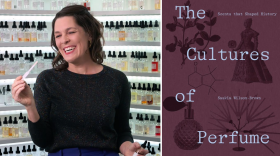 The founder and executive director of The Institute for Art and Olfaction has released a new book diving deep into the impact perfume has had on history.
-
 Carlos Alonso Nugent is a scholar of the U.S.-Mexico borderlands and author of the new book “Imagined Environments: The Making of Borderlands.”
-
 “Operation Sparrow” tells the heroic story of Florimond Duke, who helped quite literally win World War II by undertaking what many thought would be a suicide mission — and then retired to Phoenix.