MARK BRODIE: Colorado might be known today in the political world as a blue state, but a few decades ago, it earned the nickname “The Hate State” after voters there passed what was known as Amendment 2, which made it illegal to prohibit discrimination on the basis of sexual orientation.
In 1992, a Christian coalition called Colorado for Family Values saw places like Boulder, Aspen and Denver enacting antidiscrimination measures that protected gay people and wanted to stop it. And their efforts were successful: Amendment 2 passed, and not by a tight margin.
Our next guests dug into the political context of Amendment 2 and see parallels between what happened then and what’s happening now with attacks on trans rights. Ann Marie Awad and Xandra McMahon are the hosts and executive producers of the new podcast Hate State, out now.
My co-host, Lauren Gilger, spoke with them both more about it and how surprising it was that Amendment 2 passed that year.
ANN MARIE AWAD: You know, in the run-up to the election, the polling was not in favor of Amendment 2. And in fact, this year we’re facing a midterm, but that was a presidential year. So, you had Bush versus Clinton at the top of the ticket. You also had Colorado’s Taxpayer’s Bill of Rights, which I think took up a lot of the sort of oxygen in the room when it came to media coverage. So, I think like most people here in Colorado were expecting this to fail. And it ends up passing, I believe, by 57%.
LAUREN GILGER: Wow. OK, so not even by a little bit. This didn’t last incredibly long, right? This was quickly put on ice, it sounds like, by a district court in Denver. It ended up at the Supreme Court. What happened?
XANDRA MCMAHON: That’s true. There was kind of at the same time of all the campaigning for Amendment 2, there was another group that was preparing a legal case against Amendment 2 in the event that it passed. So, it was actually never in effect for a single day.
They slapped it with an injunction on the kind of Denver district court level, and then it works its way up through the Colorado Supreme Court, and then eventually makes its way all the way up to the U.S. Supreme Court, resulting in Romer v. Evans, which is a precedent that is cited in several cases after Romer v. Evans.
And the decision came down in ’96 that Amendment 2 was not constitutional and it needed to be removed. But you see this kind of long tail of impact from Romer v. Evans in future LGBTQ Supreme Court cases.
LAUREN GILGER: Right. And it earned Colorado this “Hate State” nickname, right? Which it sounds to me like the state has spent a long time trying to get rid of.
ANN MARIE AWAD: Yeah. You know, it’s very funny. I think when Xandra and I have talked to people about this podcast and we’re like, “Did you know that Colorado did this in the ’90s?” People usually have never heard of it and are kind of surprised. But it was a long, hard road.
I mean, we got in a lot of trouble nationally. “Frasier” was supposed to film here, but didn’t; they moved because of the passage of Amendment 2. I know, right? Stephen King was supposed to film a miniseries here that also moved to Utah, again explicitly because of Amendment 2. You had Barbra Streisand out there saying that people should stop taking vacations in Colorado. You have other cities that said, “We’re not going to do business with firms based in Colorado.” It was a big, loud backlash.
LAUREN GILGER: OK. So, let’s talk about what’s happening in Colorado today, because that’s sort of the framing you’ve created in this podcast series. Colorado has two propositions on the ballot related to trans rights, right? Tell us a little bit about those.
XANDRA MCMAHON: So, Proposition 134 and 135. And so, 134 would deal with a ban on trans youth participating in the school sports of their choice, and 135 would prohibit any health care provider from providing gender-affirming surgeries.
And we always kind of like to give the caveat when we talk about these two propositions that for the gender-affirming surgery one, those happen already very, very rarely in Colorado and across the country. I mean, these are not surgeries that are happening on a regular basis.
And then for the school sports one, it’s also very unclear in the language of the proposition how that would actually be enforced, ensuring that kids are not joining sports teams that don’t align with their biological sex. There’s no language in here describing how that would be enforced.
LAUREN GILGER: Are there some similarities in that way between what’s happening now in Colorado and what happened in 1992 with Amendment 2?
ANN MARIE AWAD: I would say absolutely. I think that a lot of people have pointed out the lack of enforcement language in the sports ban, but it’s really fascinating where it is explicit. It is explicit about who is a man and who is a woman and what kind of organs they have.
And similarly with the affirming care measure, it’s a little fast and loose with the wording. In certain parts, it refers to medical treatments rather than surgeries, and so there is — there are a couple people that we talk to in the course of reporting this podcast that are concerned that that could be argued to apply to other types of gender-affirming care.
LAUREN GILGER: That’s interesting. Tell us about the campaign that’s being waged in Colorado right now in terms of these measures. Who’s behind it? Is it contentious? You seeing a lot of public debate?
ANN MARIE AWAD: I mean, so just ambiently as a voter in Colorado right now, we have, I believe, 15 measures on the ballot this election.
LAUREN GILGER: Wow.
ANN MARIE AWAD: And every day, I feel like I am being buffeted from all sides about text messages for each one of these measures. I think you see a lot of the campaigning to the choir, so to speak. But in these last few weeks leading up to the election, I actually see the countercampaign getting a lot more active.
Again, to go back to sort of the length of the ballot, I think there is debate in this election and it’s just not about this measure. And it’s one of our motivations for doing this series is like we were just worried that these are two pretty consequential measures that might get lost in all the noise for the average voter.
LAUREN GILGER: That’s really interesting. And it’s not just Colorado, right? Like this is not happening in a vacuum. Like we’re seeing here in Arizona a Prop. 138 on our ballot, which would ban transgender students from school sports, restrict access to restrooms and locker rooms. Similar measures like this are on ballots across the country.
XANDRA MCMAHON: Oh, absolutely. Yes. We’re seeing it in several other states. Very similar groups, I think, that are pushing these forward. I think they all kind of are of varying names of like “Protect Kids” something, like insert state here.
ANN MARIE AWAD: Yeah. Y’all have Protect Girls’ Sports Arizona, something like that, yeah.
XANDRA MCMAHON: So, yeah, it is — we’re seeing it definitely kind of widespread.
LAUREN GILGER: Let me ask you lastly, both of you, about — you mentioned why you wanted to do this podcast: You didn’t want these measures to get lost in the noise. And it’s coming in this moment in which I think LGBTQ+ people around the country feel very under attack in a lot of ways. How consequential does this 2026 election feel for folks in the country right now?
ANN MARIE AWAD: I mean, I think it’s a little depressing to talk about, honestly, because of the way that even just pulling clips for this podcast, the way that trans people are the focus of so many campaign ads, and at the same time don’t really have much of a voice in the national debate about their own lives at all. That was also one of the primary motivations for us doing this podcast.
I think that this is — I think this election is certainly existential for a lot of people. And not just for trans people. I think, you know, I come back to a quote from Phil Nash, who was one of the founders of the Center on Colfax, one of Denver’s oldest community centers for LGBTQ people. And he was around during Amendment 2. And he talked about the emotional fallout from Amendment 2 succeeding, and about how it felt very personal because his family had voted for it, neighbors could have voted for it, his coworkers could have voted for it.
And I think that there’s a real question of that in this election. It’s like, are you going to vote for something that might hurt your neighbor’s family? I think that’s the really real question. That’s the thing that feels the most like 1992, that we could be coming up on a really consequential election and half the country might not even recognize that, because this issue isn’t breaking through for them.
XANDRA MCMAHON: But one thing you saw in the ’90s was this huge rallying of support around this community. You saw a lot more people coming out of the closet in Denver after Amendment 2 happened, Pride celebrations growing, PFLAG grew. So, I just think that there is also a tone of, regardless of how this midterm election goes, I think that the community, the queer community, will always find a way to kind of rally together and make sure that our trans community members feel supported.
LAUREN GILGER: I think that’s a good note to end it on. Xandra McMahon and Ann Marie Awad joining us, the hosts and executive producers of the new podcast Hate State. Thank you both for being here. Thanks for taking the time. I appreciate it very much.
ANN MARIE AWAD: Thank you.
XANDRA MCMAHON: Thank you so much.
-
 Raquel Terán — former state lawmaker, community advocate and founder of advocacy group Proyecto Progreso — says her own career as a Latina activist in Arizona was inspired by Dolores Huerta’s message.
-
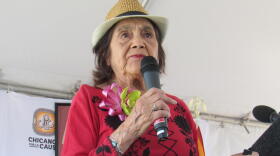 In a 2022 golden anniversary visit to Santa Rita Hall near 10th Street and Buckeye Road, Dolores Huerta recounted the history she made there after meeting with prominent Latinos to seek help overturning a law to stop farmworkers from organizing.
-
 Phoenix Pride and other similar organizations have been holding events celebrating the LGBTQ community in October, including a parade earlier this month. As the month comes to an end, The Show wanted to check in on the state of advocacy for and within the LGBTQ community.
-
 Maricopa County is appealing a judge’s decision to keep the Sheriff’s Office under federal court oversight, citing cost and claiming racial profiling behavior by the department has been fixed.
-
 ABC15 chief investigative reporter Dave Biscobing broke the story and sat down with Phoenix police Chief Matt Giordano to talk more about how people in south Phoenix can trust the department given its history there and this latest scandal.