






MARK BRODIE: An exhibit at a Phoenix gallery pays tribute to someone you’ve probably never heard of. And to be fair, some of the artists whose work is in the show also didn’t know their subject.
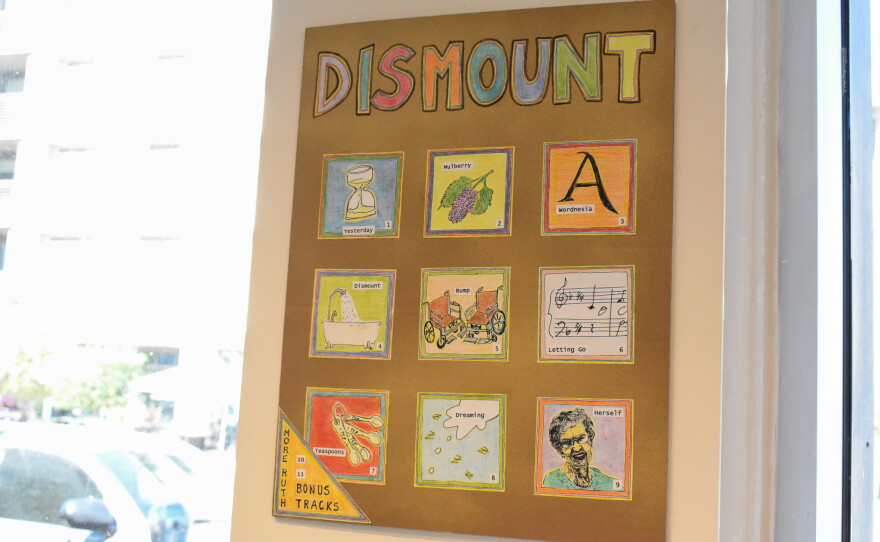
“Ruthless” is a show based on the life of a woman named Ruth Bird Scholl, who lived in the Valley and had a number of different kinds of jobs during her life, from working in a hospital to an insurance company to the Urban League. Ruth was also the cousin of Amy Bird’s grandfather. Bird is a member of the Eye Lounge art collective and the curator of “Ruthless.” She and Ruth only met in 2010 when Ruth was 85. She died early last year.
I recently visited Modified Arts in downtown Phoenix, where “Ruthless” is on display, to chat with Bird about the exhibit. And we started there, that she only met Ruth fairly recently.
AMY BIRD: My grandfather was a bit of a loner. And like many families in the U.S., we had a lot of people who moved a lot. My dad probably went to 20 schools before he graduated from high school.
And we didn’t have big family reunions on my dad’s side, like on my mom’s side. So it just happened that I didn’t meet Ruth until someone said, “Hey, if you’re interested in stories about the family, maybe you should meet Ruth.” Turns out she lived 10 minutes away from me in Tempe.
MARK BRODIE: Ten minutes away, and you’d never met her before and she’s related to you.
AMY BIRD: Exactly.
MARK BRODIE: So what was that first meeting like?
AMY BIRD: Well, I called her up, and just could tell by the quality of her voice that she had an open heart. And we agreed to meet at a restaurant. And the minute I walked in, I saw her, and she looked a lot like how I remember my great-grandmother: wore a lot of turquoise jewelry, and she had really big earlobes. I knew it was a relative.
MARK BRODIE: So what did y’all talk about? I mean, I would imagine there’s a lot to catch up on.
AMY BIRD: Well, like I said, I didn’t meet Ruth until she was 85, so I think she had honed some of her stories pretty well. And she told me stories about growing up on a watermelon farm, the family watermelon farm, about 80 acres near Bethany Home Road and 27th Avenue.
And she told stories about how she actually took care of my father for an entire week when he was about 10 months old and his parents needed to travel to L.A. I’d never heard anything about that. Maybe he didn’t even know that that had happened.
MARK BRODIE: Wow. She sounds like a real font of family lore.
AMY BIRD: Definitely. Family lore, and also her own lore. She told stories about just how she got to know herself and become herself.
MARK BRODIE: Yeah, what was she like? Talk about her personality a little bit.
AMY BIRD: Well, whenever I describe Ruth or talk about Ruth, there’s always a point where you say, “Ruth grinned,” or “Ruth cackled.” She had a real sense of humor, kind of self-deprecating humor, and very quick-witted and wry. There’s a piece here in the gallery that I put together where I actually asked different people to give me three words that described Ruth.
MARK BRODIE: Yeah, let’s take a look. Which one is that?
AMY BIRD: It’s this piece over here called “Becoming.”

MARK BRODIE: OK, so it looks like you can see face and hair, and there are some words that are sketched on there.
AMY BIRD: Right. My first idea was to get a paint-by-number so that people could come into the gallery and actually participate in creating Ruth’s portrait. One really important thing about “Ruthless” is it’s a collaborative show. By the time I started working on this piece, though, some of the paints had dried up, so I needed to take a different approach. And I just had that moment where I thought, “Well, what if I make it paint-by-word?”
So I asked a number of different people — some of the collaborating artists, people who had known Ruth — and I happened to have access to a memory book that people at New Arizona Family made for her when she retired at age 80 in 2005. So this is a selection of words that describe Ruth.
MARK BRODIE: So some of the words: There’s irreverent, there’s compassionate, resilient, best friend, content, good egg. Sounds like, it’s interesting you wanted this to be a paint-by-numbers kind of thing. It sounds like Ruth was somebody who was not like a paint-by-numbers personality.
AMY BIRD: Exactly. And I do want to point out, because it is very important that I am not conveying Ruth as a saint, some of the words I picked were thick-skinned and stubborn.
MARK BRODIE: Ah, OK. So interesting that you’re really trying to portray like a full picture, not just lionizing somebody.
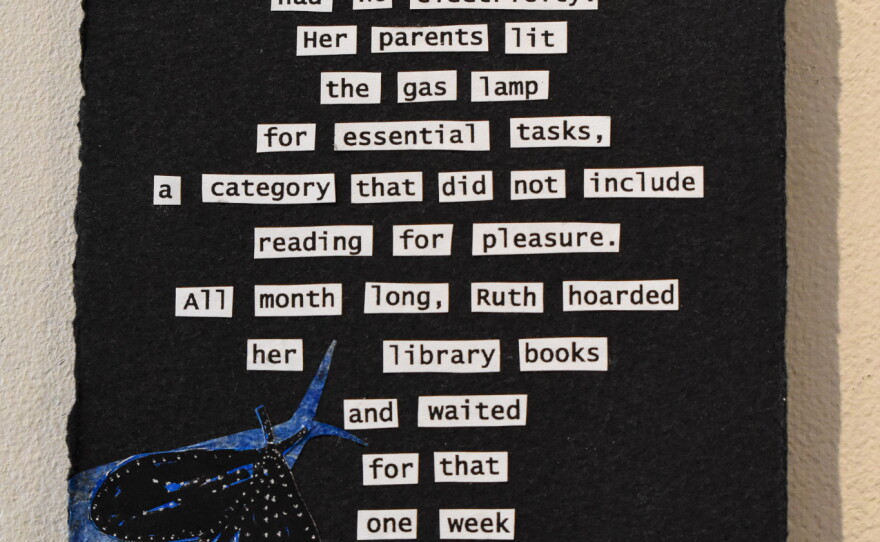
AMY BIRD: Exactly. And I think one of the other pieces that I worked on, I realized that so many of my stories had to do with Ruth’s love of books. So I actually made a series of bookmarks, each telling about her encounter with a book, mostly as a child and young woman.
MARK BRODIE: So you mentioned that this is sort of a collaborative show. Did all the artists know her or have met Ruth at some point, or were some kind of flying blind?
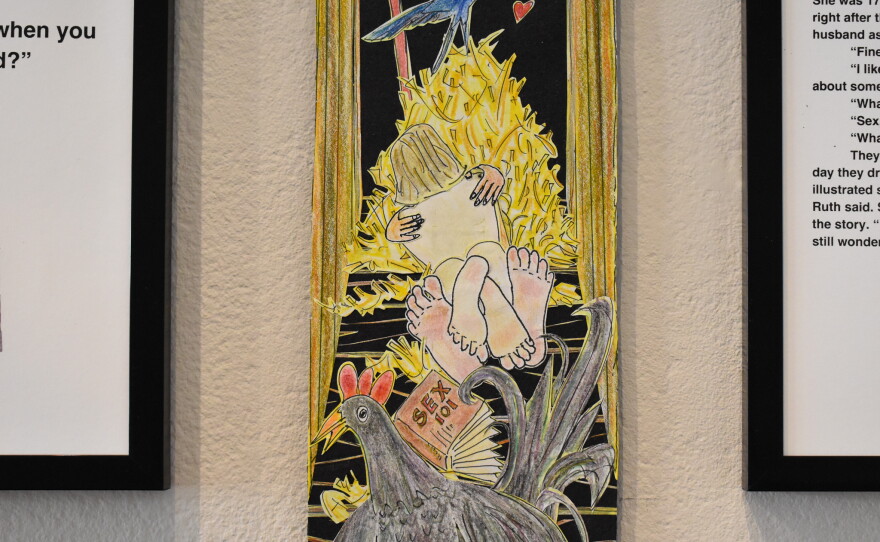
AMY BIRD: Definitely flying blind. It’s a real collection of people, very multigenerational. It’s ranging from age 5 to age 80, some family, some friends. And yes, some of the artists did not know Ruth. I shared some of the stories, and then they just went on their own with that.
MARK BRODIE: Well, so how do you try to do that? Because you mentioned with one of the pieces that you don’t want to portray her as a saint. So when you’re talking and describing her and telling stories of hers to people who had no idea who she was or what she was like, how do you try to make sure you’re really giving a full picture to get sort of the most accurate artistic representation?
AMY BIRD: Well, what I know about Ruth, I really learned from how she talked about herself. So accuracy, yes, but I think with art, you just kind of have to follow your own thread. And that’s one of the real themes of the show: that we become ourselves through interacting with other people, through those connections.
MARK BRODIE: Well, it’s interesting, one of the things you mentioned about Ruth was that she really kind of had a sense of herself, which I think is something that a lot of people work towards and in some ways struggle with. Was that informative to you at all when you’re working on your pieces, or maybe describing her to people who hadn’t met her?
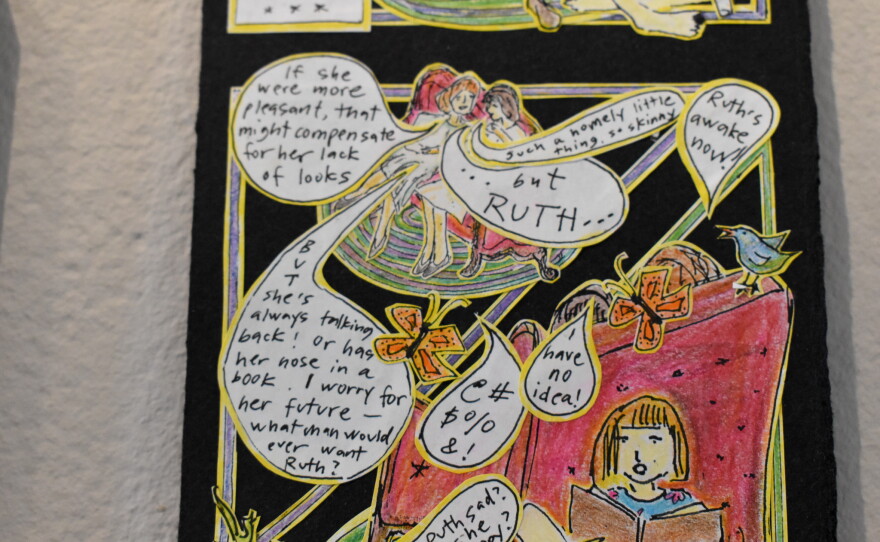
AMY BIRD: Yes. One of the stories that really resonated with several of the artists is a story that Ruth told that I really think of as one of the anthems of her life. She talked about being, you know, maybe 10, 12 years old at the most. She’d been outside reading in a tree, of course, was hot, came inside, wanted to get a glass of water from her aunt’s house and she was sitting behind a couch reading, and she started listening to her aunts, two of her aunts, talking about her, comparing her not so favorably to her sister and cousin: that she was kind of ornery, kind of mouthy, maybe not as polite and pretty as they were.
And so she had this moment where they were certainly describing that they weren’t sure she was up to snuff. And her first moment, or first thought, was a little bit crushed, and then right away, she thought, “Well, if I don’t fit the rules, maybe I don’t have to play by the rules.”
MARK BRODIE: That seems like a really deep thought to have at 12 or younger.
AMY BIRD: Right. And I think she had the spark at 12 or younger, and then I think she had her whole life to really think about that and have that be a seed of a hope and freedom and possibility.
MARK BRODIE: What do you think she would make of all this?
AMY BIRD: She would think it was hysterical.
MARK BRODIE: How so?
AMY BIRD: I think that she would enjoy the stories, and that also she would think it was way too much attention on her.
MARK BRODIE: Would it make her a little uncomfortable, do you think?
AMY BIRD: I think everybody’s a little uncomfortable when they see themselves through other people’s eyes, but I think she would enjoy it. And I think she would especially enjoy people getting together, creating something.
MARK BRODIE: And maybe getting to know people they didn’t know before.
AMY BIRD: Exactly.
MARK BRODIE: So this is going to be up into November. Do you imagine that you’re going to continue — is she going to continue to inspire your art even once this exhibit is down?
AMY BIRD: I’m sure of it. I don’t know how, but I’m sure she will.
MARK BRODIE: All right. Amy, thank you so much.
AMY BIRD: Thank you.
MARK BRODIE: That was Amy Bird, the curator of the exhibit “Ruthless,” which will be on display at Modified Arts through Nov. 15.
-
 “Operation Sparrow” tells the heroic story of Florimond Duke, who helped quite literally win World War II by undertaking what many thought would be a suicide mission — and then retired to Phoenix.
-
 The Douglas Municipal Airport is still operational, but is ineligible for FAA funding because it’s listed on the National Register of Historic Places
-
 Apple Annie’s Orchard, 81 miles east of Tucson, is bucking the trend of declining acreage, and is one of the farms in Arizona that still contributes to those harvested acres.
-
 Raquel Terán — former state lawmaker, community advocate and founder of advocacy group Proyecto Progreso — says her own career as a Latina activist in Arizona was inspired by Dolores Huerta’s message.
-
 There are close to 4,000 people buried at the Pioneer and Military Memorial Park in downtown Phoenix. Some are well known — people like John Alsap, Phoenix’s first mayor. But there are also stories of everyday pioneers and settlers who came to the Valley looking for a better life.


