LAUREN GILGER: Arizona was pounded with rainfall over Halloween weekend as the super El Niño continues to deliver. Across the state, we’ve seen reports of flooding, evacuations and storm damage rack up.
But here in the desert Southwest, we are in a megadrought, and headlines across the region have been dominated in recent months by dire warnings about our increasingly uncertain water future.
So a whole lot of water — on that level, at least — is a good thing, right?
Jacob Richardson is SRP’s senior hydrologist, and he’s on the line now to tell us more. Good morning, Jacob.
JACOB RICHARDSON: Hi. Good morning.
LAUREN GILGER: Thank you for coming on. Over the weekend, I had more than one person ask me about this, basically the question being: All of this water falling from the sky right now has got to help our water situation, right? Tell us, does it?
JACOB RICHARDSON: Yeah, absolutely it does. These are wonderful events —precipitation events— for the Valley’s water supply. These are the ones that we really rely upon to fill the reservoirs. Because we are a desert, we do experience these prolonged periods of drought. Periods like this past weekend, and really just over the last few months that have continued to bring rain kind of on a steady rhythm, have been really beneficial for us in terms of water supply.
LAUREN GILGER: OK, so talk about SRP’s water situation in particular, because you have reservoirs, as you’re talking about up north. These are not the big Colorado River reservoirs we’ve heard so much about of late in Lake Powell and Lake Mead, but we’ll talk more about that another time. Tell us about SRP’s system and where this water can be stored.
JACOB RICHARDSON: SRP manages reservoirs on two different river systems: the Verde River and the Salt River. Currently, the water that you see moving through the Valley, that’s coming through mainly from the Verde River system. We have the two reservoirs that we have on the Verde are Horseshoe and Bartlett. The percentage of storage that they provide for us in terms of storing water is much smaller than anything that we have like Roosevelt Lake, on the Salt side. When we have big events like we’ve had, those reservoirs are going to fill up faster. Just because of how much rain we got, the Verde system is now full and we’re having to release that water.
The Salt has seen just as much water as the Verde; it’s just that we have so much more storage space on the Salt side of things that we haven’t had to release water out of Roosevelt and the other lakes there. These things are something that, as the SRP system has been developed over 120 years, we’ve learned how to manage these types of events. Everything that’s been happening really has been just kind of according to the way that we operate during big flood events like we’ve had.
LAUREN GILGER: Right. I noticed this: I drove this morning over the Salt River, which is almost always dry down there, and it was like a real river. Tell us about how much water we’re talking about when you make these releases.
JACOB RICHARDSON: It’s been great to see the water in the river. Obviously, there’s some negative impacts that come along with that, but in general, these are really positive things for us. We’ve been releasing, like I mentioned, out of the Verde system from Bartlett Dam. Yesterday, we were releasing approximately 60,000 cubic feet per second. Today, that has come down. Now we’re down to about 33,000 cubic feet per second. That process is just us responding to how much water is coming into the system upstream, and we have to pass that water through the reservoirs. Those flow rates will continue to decrease as the waters recede in the rivers upstream, but it’s going to continue to flow. The Salt River will have water in it for several days, if not weeks, going forward.
LAUREN GILGER: How uncommon is this? I can remember one other time, I think, I remember seeing water flowing through the Salt here in Phoenix in recent years. Is this pretty uncommon?
JACOB RICHARDSON: I would say water in the river is probably not that uncommon. I think the last time we had releases into the river was in 2023. But the magnitude of releases that we’ve seen and had to make this year are relatively uncommon. I think the last time that I understand that we’ve released that much water from Bartlett was probably 1993. People who have been here for a while remember ’93 and how impactful that was. Over since then, a lot of the infrastructure that’s been built — the bridges, we have Tempe Town Lake, and all those things — have been built to manage these types of flows. We’ve seen fairly few negative impacts to infrastructure and things like that, so that’s a good thing.
LAUREN GILGER: So where does the water go? You can only store so much of it, as you’re saying, in the reservoirs upstream up north there. When you release it down, does it go into groundwater supply? Is it used?
JACOB RICHARDSON: Yeah, that’s a great question, and one that’s kind of difficult to answer in terms of what happens to the groundwater. We do have some estimates based on flow rate and duration of the flooding, how much actually is going to soak in through the riverbed and into the aquifers below. But the majority of that water is going to make its way across the surface into the river and on downstream. The Salt River combines with the Gila River out on the west side of the Valley, so all this water that’s making it through that doesn’t soak in or doesn’t end up ponding and sticking around is going to make its way downstream into the Gila River.
LAUREN GILGER: And once it goes there, it’s not something we can benefit from here in the Valley. Does it go to agriculture after that, or just keep going?
JACOB RICHARDSON: In terms of water rights, there are folks downstream that have the ability to access that water. But once it’s out of the Salt River system and it crosses over Granite Reef, we don’t have any ability to pull that water back out of the river. A few folks do downstream, but once it’s released from us, it’s not something that’s necessarily used for Valley water supply.
LAUREN GILGER: Last question for you in the last minute here, Jacob. Tell us, what does this big picture do for our big-picture water supply going forward in the future? As we’ve said, there’s so much concern right now about the future of water in Arizona and where it’s going to come from, and cuts to the Colorado River, which so much of it comes from. This is a different water supply than that, but does this make a long-term dent?
JACOB RICHARDSON: Certainly, what I would say long term, this falls in line with what we’ve seen for decades here in Arizona. We have these periods that are dry, and then they’re followed by wetter periods that we refer to those as pluvials. The last pluvial, the last really wet period, was in the ’70s and ’80s, ended around ’97. And then we’ve been in this drought, as you mentioned, here in Arizona and more extended throughout the West.
These types of events like we’ve had this last weekend, we anticipate that they’ll continue, but they’re going to be interrupted by long periods of dry. That’s just kind of how the nature of Arizona works; we’re a desert area. But we rely on these types of events to fill the reservoirs to continue to provide that reliable water supply.
I would expect that to continue. As we speak and meet with climate forecasts and scientists, that’s what they continue to tell us: The drier periods are going to be drier, the wet periods may be wetter and more extreme, and so we need to be prepared to handle that. I think that’s been the case for us here in Arizona for a long time. Looking out further to the west as a whole, maybe there’s some more uncertainty about that, but in terms of SRP, the way we manage water supply, this event falls right in line with what we’ve been planning for over the last few decades going forward.
LAUREN GILGER: Jacob Richardson, SRP’s senior hydrologist, joining us. Thank you so much. Appreciate it.
JACOB RICHARDSON: Hey, thank you.
-
 The Arizona Department of Transportation says there is no estimated time for completion of the remaining reconstruction efforts. Passage between Flagstaff and Sedona is limited to State Route 179 and the I-17.
-
 A major Arizona water agency is pulling its funding from a program designed to bolster the water in the Colorado River. KJZZ's Alex Hager tells us more.
-
 Zach Ben and wife Mary run two farms in northeast New Mexico where they grow, steam and blend corn in traditional Navajo fashion to make Bidii Baby Foods.
-
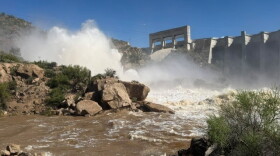 The Salt River Project says its reservoir system saw big gains after the autumn rains, helping refill a pivotal supply for the Phoenix area.
-
 ADOT has partially reopened SR89A after flood damage in the region late last month