LAUREN GILGER: The Valley has over the years been a place countless people who have lived interesting lives have come to retire. The new book “Operation Sparrow” tells the heroic story of one of them and how he helped quite literally win World War II by undertaking what many thought would be a suicide mission.
In 1944, Florimond Duke and a team of spies parachuted into enemy territory with the goal of being captured by the Nazis so they could sell a lie about where D-Day would take place. While everything didn’t go to plan, the lie worked, and Hitler’s troops were not amassed at Normandy when D-Day struck.
Duke, a former New York Giants football player and advertising executive and eventual Phoenix retiree, was the perfect man for the job. Author Jason Bell told me why.
JASON BELL: Florimond Duke was the functional equivalent of the American aristocracy. He was wealthy, good-looking guy, tall, well-built. He played professional football for the New York Giants. He joined World War I as the very first armed unit that went to the front, and then he became an officer with the French military before he was transferred to the American military flying fighter planes.
The 1920s, he was the advertising director for the Time publishing empire. This included Fortune, Newsweek, Life magazines. Became very wealthy. But when World War II broke out — and this was before America became involved — Florimond Duke volunteered to serve once again because he saw that the war was coming.
And then he was quickly recruited into the OSS, which was America’s wartime intelligence agency. It was kind of the CIA and the Army Special Forces rolled into one. He quickly was promoted within that organization to become the chief of OSS Southeastern Intelligence. So he was arranging for commandos to get into these countries, airdrops, getting intelligence out, sabotage.
LAUREN GILGER: Quite a resume there, and also like in the private sector. It sounds like his personality was fit for this. He had the sort of aristocracy, kind of ranking stuff that he could function in this world and be believable in this lie, but also that he was sort of prepped for it, right?
JASON BELL: Exactly. Allen Dulles was the architect of the Sparrow mission. He went on to found the CIA and became its first director and long-serving director. But he wrote to OSS and he said, “We need the right person for this job, and it’s somebody who is going to look convincing and be convincing, somebody who can go in behind enemy lines in this incredibly dangerous situation and to be building networks with the very top people, so the prime ministers, et cetera.”
Really what that gave Florimond Duke, when this mission went sideways — the Germans invaded Hungary to stop the Sparrow team, these three guys, from succeeding — Florimond Duke was then able to negotiate with these Germans. He was able to figure out which ones of them were anti-Hitler, which ones of them were just trying to save their own skin, which ones of them were pro-Nazi. He was able to use that leverage that he had from all these years in the intelligence business to be able to manipulate the bad guys and to work with the good Germans that he found.
LAUREN GILGER: Which was quite a feat, right? Tell us about the mission itself and how this began. Purposely, as you said, went behind enemy lines and purposely got captured before things kind of went sideways, right?
JASON BELL: The Sparrows went in with these orders to be airdropped into Hungary, surrender as quickly as possible to the Hungarians, who were allied with the Germans, then they would be handed over to the Germans to be interrogated. Then these Americans would sell the story that the invasion was going to happen through Southeastern Europe.
And then the plan was that the Hungarians were going to get possession of the Sparrows back again, and then announce their divorce from Germany. Florimond Duke was going to be in place to help wage this war with Hungary fighting the Germans, and Florimond Duke was going to be coordinating allied airdrops, commando drops, etc., to help the Hungarians fight the Germans.
LAUREN GILGER: Right, and that’s not exactly how things played out.
JASON BELL: Exactly.
LAUREN GILGER: I want to ask about the inherent risk in this and then the sort of obvious risk in it. They knew that if they did this, they might not be respected as prisoners of war, right? They might be seen as spies. They knew that they would not have a rescue mission come and get them if this was going to go wrong. They knew that none of this was going to probably all work. It sounds like even Duke himself did not really think every piece of this would work. How crazy was this?
JASON BELL: It was off the charts insane in one sense. Just imagine three CIA officers going into Iran today to be captured to mislead their murderous, torturous interrogators about what was happening, and the Nazis were at least that bad or worse. This was absolutely a crazy risk. There were numerous people in the OSS who tried to get it canceled, but President Roosevelt agreed that it was worth the risk.
And the risk was that these three guys could get captured, they could possibly get tortured, they could possibly reveal that D-Day was not happening through Southeastern Europe, but the risk of not doing it was even greater. If the Germans had been well prepared at Normandy, Hitler had the troops easily to defeat the invasion if he had known where it was going to come, but they had to take this crazy chance in order to make sure that D-Day could succeed.
LAUREN GILGER: You think it wouldn’t have happened the same way. History would have played out differently if this had not been as successful as it was?
JASON BELL: Absolutely. There were millions of troops that Hitler had in southeastern Europe, and he was convinced that a major invasion was going to happen there. Not only did this work on June 6, 1944, when D-Day struck, but to the amazement of Allied planners, it kept working for months afterwards. Hitler’s generals were pleading for him to redistribute these troops from the southeast to France, and Hitler, who thought he knew better, was certain that Normandy was the trick and that the real invasion was going to be elsewhere. Even deep into the summer, there were German generals who said, “We could win if we could get these troops where we needed them,” but Hitler just kept on refusing to let those troops be relocated.
LAUREN GILGER: Wow. OK, so a hugely important role there. Let’s talk then about the legacy of this man, of Florimond Duke. He retired to Arizona in the ’60s. He lived a whole life after this, it sounds like. He was writing a book about these events, about his career, when he died in the late ’60s. Is that right?
JASON BELL: He died shortly before it was published. His wife, Ellen, who had been a powerful editor in her own right, oversaw the final revisions. The book is called “Name, Rank, and Serial Number.” It’s a fantastic book, a firsthand account. He was not able to tell everything because Operation Bodyguard itself remained classified.
This was kind of the one quirk of the book. The other quirk of the book was he demanded of his co-editor, Charles Swofford, who was an Arizonan, that Florimond Duke not look heroic. He kept on making Charles take out all these passages where Florimond Duke was going to look like a tough guy.
Absolutely, he was a tremendously tough guy. At the age of 48, he was intimidating the Gestapo. Part of the reason that they avoided the worst kind of torture and execution was because Florimond Duke was a physically imposing guy who had this voice of authority, and was really able to scare the Gestapo that if they hurt and killed this team, that it would be on their own heads after the war.
LAUREN GILGER: What does this mean to you, Jason, to be able to bring this story and all of these details, all declassified now, to light? To give this guy kind of his due, which he didn’t even give himself in his own book?
JASON BELL: It gives me tremendous confidence in America. I’m an American citizen in addition to being a Canadian citizen. In this era of partisan discord and rancor and things like this, I think it’s just good to think that here’s a group of people, three people from across the political spectrum, Democrats and Republicans who are part of Sparrow, who were able to cooperate in the boldest, most courageous way possible to help win the war.
LAUREN GILGER: We’ll leave it there. Jason Bell, philosophy professor at the University of New Brunswick in Canada. The book is “Operation Sparrow.” Jason, thank you so much for coming on The Show. I appreciate you telling us this story.
JASON BELL: Thanks, Lauren. It was a pleasure.
-
 Janelle Molony has delved into that history in her new book "Birds Gone Wild (And Other Stories of Arizona Ostrich Ranching)."
-
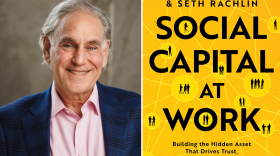 Seth Rachlin is an assistant teaching professor in ASU’s School of Social and Behavioral Sciences and co-author of the new book "Social Capital at Work: Building the Hidden Asset that Drives Trust, Engagement and Performance."
-
 The founder and executive director of The Institute for Art and Olfaction has released a new book diving deep into the impact perfume has had on history.
-
 Carlos Alonso Nugent is a scholar of the U.S.-Mexico borderlands and author of the new book “Imagined Environments: The Making of Borderlands.”
-
 Acclaimed poet Brenda Hillman’s newest collection, “Still House in the Desert,” brought her back to her childhood home in Tucson.